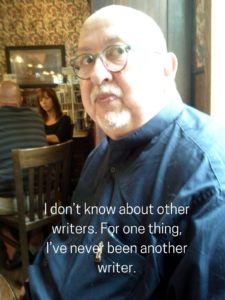
I don’t know about other writers. For one thing, I’ve never been another writer. For another, although I’ve observed practically all the interviews, or as in this case requested from writers, are about how the writing is done, creative tricks, recipes and such. I can’t listen to, view, or read that stuff…not that it isn’t full of useful information, just that my attention wanders, or I fall asleep. So, the nice guy who works for the publisher and arranges this kind of thing told me it would be a good idea if I wrote something about writing. And I just told you that I really don’t know anything about how other writers do it.
I’m on a bit of a spot here, because I’m not sure I know anything about how I do it. But I do have an idea. This idea is brand-new, I just came up with it the other day. It’s based on something I observed about a dog we have. This is a pure-bred rough collie, presently about 18 months old. I digress for a moment to tell you that for two people who are pushing 80 to go out and buy for a lot of money, an energetic 13 week old puppy is completely insane, but that’s what we did. What you’re supposed to do is match the dog to your own time of life, seniors should get a senior dog, doesn’t move so fast and naps more, just like us. We did the opposite. We had the puppy for a month or so when Jill, that’s my wife, got bitten by a tick, it was bearing a tick-borne disease, Erlichiosis, which is nasty. Jill wound up in the hospital more or less out of her mind for five days, and then did 41 days in rehab. While this was going on the puppy went back to the farm with mom and dad and the sibs.
When Jill was home and well enough, the breeder brought the puppy, now around 6 months old. We didn’t expect the pup would remember us very well, probably hardly at all. But we were wrong. She came in the door. “I’m back!” she said, gave us each a fast lick, and curled up next to Jill’s chair in the spot she had napped before the interruption. Later she took me on a tour of our house, “These are the stairs to your office. Here’s where I stole the 3×5 cards and brought them to you one by one, just like I’m doing now…still funny. I’m not supposed to get onto this couch, but this ratty one is ok.”
The puppy, her name is Peach, by the way, remembered everything, and had quite a bit earlier in her short life clicked on her role as “our dog,” and she even loved us without rhyme or reason, undeterred by how uninteresting we are, it was all, everything, baked in. She had to learn a few minor things, don’t bite, don’t poop indoors, walk nicely on the leash, but all the essential stuff was in place and only awaiting whatever prompts activation.
And, believe it or not, I never gave this thought until this week. That, in the case of this one writer, not speaking for or about anyone else, is how I exercise my profession.
Daniel Pinkwater is, in brief, the author and sometimes illustrator of over 80 (and counting) wildly popular books. He is also an occasional commentator on National Public Radio’s All Thing Considered and appears regularly on Weekend Edition Saturday, where he reviews exceptional kids’ books with host Scott Simon. Said books usually go on to become best-selling classics.
This was a guest blog post. Interested in blogging here?
Assembling an itinerary for a blog tour? Promoting a book, game, or other creative effort that’s related to fantasy, horror, or science fiction and want to write a guest post for me?
Alas, I cannot pay, but if that does not dissuade you, here’s the guidelines.
Guest posts are publicized on Twitter, several Facebook pages and groups, my newsletter, and in my weekly link round-ups; you are welcome to link to your site, social media, and other related material.
Send a 2-3 sentence description of the proposed piece along with relevant dates (if, for example, you want to time things with a book release) to cat AT kittywumpus.net. If it sounds good, I’ll let you know.
I prefer essays fall into one of the following areas but I’m open to interesting pitches:
Interesting and not much explored areas of writing
Writers or other individuals you have been inspired by
Your favorite kitchen and a recipe to cook in it
A recipe or description of a meal from your upcoming book
Women, PoC, LGBT, or otherwise disadvantaged creators in the history of speculative fiction, ranging from very early figures such as Margaret Cavendish and Mary Wollstonecraft up to the present day.
Women, PoC, LGBT, or other wise disadvantaged creators in the history of gaming, ranging from very early times up to the present day.
F&SF volunteer efforts you work with
Length is 500 words on up, but if you’ve got something stretching beyond 1500 words, you might consider splitting it up into a series.
When submitting the approved piece, please paste the text of the piece into the email. Please include 1-3 images, including a headshot or other representation of you, that can be used with the piece and a 100-150 word bio that includes a pointer to your website and social media presences. (You’re welcome to include other related links.)
Or, if video is more your thing, let me know if you’d like to do a 10-15 minute videochat for my YouTube channel. I’m happy to handle filming and adding subtitles, so if you want a video without that hassle, this is a reasonable way to get one created. ???? Send 2-3 possible topics along with information about what you’re promoting and its timeline.
Want access to a lively community of writers and readers, free writing classes, co-working sessions, special speakers, weekly writing games, random pictures and MORE for as little as $2? Check out Cat’s Patreon campaign.
Want to get some new fiction? Support my Patreon campaign.
"(On the writing F&SF workshop) Wanted to crow and say thanks: the first story I wrote after taking your class was my very first sale. Coincidence? nah….thanks so much."
~K. Richardson
You may also like...
On Eating Frog Legs and White Asparagus by Jennifer Brozek
Imagine this. You are nine or ten or eleven years old. In your “tweens” as the hip kids call it. Or is that “cool”? You have moved to a foreign country “overseas” because your father was stationed there and you are experiencing non-American food for the first time. Belgium. A little country partially notable by the fact that NATO exists within it. (And so much more…)
First, it is all hotel food because there are no quarters available for you and your military family in SHAPE, Belgium (Supreme Headquarters Allied Powers Europe). And the food is good. I mean, really good. We’re talking fresh fruit, chocolate croissants, and Belgian waffles. My mom complained that she gained a pound for every day we were required to stay in that hotel. I don’t remember how long. It was too long for nine-year-old me. I just wanted a home and my things around me.
Then we were there. Living in a 300-year-old manor house in Brugelette, Belgium in 1979 because “the franc was so good.” The backyard was bigger than any school playground I’d ever played in before. The house had history. Real history. This is where “Dear Penpal, Belgium 1980” was born. “Dear Penpal, Belgium 1980” is a unique, middle grade-appropriate ghost story told through 24 physical letters that I am kickstarting from March 26th to April 26th.
In the letters a recipient will receive, I’ve included description of fritz. Real fritz (I’m convinced that Belgium is the only place to get this near-mythical food) and fritz stands with their paper cone conveyances for food beyond fritz. The only thing I really remember were the fried meatballs my father loved so much with a condiment concoction we called “goopy.” We recreated it at home with a mixture of ketchup and mayo. Dad insisted on having goopy with his fries for the rest of his life.
I also remember going to 3-hour long meals at a tiny Belgian restaurant…whose name I never knew…that had maybe five tables, where I ate all manner of things. In this place, we were known as “the polite American family” and they would bump other reservations for us if Dad called. It was within this restaurant that I learned to be fearless about “foreign” cuisine. I would willingly taste everything at least once.
I had two favorites: Frog legs (that really did taste like gamy chicken) in the most delicious sauce and white asparagus. The frog legs were a treat. A birthday meal. The same with the white asparagus that I thought was a special type of asparagus. It took me into my adulthood before I looked up how white asparagus was made. (I’m not going to tell you. You need to look it up yourself.) But, since then I have always loved asparagus and I consider any restaurant to serve white asparagus high class indeed.
My time in Belgium gave me a boon. That boon is the ability to say “yes” to whatever local cuisine is offered to me. As a Guest of Honor at GothCon in Gothenburg, Sweden, I was offered smoked puffin as an appetizer at a restaurant that was located at the corner of Baldur’s Gate and Odin’s Way. I accepted. It was fine. Not really to my taste, but I’m glad I did taste it. As a Guest of Honor at Tracon in Tampere, Finland at a Viking feast, the interesting food I was offered included duck heart (so tasty) and tar ice cream (a campfire in ice cream form). Both of which were marvels to taste. My hosts were so pleased that I was willing to try the food from their country. American GoHs have a reputation of being shy around “exotic” food.
Living in Belgium during my formative years gave me a willingness, and a fearlessness, to try foods outside my comfort zone, and I have been richer for that experience. My rule is: I am willing to try anything once. Twice if I am in a bad mood the first time. It’s a rule I encourage others to adopt. Otherwise, you won’t know what you are missing.
Jennifer Brozek is an award winning author, editor, and tie-in writer. A Secret Guide to Fighting Elder Gods, Never Let Me Sleep, and The Last Days of Salton Academy were all finalists for the Bram Stoker Award. She won the Scribe Award for best tie-in Young Adult novel, The Nellus Academy Incident, and won an Australian Shadows Award for best edited publication. Visit Jennifer’s worlds at jenniferbrozek.com, or follow her social media accounts on LinkTree.
Guest Post: Alienation and Marginalization: Demons, Robots, Aliens and Monsters in Fantastic Literature by Laurence Raphael Brothers
It doesn’t take any very profound insight to see that the roles nonhumans play in speculative fiction are often stand-ins for humans. In first-intention and unselfaware work (two very different things, see below), nonhumans are often monstrous and hostile. They frequently stand in lieu of othered humans who the writer might think it improper to name directly, or for that matter who the writer is intentionally dogwhistling by associating their secondary attributes with the negative qualities that racism and other forms of bigotry have painted for them.
And yet there are dangerous animals and people in our world who are hostile, sometimes implacably hostile and deadly dangerous, and in principle there should be nothing wrong with embodying these figures in fantastic fiction, even in pared down and totally inhuman forms from which all other qualities but their monstrousness have been flensed. In real life, sharks and venomous snakes and grizzly bears are not generally malicious, and their relative danger is far inferior to that of automobiles, diseases, and police officers. But in fiction, does it do any harm to pretend they are terrible threats? As always, the answer is yes, and no, depending on technique and presentation.
The trope-subversive reaction to monster stories generally involves their humanization. The dragon-viewpoint story that sees the questing knight as a villain, the sympathetic look at a fallen angel’s rebellion, the AI who comes to life only be oppressed and treated as a thing by their creator, the alien whose attempts to help humanity are viciously rebuked: all these acknowledge the base form of the monster story and turn it on its head. In many cases, the inversion is charmingly, touchingly, and effectively achieved, but again the final result depends on the author’s insight and skill, not just the fact of the reversal.
So what makes a monster story good or bad, or for that matter, a monstrous-sympathy or anti-monster story? In a word, understanding. In The War of the Worlds, H.G. Wells had two objectives: first to present the visceral fear of the monster to his reader, the overwhelming power of an implacably hostile foe whose strength cannot be contested. But he also wanted to present his idea of what indigenous populations such as the Tasmanians must have experienced when British colonial military forces invaded. There’s no characterization of the Martians in Wells’ book. They’re apparently trying to seize terrestrial resources, but it’s not as if they twirl their mustachios and speechify to a captive audience. They just do their thing, obliterating any opposing military forces and casually wiping out civilians who are in the way until finally they’re overcome by terrestrial disease. (This last is so that for Wells’ didactic purposes, something like the status quo can be regained, with a cautionary warning.) This is an example of a “first-intention” monster story that is nevertheless self-aware; the monsters are simple to the point of being simplistic and more or less incomprehensible, but their action and the reason for their action is based on the writer’s understanding of humanity and his hope to prevent his own people from adopting the monstrous role of his Martian invaders.
Must a good monster story always be intellectualized? Not at all, hopefully needless to say. Consider Beowulf, another first-intention story, and this one with probably considerably less deliberate auctorial intention behind it. In this story, Beowulf is a pure hero, and both Grendel and his mother are pure monsters, though the mother’s desire for revenge is only natural, and this serves in some way to humanize her. But I shouldn’t leave the reader with the idea that self-awareness and understanding are modern qualities, and that older works are necessarily simpler, more direct, and more “primitive.”
One can see some very profound self-awareness in the nameless author of the Gilgamesh epic, who takes the monstrous and frightening foe Enkidu (created by the gods to give Gilgamesh someone to fight because he’s been ruining his own subjects’ lives) and turns him into a sympathetic friend. Along with the wild and uncivilized Enkidu (humanized through sleeping with a priestess of Inanna), and apparently as a result of their coming together, Gilgamesh matures from a boorish and casually destructive youth into a mature, responsible, and reflective adult. With its transformation of Enkidu from monster into a friend so intimate as to be closer than most lovers[1], the epic’s attitude may seem implausibly modern, except of course that our intuitive notions of what constitute “modern” and “primitive” are wildly biased in our own favor. Coming thousands of years before most classic western monster stories, the transformative early section of the Gilgamesh epic (the latter half mainly involves Enkidu’s death due to Gilgamesh’s arrogance, and Gilgamesh’s futile quest to resurrect his fallen friend) illustrates that anti-monster stories are at least as old and as essential.
Man, I hope all that didn’t come off as too pompous, or too obvious either. In my own stories, I most often do the inversion thing, but I have the deepest respect for people who can write first-intention monster stories without dehumanizing the antagonists or deliberately or unconsciously linking their monsters to othered humans in the real world.
But that’s a tough thing to pull off. In my stories, the apparent monster is frequently your friend, and the real monster is another human, or perhaps the social forces that move humans to act monstrously. For me, that kind of story is much easier to write.
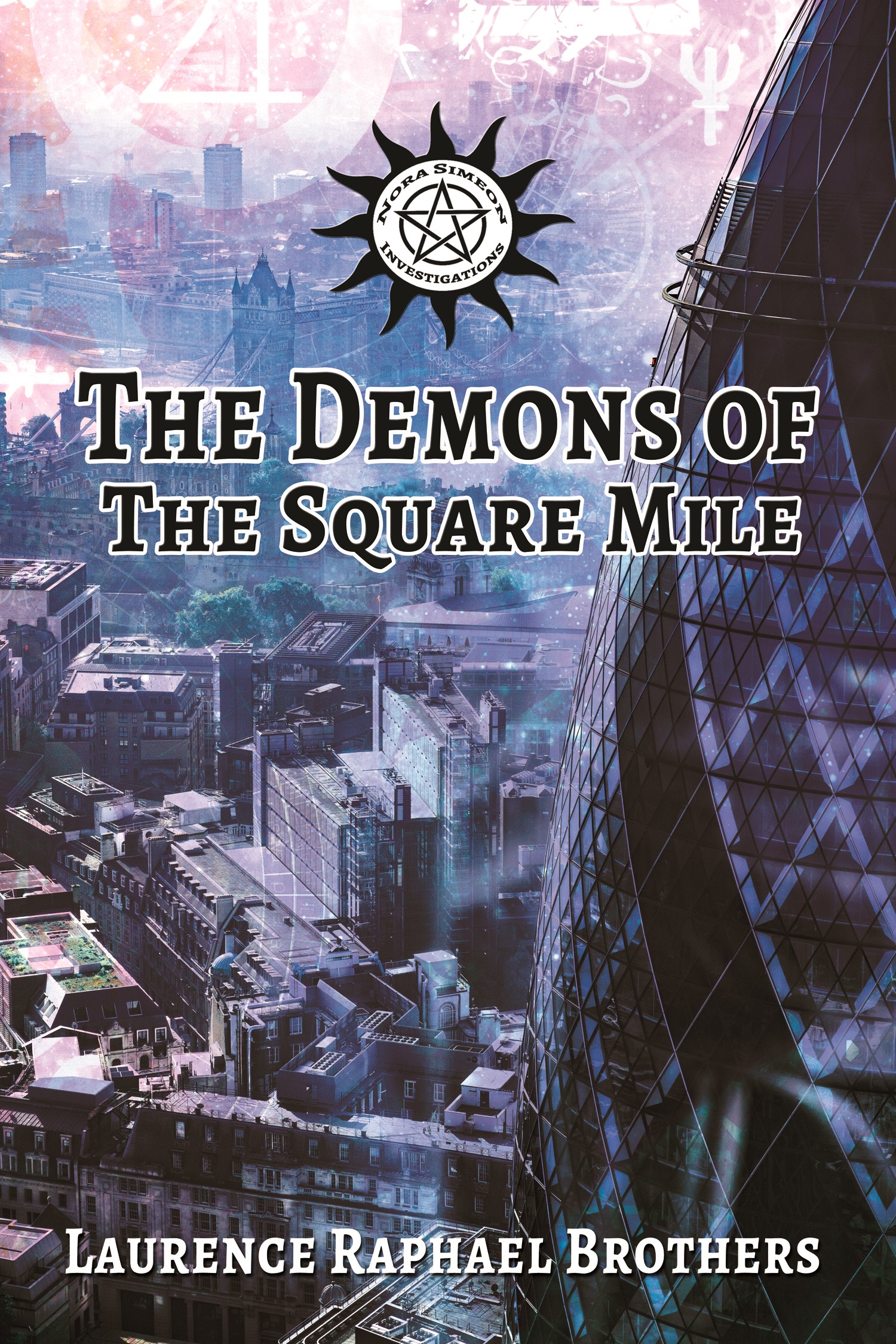
My romantic noir urban fantasy series beginning with The Demons of Wall Street (Mirror World Publishing, 2020) and in its recent sequel The Demons of the Square Mile (Mirror World Publishing, 2021) features demons who are indeed monstrous in many respects, due to the horrible ecology and social forces of their native world. But they’re also oppressed slaves summoned and bound by financial industry banker-sorcerers who want to exploit their precognitive abilities to manipulate markets. Some of these demons are true to type, but others are capable of defying and transcending their origins to become people more capable of kindness and compassion than the abusive humans who summon and bind them. The real monster is late-stage capitalism; but I guess that’s either trite or obvious, depending on your point of view.
The main character in this series, occult PI Nora Simeon, is a deeply traumatized and alienated person, in danger of becoming a moral monster herself by dint of her isolation and lack of empathy. She starts the first book convinced that demons are essentially evil and destructive (note in the books they are beings from an alien realm of existence, not fallen angels). She soon learns that just like with humans, these qualities are contingent, not essential, and in the usual moral fashion, the worst monsters are those we make of ourselves. And with the help of her unusual friend and lover Eyre (met in the first book and becoming a Thin-Man-style romantic and professional partner thereafter) she wrenches herself free from her downward spiral; it’s not an easy thing to do, and it will take her the full arc of the series to become truly free, but like the rest of us, all she can do is take the next step. My own next step is tentatively titled The Demons of Chiyoda, a just-completed first draft that I’m getting ready to submit to my publisher. In the meantime, I hope you’ll take a look at the first two entries in the series, available in paper or ebook direct from the publisher as well as from most online bookstores.
[1] I suspect this to have been the first ship in history, and that therefore the epic of Gilgamesh could be the first example of fan fiction, too.
BIO: Laurence Raphael Brothers is a writer and technologist. He has worked in R&D at such firms as Bell Communications Research and Google, and he has five patents along with numerous industry publications. His areas of expertise include Internet and cloud-based applications, artificial intelligence, telecom applications, and online games. He has published many science fiction and fantasy stories and is a member of Science Fiction and Fantasy Writers of America. Find out more about Laurence Raphael Brothers on his website.

 I don’t know about other writers. For one thing, I’ve never been another writer. For another, although I’ve observed practically all the interviews, or as in this case requested from writers, are about how the writing is done, creative tricks, recipes and such. I can’t listen to, view, or read that stuff…not that it isn’t full of useful information, just that my attention wanders, or I fall asleep. So, the nice guy who works for the publisher and arranges this kind of thing told me it would be a good idea if I wrote something about writing. And I just told you that I really don’t know anything about how other writers do it.