Five Ways
Subscribe to my newsletter and get a free story!
Share this:

Hands

signs of life
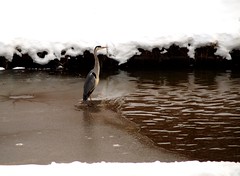
Photo owned by zoetnet (cc)

The crescent moon is a fingernail mark pressed into the darkening sky. An anxious star tugs at it, trying to pull it up farther. Hands swim below the surface of the water. Birds cradled in the wickerwork of leafless branches eye the restless fluttering of the fingers.

Someone calls, but no one answers. Shadows sweep along the banks of the lake, pulled and stretched into awkward shapes by passing headlights. No one answers.

Someone walks and feels the dry stiff grass lace itself around their ankles, tracing lines of frost. The hands continue to crawl and the moon creeps up the sky.

No one answers.

Tin dancing mice revolve in the warmth of the kitchen. One watches the light of the moon as it moves down the blue stripes of the wallpaper. It marks the time with one ticking paw. The mice click and whir, dancing frantically, trying to forget that their clothes are only painted on.

The salt and pepper shakers, shaped like ears of corn, sit sullenly. Upstairs, sleepers move restlessly, their dreams escaping, leaking into the feather comforters.

The moonlight reaches the fifth bar of delphinium.

There is still no answer. Someone longs for the heated air of the kitchen, but instead sits on a bench and watches the movements of the hands. Fingers break the corrugated surface of the water and return to counting the pebbles in the silt below.

Ducks whisper among the reeds, revealing their secret journey. Their tickets are crumpled birch leaves, spiderwebs of veins eroded by the autumn rain, gilded by the guilty starlight. Someone takes one and tucks it in the pocket of their jacket, where it tangles with milkweed down.

The moonlight reaches the twelfth bar,and the mice spin slowly, regretfully, back into their boxes. The comforters are stained crimson and ebony with the dregs of dreams.

The hands swim like memories in the process of being forgotten. Someone waits, and no one answers.

Leave a Reply

Your email address will not be published. Required fields are marked *

Get Fiction in Your Mailbox Each Month

Want access to a lively community of writers and readers, free writing classes, co-working sessions, special speakers, weekly writing games, random pictures and MORE for as little as $2? Check out Cat’s Patreon campaign.

Want to get some new fiction? Support my Patreon campaign.


"(On the writing F&SF workshop) Wanted to crow and say thanks: the first story I wrote after taking your class was my very first sale. Coincidence? nah….thanks so much."

~K. Richardson

You may also like...

Acquainted With the Night

Rain sleets down like multicolored metal needles to splatter against the chill, neon-lit street’s surface. The light gutters across the wet surface of his black plastic rain poncho, picking out abstract tattoos.

Somewhere in the night, he knows there is darkness brewing.

The mask fits loosely on his face under the rain poncho’s shroud. Some people look at him as they go past in the rain, but their eyes skitter away, seeing him faceless in the dark.

At one point the mask was crimson, and golden wind vortexes, bright as daylight, rode his face on either side, framing his power, his strength.

Far away he hears a shout. He pauses to listen, but it does not come again, and he is not sure of the direction. Cars hiss past in a spray of sparkling, heavy, wet mist, and touch the surface of his jacket with beaded jewels.

He tugs at his dark grey face covering, pulling it into place. Rain has seeped in through the eyeholes and walks along his face like the memory of tears.

Is he crying or is it the rain? The question seems overwrought, and he feels himself slipping into one of those dark, cinematic moods, where he sees everything from the outside. It’s starting again, the loop of film that is his life.

#
Scene 1: The Origin

He was an ordinary boy in an extraordinary place, he tells himself. Working in Miracle Labs, he was a go-fer, fetching coffee and sandwiches for the scientists in their bright white lab coats. Everyone was so pleasant, so marvelously cheerful! He whistled on his way to work every morning.

As time passed, though, he became aware of undercurrents. Doctor Octo hated Doctor Sept, and they both vied for the attention of receptionist Wye. Who was worth vying for, he admitted to himself, but he knew that he, pimple-faced and adolescent gangly, wouldn’t have a chance with her. Most of the scientific in-fighting, though, had to do with who published what where. Most of them worked hard at publishing, and conducted their research with scrupulous but eager abandon.

It was easy for someone like himself to pick up some extra cash acting as a guinea pig. It paid well, and his mother.s birthday was coming up. Sept was working on a military project, augmented strength, while Octo was working on a similar project, increased speed.

Tuesdays and Thursdays he sat in Sept’s lab, squeezing grip-meters, while on Mondays and Wednesdays, he used a mouse to click colored shapes on a computer screen. He swore to both of them that no one else was interfering with his physical structure, and they both were horrified but intrigued when their experiments collided, geometrically increasing both strength and speed as though cross-multiplying.

Military types swarmed the labs, smoking jovial cigars while the scientists ran him through test after test with suppressed jubilation, which faded into pretense as every other test subject underwent both treatments to find themselves no stronger or faster than before.

He was their golden boy at first, and even Wye unbent in his direction, admitting she wouldn’t mind a cup of coffee, which led to one thing, then another, then him offering in-home demos of what it was like to bang a genuine superhuman. But more test subjects came and went in failed succession. The doctors became less fond of him as the military soured.

He lost his job at the laboratory, although no one ever really gave him a straight answer as to why.

So he became a superhero, which seemed like a viable option at the time.

#
Part 2: The Career
He got an agent who he.d seen on early morning TV, representative to a group known as the Weather Team. He took the name Captain Hurricane, superspeed and strength qualifying him, he figured.

It was never clear how many superheroes Alan Mix had in his stable. Although his Variety piece when Captain Hurricane joined him said seven, two of those, Ebon Lightning and el Invierno, were sometimes there, sometimes not, due to other gigs with the world of superhero wrestling.

They offered to cut their fellow heroes in on the deal.

“Sweet money and not that hard,” Ebon Lighting urged three of the others, Sunshine Princess, Tsu-nami, and Captain Hurricane. Sunshine Princess did try it, as he recalled, but did not do well in a match against the Hunktress.

Women liked him. What.s not to like about strength and charisma? They liked his gee-whillikers good looks.

He was a little bit in love with Sunshine Princess at one point when he was depressed, but the woman that he would go to his grave loving was another of the Weather Team, Waterlily Elegance, an enormous-haired alien, cerulean-eyed with pumpkin-colored skin from beyond Betelgeuse.

She did not return the affection, though. The mate waiting for her, after she had spent a year in their world, was an enormous purple flower, forever stationary, who floated on a lake of violet emulsion on her home planet.

When she returned home to engage in the mating ritual that would lead to her explosion in a rain of seeds, he spent three nights running in a bar with Sunshine Princess. Each night they staggered home to his apartment and made clumsy love in his unwashed bed. On the third morning he woke up to find her making eggs and coffee in the tiny kitchen.

He drank the coffee in a sullen silence which ate away like acid at her happiness, making it more and more brittle as she moved around cleaning the small space, wiping at the counters with a lemon colored sponge.

“Sit down, for the love of God,” he finally snarled, and she sat, pouring herself coffee and sweetening it with lavish spoonfuls.

“Is everything okay, babydoll?” she cooed, and he could tell she was latching on, sinking in the hooks that would drag him into married life and an eternity of lemon sponges.

“I’m not your babydoll,” he told her startled face. “Not your gumdrop, not your honeybunch, not anything. You were convenient, that’s all, Eleanor.”

She went white as she stood, swaying, and then stiffened herself and marched out to collect her things. She wrapped the yellow cape around herself, sodden still from the previous night’s rain and clinging in damp folds to her skin. He caught a glimpse of her eyes, which were enormous and bruised dark.

That night he patrolled Central Park, and beat three muggers so savagely that they could not walk.

#
Part 3: The Announcement
Three months later when she came to see him about the pregnancy, he already had felt it in his heart. He pushed money in her hand and then pushed her away, physically, a hard shove that sent her sprawling. He turned his back and walked away.

He’d gotten a photogram that morning from Waterlily Elegance. She stood by the shore of the violet lake, one slender hand cupped around her swelling body, ripe with the offspring that would kill her. He wondered what it would look like . would the seeds explode outward, scattering her flesh, leaving scraps of squash color to dry and brittle on the ground? He asked around, asked Silver Spring, the other alien on the Weather Team, but Spring ignored him in a way that screamed impoliteness. Realizing he was violating some taboo, he dropped the subject with reluctant haste.

#
Part 4: The Arrival
He met his daughter first when she was four, hair like cotton-candy floss, colored with pale light. She had inherited powers from both of them, although he could sense she would never be as strong, as fast, as him. From her mother, she had taken the trick of fostering light beneath her skin, letting it go in pulsations of brightness. He called her his Firefly.

He took her every Saturday: to the zoo, to the harbor, to the botanical gardens, to the sculpture garden, to the play ground, to the grocery store, to the laundromat.

They had a year of such meetings before she vanished.

Someone took her out the window, the thirteenth story window that she looked out of each night, her small luminous moon face pressed up against the clear surface. They melted through the glass as though it was water and abducted her in silence.

He nearly died when the police showed him the film, which they said was selling well in underground circles. Although she wore a mask, he recognized the flashes of light that trembled on her naked skin. The men with her wore masks too. They said it was a snuff film, and would not show him more than the moment he needed to identify her. The corpse was never found.

He never found the men either, though he has spent a decade looking. Princess Sunshine committed suicide, and most of the Weather Team is gone. He had to leave it after three years and the fourth scandal of a criminal killed in the course of apprehension. In another decade one of Waterlily Elegance’s children might come back to this planet and perhaps join a new superhero group. He knew that twenty two had survived her death. Their names blended together for him: Casual Horizon, Immaculate Bliss, Serenity of Spite…

Sometimes he wrote to her mate and received in return graceful thought-grams, blended nuances of mental energy and sensation that conveyed regret and well wishes and never spoke of her.

#
And now, the loop complete for another hour, he steps forward again into the darkness. The mask he wears is a duplicate of one from the film . he has no wish to explore why he chose it.

But every night it’s the same, his mask looming down over the fallen form of the mugger, the purse snatcher, the rapist, the suspected harasser, the suspicious stranger out late at night as he kicks and slaps at them, superhuman strength making bruises bloom like light flashes on their skin. Tonight, jewels of light will glitter on their unturned, blank face, and he will feel the blood hot within himself, boiling hot and mammal, unlike the rain.s cool and vegetative touch.

(This story originally appeared in the online publication, FERAL FICTION, in 2004.)

...

Folly Blaine reads "Zeppelin Follies" from Near + Far

Aerial Battleship (aka Zeppelin)
This steampunk zeppelin comes from "Robur the Conquerer" by Jules Verne.
The excellent Folly Blaine reads one of the stories from Near + Far, “Zeppelin Follies.” I’m hoping that link works; WP is being recalcitrant about hosting large files.

Here’s the afternote for the story:

This story was written for Clarion West, during the week that L. Timmel DuChamp was our instructor, and is my attempt at a screwball comedy, combined with the idea of the Bodys, which was inspired by a long walk in which my foot began to hurt, making me think about what it would be like to be able to switch body parts easily.

The story appeared in the final issue of Crossed Genres, a magazine which I was pleased to support during its existence and which went away far too quickly (although at the time I’m writing this, a Kickstarter projector looks as though it may succeed in reviving the magazine.) “Long Enough and Just So Long,” which appears in the Near volume of this collection, was originally written for a contest of theirs, but got purchased before I could send it to them.

“Zeppelin Follies” remains a story I’m fond of, particularly since I can remember the three am, story-due-tomorrow moment that led to the line, “Look, is that a zeppelin?”

...

Skip to content