

Five Ways
Subscribe to my newsletter and get a free story!
Share this:

You Should Read This: The Last Unicorn by Peter S. Beagle

The Last Unicorn, by Peter S. Beagle, reviewed by speculative fiction writer Cat Rambo.Not the movie. No, that was an okay movie, but this book? It’s pure gold. It’s beautiful. It’s enchanting. You should read it.

What: The Last Unicorn is, as you would expect, the story of the last unicorn. She must find out what has happened to the other unicorns, aided by a fraudulent magician, a fierce butterfly, and a would-be Maid Marian. You’ve formed a story in your head from reading that last sentence. The book is nothing like that. It’s better.

Who: I do not think anyone should call themselves a fantasy writer that has not read this. I’m sure there are reasonable exceptions. But I’m not seeing any of them.

Why: Read this for characters that will tangle themselves up in your heart and never let go. Read it for Beagle’s skill with prose, the sly humor, the sheer beauty.

When: Don’t read this when you are feeling insecure about your own writing, because it will only make it more so. Read it for inspiration as well as entertainment.

Where and how: Copy passages out and try to figure out how Beagle DID that. How the butterfly enchants us in only a few sentences. How the Bull menaces in even less space. (Be aware that Beagle did write about some of these characters again; they appear in novelette “Two Hearts,” which I only see available in The Nebula Award Showcase 2008 and The Year’s Best Science Fiction, Volume 24.

#sfwapro

One Response

  1. Such an amazing book.

    If it’s any help, “Two Hearts” was also anthologized in “The Very Best of Fantasy & Science Fiction”, which I think is out of print but is a *stellar* anthology well worth hunting down. And it’s also in Beagle’s single-author collection “The Line Between,” which has a couple other uniquely Beagle-ish treasures as well.

    (“Two Hearts” was my own introduction to Beagle, and was it ever a wallop to my heart and mind. A worthy creation in its own right.)

Leave a Reply

Your email address will not be published. Required fields are marked *

Get Fiction in Your Mailbox Each Month

Want access to a lively community of writers and readers, free writing classes, co-working sessions, special speakers, weekly writing games, random pictures and MORE for as little as $2? Check out Cat’s Patreon campaign.

Want to get some new fiction? Support my Patreon campaign.


"(On the writing F&SF workshop) Wanted to crow and say thanks: the first story I wrote after taking your class was my very first sale. Coincidence? nah….thanks so much."

~K. Richardson

You may also like...

You Should Read This: Woman and Nature by Susan Griffin

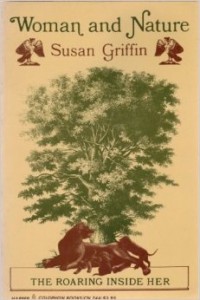
Cover for Woman and Nature by Susan Griffin to accompany review written by speculative fiction writer Cat Rambo.
She knew her skill and she knew it well. She could speak more than one language. She spoke their language, and she spoke hew own, which they could not speak.
What: Poetry and meditative essay mingle in Woman and Nature: The Roaring Inside Her by Susan Griffin. I found this book in grad school when I was first learning to look into metaphors to find out what they contained.

Who: Read this if you’re a woman, whether or not you call yourself a feminist. Read it if you’re a man trying to write realistic women, because the structures Griffin talks about are ones that affect all of this, but particularly women. Read it if you don’t mind some poetry mixed in with your thinking.

Why: Read this to reexamine the words and metaphors we use to describe both nature and women, to understand the attitudes behind the language.

He says that woman speaks with nature. That she hears voices from under the earth. that wind blows in her ears and trees whisper to her. That the dead sing through her mouth and the cries of infants are clear to her. But dfor him this dialogue is over. He says he is not part of this world, that he was set on this world as a stranger. He sets himself apart from woman and nature.
And so it is Goldilocks who goes to the home of the three bears, Little Red Riding Hood who converses with the wolf, Dorothy who befriends a lion, Snow White who talks to the birds, Cinderella with mice as her allies, the Mermaid who is half fish, Thumbelina courted by a mole.

When: Read this when you want to be lulled by words out of your own body and into the material forms of tree and earth and shell.

Where and how: Read this near a window, where you can look out at trees or sky or mountains or water.

#sfwapro

...

An Octet of Useful Resource Books For Writers

I blogged a couple of weeks ago about books I’d recommend for writers focusing on their craft. This time I’m choosing books that are handy to have on a nearby shelf, particularly books that help spark new ideas, whether it’s at the overall story or plot level, or bits that can be used to adorn a story, the tiny embellishments like filagree or the lines in the Book of Kells, because we can always use new idea, little shocks, a kick in the head that turns the world askew in a way that lets us see it more clearly.

  • The Penguin Dictionary of Symbols. Sometimes when I’m stuck on a story (or even a polish of a story), I like to look up things that appear in the story, using this dictionary. Looking at the lore behind a symbol can often help you use it effectively.
  • Talk the Talk: The Slang of 65 American Subcultures by Luc Reid. I love this little book both as a way to spark ideas for stories or characters, but also creating touches of authenticity when ivoking subcultures like rock climbers, sky divers, and UFO believers.
  • Visual Dictionary – I like my Macmillan Visual Dictionary, but there’s also plenty of others, like Merriam Webster’s. If you don’t know what a widget or boat part or architectural feature is called, this will have it. A great aid towards precision.
  • Some book of poetry. It could be anything, Shakespeare to Ogden Nash. T.S. Eliot. Sylvia Plath or Emily Dickinson. Something densely poetic. It can be prose, but it has to be dense, poetry-drenched prose, like Djuna Barnes or James Joyce. Recently I’ve been employing Rumi. Use it several ways – to spark timed writings or stories or whatever, but I use it primarily for coming up with titles.
  • People’s History of the United States by Howard Zinn. (Kindle version) This is a view of history from the left, and one that looks at a lot of moments that are not covered in the mainstream history books. Look here for interesting story ideas or historical details for period pieces.
  • Booklife by Jeff VanderMeer. (Kindle version) A career guide that is worth looking at repeatedly. (Disclosure: I wrote the appendix on writing workshops, but there are much, much wiser voices throughout the book, particularly Jeff’s.
  • A tarot deck. Yes, technically not a book, but certainly there’s been plenty of books written about them and these books tap into all sorts of archetypes.
  • The White Goddess: A Historical Grammar of Poetic Myth, by Robert Graves. A rich source of European Mythology, Graves is both reading through or dipping into on an occasional basis, this can be another useful source of starting images, symbols, or even poetic titles. For similar books, look at Weston’s From Ritual To Romance or Frazer’s The Golden Bough.

...

Skip to content