


Five Ways
Subscribe to my newsletter and get a free story!
Share this:

Getting Back in the Groove

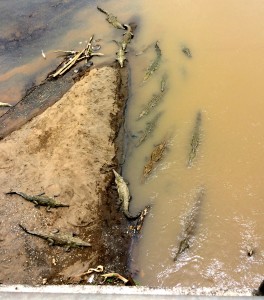
Picture of freshwater crocodiles
Why crocodiles, of all things, to accompany a post about writing? Because there's so many things out there waiting to eat your writing time, to gobble it down and leave you with only the shreds.
Tried the balcony out for writing last night. Here’s a blog post that emerged.

For a long time I listen to the ocean, a background of some chirping insect, shrill arcs of sound going out against that massive, constant grumble. That is what life is like, singing out against that gray and empty grind, not caring what it sounds like, because singing is the only thing you can do.

I can feel my shoulders relaxing as I type, the guilt of several weeks (over a month, really) of getting little done, not just because of the traveling or the distractions but because I let myself get lazy and forget that what a writer does is write. If you want to call yourself one, that’s what is necessary and while that’s a hard standard to maintain consistently sometimes in the face of a multitude of crises of the mind or body or world or family, it’s one I hold myself to, first and foremost.

A confession: I am not one of those writers who “have to” write, the ones seized with such a fervid muse that they cannot exist without words spilling out of them. I envy them, and sometimes in my heart, get irritated by a smugness that is really an interpretation imposed by my own insecurities.

But I have always defined myself as a writer, even in the days when I wasn’t writing so much and was pouring all that energy into writing for an online game or technical documentation or some combination of the two. So when I don’t do it, it’s not so much that it’s the writing building up. In fact, some days I’m digging the words out, and they’re obdurately clinging to the inside of my skull so I have to wrestle them onto the keyboard. Even now, I want them to flow and they’re halting, the flow coming in fits and spurts while all the time the ocean softly roars, as though it can’t help itself at times, perhaps getting just a little too excited, a little too enthusiastic in its mutterings.

Here’s the thing. When I’m not writing consistently, when I’m not hitting solid word count on at least most of the days of the week, I feel unmoored, adrift, unsure of my center. What good is a writer who isn’t writing?

There’s also an awareness of time creeping up on me. Often I wish I’d done more with those early years “” though who would have known in all that young adult thrashing about? While I don’t want to let guilt consume me, it’s not a bad goad. I believe it was John McPhee that said any motive for writing is valid, even spite and malice.

And it’s a goal that I know is doable, to hit two thousand words “” and more when I’m being motivated, which often coincides with felicities of mind or body. I don’t worry about whether they’re bad or good, all that matters is that they’re words that actually make it from my mind to the page. Right now I’m adding these words into the count, even though I don’t usually count nonfiction, because right now the focus is warming up, priming the pump, getting myself back into that productive groove.

It’s the days when I get no word count, not even a page written in a notebook, that really bug me, so when the words are flowing, there’s a point where all is well, when I can feel myself assembling words to express what I want to say and they’re falling into place quickly, one at a time but in a constant patter, like raindrops falling on the keyboard.

So tonight is swell and good. We’re here for a month, then probably onward to another country to try a few weeks there. I can get into a routine that feels productive and which includes some of the things that help ensure my mood is good and I’m undistracted by feeling unwell, such as good solid walking bouts and not eating junk food and getting enough sleep.

So what will I work on this month?

First and foremost is finishing up the YA novel I’ve been working on, along with several stories, two for anthologies and a couple for the Patreon campaign. While the stories will be fun and I do want to get them finished, the novel is what I want to be spending most of my time doing. I’ll be posting snippets and word counts as I go, keeping myself accountable. Because that’s another thing for a writer — you have to hold yourself accountable, because there’s nothing out there, really, to do it for you.

Good writing to you all. I hope you’ll get some words today as well.

Leave a Reply

Your email address will not be published. Required fields are marked *

Get Fiction in Your Mailbox Each Month

Want access to a lively community of writers and readers, free writing classes, co-working sessions, special speakers, weekly writing games, random pictures and MORE for as little as $2? Check out Cat’s Patreon campaign.

Want to get some new fiction? Support my Patreon campaign.


"(On the writing F&SF workshop) Wanted to crow and say thanks: the first story I wrote after taking your class was my very first sale. Coincidence? nah….thanks so much."

~K. Richardson

You may also like...

Writing: Description, Details, and Delivering Information

I haven't written here yet.
I haven’t written here yet.
I’m working on converting the Description and Delivering Information class to the on-demand version, along the same lines as the Character Building Workshop and the Literary Techniques for Genre Writers workshop, and hoping to finish it up over the next couple of days, which may be overly ambitious, because a) I am doing NaNoWriMo, b) life is complicated by Orycon and then a Thanksgiving trip on the 20th and c) this is my birthday weekend and I like to slack a little.

So, what’s the difference between taking one of my live online writing classes and the on-demand versions? Let’s look at the cons first:

  1. No live interaction, which is a little sad. You can comment on the class material, though, which you have access to in perpetuity, or at least as long as it’s up.
  2. No chance to hear other people’s work with the exercises or get a chance to chat with them.

Pros, on the other hand?

  1. A bit more lasting. As I said, you do get permanent access, including when the material updates.
  2. Work at your own pace. Want to do an exercise more than once? Go for it. Want to stretch things out or take a break for that trip to Bermuda? You’re fine.
  3. Considerably cheaper than the live version — half the price, usually.
  4. Considerably expanded material and more exercises. The character building workshop ended up being close to 20,000 words; this one will match and probably surpass that.

Want a preview? Here’s an early page, Description as Collaboration:

The Writer/Reader Relationship
Description is a collaboration between writer and reader. You provide a handful of details; from them your reader constructs a three-dimensional experience. You build the funhouse ride, but so does your reader, an experience that will differ — sometimes radically — from reader to reader, depending on their experiences and depth of imagination.

It begins the minute you supply a detail. The author says “red” and immediately a red — perhaps a bright candy apple red, maybe something murkier — appears in the reader’s mental vision. Add “wheelbarrow,” and they supply a wheelbarrow based on the ones they’re most familiar with. Add “glazed with rain” and the possibilities splinter even further.

And that’s fine. It is an inescapable fact and nothing you can do will change it. It is impossible for you to include the depth and range of detailed description that would be necessary to unquestionably determine every nuance for the reader.

Choices Matter
As soon as an author introduces a detail, it begins to grow in the reader’s mind. And unspoken behind every detail is an authorial I selected this detail rather than any other for a reason that will matter to the reader. That is perhaps one way of looking at writing: the art of selecting and conveying details in an order that creates a complete experience for a reader.

How the author presents details — which details are mentioned, the things that are included about them, and the wording and syntax in which they are presented — is one of the major factors that creates style and tone.

Style might be defined as the overall way in which the story is told. It is different than the content of a story, but usually content and style are linked and work together.

Tone is the overall emotion or mood of a story, and is created primarily but not solely by the style and word choice.

Recently spotted in Value Village. I believe this is the god of pumpkin spice.
Here’s a photo of a thrift shop object described in two different styles, then two different tones*.

  • Style example #1: There it stood, the proud ceramic, small in stature but twice as splendid. The corn god glared out, positioned, poised, ready to bring autumn to the land.
  • Style example #2: Paul glanced down at the statue. Small. Yellow and orange. Glazed. Corncob-extured body. Why this, he wondered.
  • Tone example #1: The little statue was a welcome find, smiling at her from the shelf, colored like the first autumn leaf. It was solid in her fingers, still smiling up at her as she tilted it to see if there was any marking on the weathered bottom and with a thrill of pleasure saw the mark, right where she had hoped.
  • Tone example #2: Shadows gathered in the corners of the curiosity and her scalp prickled, as though in warning, as she picked up the little yellow statue. It felt ominously solid in her fingers as she tilted it to look at the base. The sight of the marking struck her like a blow.

Same object, four different stories. Stop now and do a five minute timed writing with your own description of the object.

Don’t Jar Your Reader
Because of a reader’s inclination to create what’s happening in a story in their head, experiencing it in something like a dream, or at least that state of fierce inattention to anything else in which a spouse, child, or friend can speak repeatedly before being perceived. That’s the delicious immersion that is part of the joy of reading and part of it is making the reader comfortable enough to forget that they are reading.

An author must lull a reader into trusting them, by letting them know that they will deliver that immersion, in part by not ever reminding the reader that they are reading. Anything that reminds a reader of this fact generally should be avoided, unless you’re doing something funky and metafictional.

And the thing that reminds a reader that they are reading more than anything else is the author supplying a detail that the reader has already firmly fixed in their head. This is a moment which for a reader is like having the GPS in your car suddenly go “Recalculating” because you took a wrong turn. It should be avoided at all costs. Paying attention to the collaboration and what expectations you are creating in your reader is important. Get the hang of that and you can even play with and subvert those expectations.

*I make no claim any of this is good writing, simply a good example.

If you’d like to get more information about classes as they appear, including upcoming special holiday gift certificates, fill out the following:

#mc_embed_signup{background:#fff; clear:left; font:14px Helvetica,Arial,sans-serif; }
/* Add your own MailChimp form style overrides in your site stylesheet or in this style block.
We recommend moving this block and the preceding CSS link to the HEAD of your HTML file. */

...

Retreat, Day 3

I haven't written here yet.
I haven’t written here yet.
Words achieved today: 5022
Current Hearts of Tabat wordcount: 85264
Total word count for the week: 10022
Total word count for this retreat: 10022
Worked on Hearts of Tabat, Christmas story for anthology (“My Name is Scrooge”)
Time spent on SFWA email, discussion boards, other stuff: 10 minutes, but I’ll give it an hour this evening
Other stuff: prep for Saturday’s class
Steps: 10410

Excerpt from today’s work, part of Hearts of Tabat:

At the head of the Tumbril Stair is a landing, stone-bannistered, which overlooks all of the city. From that central point, one can look right and see the Duke’s castle far atop the cliffs overlooking the city, and then fifteen terraces down, shelf after shelf, flat lines broken by avenues of flowering trees and other staircases small and large and immediately at hand the oily black iron lines of the Great Tram with its basket cars swinging up and down, laden with those who had the pennies to spend on such transport.

At the edge of the water lies the Winter Garden and then the bay. Retreat inward a little, and the gaze encounters the docks and warehouses that are the center of the city’s industry. Keep traveling leftward for more shelves, and the great clots of smoke that mark the Slumpers, and then the salt-marshes, planted thick with purple and green reeds, a single channel leading through them to allow ships to come down from the Northstretch river and reach the sea.
The five terraces closest to the water were the saltwater neighborhoods; above them lay the freshwater. In Tabat, one distinguished between saltwater and freshwater, from matters such as foodstuffs to professions (for pilots it was the most important distinction, and the most bitterly fought). Even the markets were separated by that division, with the Saltmarket hosting only wares that knew the sea’s touch: dried fish for chal (which always must be made with salt fish), and bushels of seaweed, dried and fresh, smelling tangy sharp and green, and the woven reed-ware “” baskets and hats, parasols and stiff caplets, tight woven and rain-repellent “” that everyone wore once the summer heat started, until time to burn them in autumn’s bonfires.

Saltwater tailors dealt with fabrics from elsewhere “” silks and petals from the Rose Kingdom, cheap bright cottons from the Southern Isles “” and freshwater with homegrown, wools and flaxy linens, stiff and glossy but prone to wrinkling and expensive to maintain.

The Nittlescents were saltwater merchants, their house built on trade, perfumes and attars. Adelina had done her turns in the manufacturing side of the house, but her nose was not keen enough to be a perfumer, and she preferred the numbered side of things, the flow of revenue and payments that was the ledger reflection of that industry.

...

Skip to content