This post marks a change-up in my Patreon campaign – I will post content publicly. If you’re enjoying it and want to make sure it continues, please consider supporting my ongoing attempts with this publishing model! There are several levels of possible support, but you can do it for as little as a dollar a month.
I’m enjoying on retreat in California right now, which will explain what provoked this piece.
California Ghosts
When you walk in the hills in southern California, through stands of pine and tall grass, up shaly mountains where the sides fall away steeply and the rock splinters rather than crumbles, you can hear the sound of the wind in the treetops, making them sway, making them creak. Stand still and you will hear the little noises, the sound of a deer’s delicate steps, far away a Stellar’s jay scolding some interloper, the click and tap of falling rocks.
There are ghosts out there in the hills, walking the ridges, slipping among the trees, but they are mostly animal ghosts, the memories of deer and mountain lions, a flicker of rattlesnake among the grass stalks, an eagle’s shadow floating over the earth.
If you find a human ghost alone out there while walking, approach it with caution. Groups of ghosts are left behind by villages and tribes, and many of them died peacefully, among those they loved. Solo ghosts are usually ghosts who came to a violent end, blade or bullet or even bared teeth, and they do not want to be disturbed.
If such a ghost blocks your path, stand still enough to hear the protests of the pines, the slide of dust downhill. Do not look them in the eye, but at a point past their shoulder. At first they will know this for a ruse, but give it time and they will falter. Finally they will turn away and vanish, because you can never see the back of a ghost, and you will be free to move further.
There are other dangers in the hills, but you know if you keep walking towards the sunset, eventually you will find the ocean ““ perhaps cliffs dropping down, perhaps sand and rock sloping. There are more ghosts in the ocean than anywhere else, but that is because it is so very large, and most of them are fish and gulls, whose ghosts pay no attention to humans. Sit on the shore and listen again. You’ll hear it say, Why go on walking? and Who knows why the wind blows?
And when you realize that the only sounds you cannot hear are your breath, your heart, your body, you will know you are a ghost yourself, ready to go down to the sea, and swim there in the water, in the waves alive with noise.
I really love this, Cat–thanks!
PS> Facebook friends–consider supporting this great author with $1 a month through her Patreon campaign. I think Cat Rambo does a great job with an important new publishing model, offering consistently fine short speculative fiction via monthly subscription.
Want access to a lively community of writers and readers, free writing classes, co-working sessions, special speakers, weekly writing games, random pictures and MORE for as little as $2? Check out Cat’s Patreon campaign.
Want to get some new fiction? Support my Patreon campaign.
"(On the writing F&SF workshop) Wanted to crow and say thanks: the first story I wrote after taking your class was my very first sale. Coincidence? nah….thanks so much."
~K. Richardson
You may also like...
WIP: A Cavern Ripe With Dreams
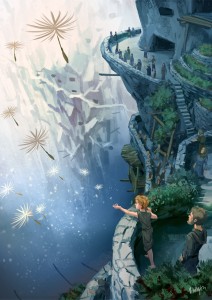
Tiny things floated through the air all around him. He stretched out his palm and kept it motionless long enough that one drifted to be trapped in his palm. A seed, a brown seed. Attached to one end a tuft of hairs, fine and feathery, to carry it along. Carefully he raised his hand, examined it more closely. So small. As it neared his eye, it became no longer brown, ridges and swirls marked its surface in grays and greens and reds that somehow blended together to create the impression of brown from just a few inches farther away.I’m finishing up A Cavern Ripe with Dreams, the sequel to A Seed On the Wind. A version will undoubtedly go out to Patreon patrons before I start shopping the combined novellas around as a single entity.
Bill felt a rush of fear, but a kind that he had never experienced before, something like the fear you feel when someone tells you a frightening story that they believe is true. A terror that was convincing yet somehow dilute. A terror that was not his, somehow.
A fear that was enjoyable.
He realized that it was the creature. That he was feeling its emotions. That if he closed his eyes, he could still see the room like a ghostly overlay across the darkness behind his lids.
He wondered if it experienced the same phenomenon, this double life. He put his hand up and touched it with a fingertip, stroking along the coarse fur that was still damp with eggy fluid. It smelled like newly-split wood, rare and sharp. As he touched it, it shuddered but stayed still, like a woman whose innermost core had been touched, who feared and craved more. At the thought, he grew hard, and he felt it shudder again before it curled tighter around his neck.
He lay there with it around his neck, savoring the mental taste of it, dipping in and out of its perceptions. After a while, his bladder drove him into standing and using the chamber pot beneath his bed. As he pissed, he could feel the creature tasting his sensations in turn.
It made him curious. Settling back onto the bed, he took a syrette from the bedside table, already loaded with honeypain. He injected it in his wrist and lay back to feel the twofold sensation.
First it felt as though the back of his eyes had dissolved, only to be filled with a subtle warmth that flowed out from them, flowing through him until he was only a zone of temperature and sensation, as though he was warm water in a bath, only an outline. But always with that lurking presence perceiving him, keeping him whole. He had loved honeypain for its ability to take him outside himself, but now he realized that it was nothing compared to the creature.
He tried to think at it, to see if it would answer him, but all his thoughts were blurred by the honeypain. He could hear only his blood drumming in his veins, a hard and insistent beat that told him he was alive, as it had before, for sometimes when he was dipped deep in these reveries, he thought himself dead. Now he had that beat but more ““ the creature curled on his chest. Part of him but not part.
A stone lantern sits along the pathway, waiting to be sold to a Kadian merchant.This essay originally appeared in the February 2001 issue of Imaginary Realities. The crafting system in Armageddon is something we worked towards for a long time. The implementation may not have been the most efficient (I still, vividly, remember making hundreds of arrow objects so we could have them with every possible color combination of fletching) but getting it into the game was a huge source of satisfaction.
One of the desires expressed at the very first Armageddon player-staff meeting I ever attended was a yen to move away from “a hack and slash economy,” where players made their income by selling the gear off NPCs (and the occasional PC) that they had killed. How, one immortal noted, could the world be realistic when there was no coded reflection of the material underpinnings of it? How to create this economic reflection was a question that remained in the air for several years, and it was not until discussion of implementing crafting code came up that such a move seemed possible.
We laid the groundwork for crafting by first creating ways to get the raw materials. I reviewed what was produced from skinning the various creatures in the game, both to make sure that players could skin most corpses and to ensure that what was being produced was reasonable. We implemented skinning difficulty: some things, such as pelts, are harder to extract from a corpse, as opposed to cuts of meat. Beyond that, we added a forage command, allowing players to find rocks and wood. Later, this was expanded to add other arguments: artifacts, salt, and roots. Forageable objects differ according to the sector type of the room and in order to make this reflect geographical differences, we added some more sector types, such as thornlands, salt flats, and ruins. Salt can only be foraged in the salt flats, for example, and roots are only available in fertile land (hard to find on a desert planet).
Once the ability to gather raw materials was in place, a couple of initial crafting skills were implemented: basket weaving and tanning. Basket weaving, admittedly, started out as a bit of a joke, but it served its purpose: to allow us to discover flaws. Both skills necessitated the creation of the objects to be crafted: a series of baskets for basket weaving, and tanned versions of various pelts and hides. With each, I tried to make sure there were incentives to use the skill: tanning a hide made it both more valuable as well as sometimes adding wear flags, while baskets included some objects that were wearable on the back or otherwise handy. I included the ability to craft an object, a numut vine sash, that had vanished from the game when the city of its origin was destroyed, and this in turn led me to wander through the database to find other objects that could be recycled and used for the code. As part of this effort, I ended up adding a component crafting skill for the magic users in the game in order to use a series of objects left over from an immortal project that had never been fully finished.
Although some objects could be recycled in this fashion, many others had to be made for the crafting code as we began to implement additional skills, including bow making, knife making, cooking, dyeing, leather working, bandage making, etc. Occasionally, obsessiveness got the better of me: after creating four different types of arrowheads, I decided that people should be able to make striped fletching for their arrows, so they could, if they wished, make arrows using their clan or House colors. This required me making some 300 or so arrow objects in a madcap building session that left me not wanting to ever type the word “arrow” again. Here, planning out the entire effort in detail ahead of time and having used a different structure for coding the items would have paid off, instead of having added bit by bit as I went along. For example, I found myself regretting the variety of gems one could forage in the game when I ended up making multiple bone dagger items, each with a different gemstone in the hilt. Having the entire structure sketched out ahead of time, rather than adding in skills as they occurred, might have been helpful, although some of the skills came from player suggestions after they’d been exposed to the new code.
As the skills began to be more fleshed out, we started making them available to the players. Cooking was a skill everyone got, while others were fitted into the skill trees (Armageddon has a branching system) where appropriate, with merchants ending up the vast beneficiaries overall, going from a possible 13 skills to 38. Some additional skills grew out of the effort, such as analyze, which allows a player to determine an item.s component parts, and armor repair.
At the same time, we added a secondary guild system, which allowed players to flesh out their backgrounds further, by adding a few skills, usually crafting. The secondary guilds were not the same as the regular guilds but intended to reflect life experiences or talents, including stone worker, bard, house servant, guard and mercenary, and I enjoyed putting the packages together in a way that made sense, such as giving the house servants pilot, flower arranging, and a high cooking skill or the mercenaries ride, knife-making and an increase in their ability to hold their liquor.
Inevitable questions and problems arose. On Armageddon, skilled merchants can often identify the style of an item via the value command, if it came from a specific region or culture, and in order to accommodate this, I made the crafting of some items dependent on materials available to only those groups. Shopkeepers began to be glutted with some items (nothing is sadder than a Kadian merchant laden with nothing but spiral-carved green marble incense burners), but this allowed us to check and adjust item prices by monitoring the shops to see what items were appearing at what costs.
For example, since wood is more expensive in Allanak than in the Northlands, some players were cashing in wildly by making and selling wooden spears to House Salarr, which I hadn’t realized would happen till I noticed them selling for 300 sid (Armageddon uses obsidian for its coinage) in the shops.
The experiment still continues and new items, many contributed by players, are added every few weeks. Currently, there are some 3000+ possibilities, crafting wise, coded, and there are still gaps. When I initially did the dyes, for example, I left out the color orange, which means that I keep getting inquiries about implementing variations with that color from the players. The fact that it would require writing up another 300 or so objects has stopped me so far, however. But the players are using the code right and left, and some are actually supporting their characters with it. Though there is still a limited market for incense burners.

 This post marks a change-up in my Patreon campaign – I will post content publicly. If you’re enjoying it and want to make sure it continues, please consider supporting my ongoing attempts with this publishing model! There are several levels of possible support, but you can do it for as little as a dollar a month.

10 Responses
I really love this, Cat–thanks!
PS> Facebook friends–consider supporting this great author with $1 a month through her Patreon campaign. I think Cat Rambo does a great job with an important new publishing model, offering consistently fine short speculative fiction via monthly subscription.
RT @Catrambo: Patreon Post: California Ghosts: http://t.co/peH0I0hcYR
RT @Catrambo: Patreon Post: California Ghosts: http://t.co/peH0I0hcYR
RT @Catrambo: Patreon Post: California Ghosts: http://t.co/peH0I0hcYR
RT @Catrambo: Flash fiction – California Ghosts – http://t.co/DA5iHBEr1i
http://t.co/HdwJ1acLHi
RT @Catrambo: Flash fiction – California Ghosts – http://t.co/DA5iHBEr1i
Calm and full of quiet is @CatRambo’s Patreon Post: California Ghosts. http://t.co/Drx5JRTh1x
Delicious.