One of the things we’ve been working on behind the scenes is getting submission guidelines for both the SFWA Bulletin and the SFWA Blog up. The former pays ten cents a word, the latter six cents. They’re looking for much the same sort of content, things of interest to professional genre writers; blog articles are a bit shorter and more informal.
You do not have to be a SFWA member to write for either publication. I’ve done a number of pieces for both, most recently a series on teaching workshops that finishes up soon.
If you’re not familiar with the blog, it runs a number of articles that are useful, including tips on tools, new markets, industry news, and writing advice.
Want access to a lively community of writers and readers, free writing classes, co-working sessions, special speakers, weekly writing games, random pictures and MORE for as little as $2? Check out Cat’s Patreon campaign.
Want to get some new fiction? Support my Patreon campaign.
"(On the writing F&SF workshop) Wanted to crow and say thanks: the first story I wrote after taking your class was my very first sale. Coincidence? nah….thanks so much."
~K. Richardson
You may also like...
It's All About the Algorithms: My Take on AI Art
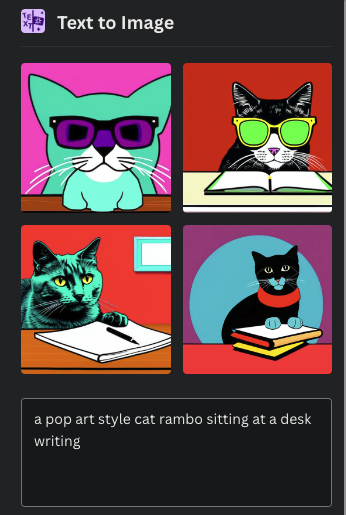
A day that I’ve been saying would arrive for about twenty years now is starting to loom on the timeline, and it’s taking a lot of smart people by surprise when it shouldn’t have.
I’m talking about AI (artificial intelligence) creations – art appearing in visual, auditory, and textual forms. Such creations are in the news lately because we’ve hit a point where what they’re creating is pretty sophisticated. Not sophisticated enough though (yet) – Clarkesworld Magazine just stopped taking submissions because of a sudden upsurge in AI-generated stories, none of them actually publishable. But the quality of that prose will improve and already people are talking about how to create systems to distinguish between a submission written by a human writer versus a machine-generated one.
I forced a smile and patted Fitz’s shoulder. “Be ye of good cheer,” I said. “I think I’ve got that dialogue problem I was having licked.”
Fitz, as I well knew, hated getting drawn into the technicalities, so when I started to explain how reducing the adverbial modifier minimum downwards had tautened the syntactical delivery, he backed out pretty fast. I spent a few hours testing it out, and was pleased with the results. 90% of writing is putting together the formulas, so once I had this one, and a slight problem with the scenery equivalence parameters solved, I’d be sitting pretty, ready to generate a manuscript to hand over to Mikka the editor. Around three, I took a break and went out to sit in the Plaza.
In “Zeppelin Follies,” the writers don’t write. Instead they create the algorithms used to generate their fiction. Will there actually be a point where AIs can generate prose sufficiently adept to construct something that’s an entertaining read? Absolutely, and I would suspect that point is much closer than current writers would like to admit.
But I think the question that most people are deluding themselves about is this: will AI art reach the point where it touches the human soul, the way a Georgia O’Keefe painting can make you stand and stare or the way an Ursula K. Le Guin can make you stop and think, and perhaps even copy it into your notebook to ponder over later? I believe it will, because the consuming human soul remains a constant in that equation, and it doesn’t require another, second soul to be involved in creating the thing we’re appreciating: we can pause for a sunset, for a scrap of birdsong, or to admire the Fibonacci curve inside a conch shell. The experience of the aesthetic depends on the viewer perhaps more than the origin of the viewed.
We would like to think that there is something inside ourselves that recognizes “authenticity,” a word that is a little nebulous. What makes the words coming out of a biological entity’s mouth “authentic” in a way something created mechanically is not? Is it the intent behind the creation? Or something else? We would like to believe that we are more than biological machines, whose actions are on some level as predictable as those of the mechanical ones. We move in a cloud of delusion, in fact, thinking ourselves unique in this universe.
As far as the consumption of what is produced by machines versus what is produced by human hands goes, there are things we buy to use, and there are things we buy to enjoy. We usually don’t worry about the “authenticity” of the dishes we eat out of, but at a certain economic level, we may worry about it as a status symbol, a way to display affluence by using handmade rather than mass manufactured goods. And I don’t know that most people worry too much about the authenticity of what they enjoy, unless they are a connoisseur of it.
I used romance writing as my example in “Zeppelin Follies,” because romances are notoriously formulaic. But the truth is that every genre has its tropes, and that’s something that an AI can use.
Some artists have stopped putting work up online in order to keep it from being fed to artificial intelligences to use. I don’t know that will work all that well, but it’s worth thinking about. But art is also meant to be seen, music to be listened to, text to be read, and we cannot make it so humans are the only ones seeing, listening, and reading.
I think that one way writers will be able to survive a while is by holding onto the overarching ideas of their properties, and the things that make them distinctive and enjoyable. This is one reason why I plan to keep writing books about bioship You Sexy Thing and its crew, because I hold the rights to its world and character. But will AIs create new properties, new worlds? Beyond question, although they will be made of the fragments of other properties, recombined and reworked. Which is, I would argue, on some level what literature is about, replying to the stories that have come before.
Which makes me ask – will an AI be able to look, for example, at Chaucer’s Canterbury Tales and come up with something that is not a reworking, but an original thing that speaks to the Tales? That I’m not sure of. But I’m definitely looking forward to seeing what happens when one tries.
I will not threaten any countries or national leaders with veiled (or direct) references to my boobs. Or vulva.
I will continue not to be involved with SFWA controversies, slights, feuds, grudges, mishaps, bureaucratic screw-ups, gross incompetences, and other scandals of note that occurred before I first defeated all comers and ascended to the throne took office as VP in 2014.
I will continue to let other people run the following things: the EMF, Griefcom, Writer Beware, the discussion forums, SFWA social media, the SFWA website, the Bulletin, the SFWA volunteer process, the SFWA Grants program, the Singularity, and the vast majority of SFWA committees.
I will celebrate the glory of SFWA by wearing both tiara and trident to the 2018 Nebulas. I will not abuse the trident. Much.
I will also wear my “Gay Haldeman Fan Club” t-shirt to the Nebulas while continuing to celebrate the many excellent volunteers and staff of the organization at both the volunteer celebration breakfast (if you are a SFWA volunteer who is coming to the Nebulas, please leave time in your schedule on Sunday morning for this!) and throughout the overall weekend.
I will refrain from blowing part of my discretionary fund on Nebula temporary tattoos this year because last year they weren’t enough bang for the buck.
Throughout the year I will try to push good stuff forward as best I can without totally sacrificing all my writing time.
I will continue to be slightly cranky towards people who contact me via social media or my personal e-mail instead of official SFWA email while refraining from pointedly providing “Let me Google that for you” links.
I will work at paying attention to all the disparate groups that make up SFWA and serve their needs, particularly both our newer groups, like game writers and indie writers and groups that have in the past been underrepresented or underserved in/by the organization.
I will continue to piss off a few people with what they think is my irreverent or otherwise inappropriate sense of humor/outlook/set of principles.
And finally, as always, when I screw up, I’ll admit it and say what I’m doing in the future in order to do better.

 One of the things we’ve been working on behind the scenes is getting submission guidelines for both the SFWA Bulletin and the SFWA Blog up. The former pays ten cents a word, the latter six cents. They’re looking for much the same sort of content, things of interest to professional genre writers; blog articles are a bit shorter and more informal.
 A day that I’ve been saying would arrive for about twenty years now is starting to loom on the timeline, and it’s taking a lot of smart people by surprise when it shouldn’t have.
31 Responses
RT @Catrambo: SFWA Bulletin and Blog Submission Guidelines: https://t.co/vxWhLkT8kM
RT @Catrambo: SFWA Bulletin and Blog Submission Guidelines: https://t.co/vxWhLkT8kM
RT @Catrambo: SFWA Bulletin and Blog Submission Guidelines: https://t.co/vxWhLkT8kM
Cat Rambo: SFWA Bulletin and Blog Submission Guidelines https://t.co/2zE0jYmGoY
RT @Catrambo: SFWA Bulletin and Blog Submission Guidelines: https://t.co/vxWhLkT8kM
RT @Catrambo: SFWA Bulletin and Blog Submission Guidelines: https://t.co/vxWhLkT8kM
RT @Catrambo: SFWA Bulletin and Blog Submission Guidelines: https://t.co/vxWhLkT8kM
RT @Catrambo: SFWA Bulletin and Blog Submission Guidelines: https://t.co/vxWhLkT8kM
SFWA Bulletin and Blog Submission Guidelines https://t.co/q5QBGbSCvs
RT @SFWAauthors: Cat Rambo: SFWA Bulletin and Blog Submission Guidelines https://t.co/2zE0jYmGoY
RT @SFWAauthors: Cat Rambo: SFWA Bulletin and Blog Submission Guidelines https://t.co/2zE0jYmGoY
2 good nonfiction markets for freelancers: the SFWA Bulletin and the SFWA Blog – https://t.co/dae0n7h0rk
RT @Catrambo: 2 good nonfiction markets for freelancers: the SFWA Bulletin and the SFWA Blog – https://t.co/dae0n7h0rk
RT @Catrambo: 2 good nonfiction markets for freelancers: the SFWA Bulletin and the SFWA Blog – https://t.co/dae0n7h0rk
RT @Catrambo: 2 good nonfiction markets for freelancers: the SFWA Bulletin and the SFWA Blog – https://t.co/dae0n7h0rk
RT @Catrambo: 2 good nonfiction markets for freelancers: the SFWA Bulletin and the SFWA Blog – https://t.co/dae0n7h0rk
RT @Catrambo: 2 good nonfiction markets for freelancers: the SFWA Bulletin and the SFWA Blog – https://t.co/dae0n7h0rk
RT @Catrambo: 2 good nonfiction markets for freelancers: the SFWA Bulletin and the SFWA Blog – https://t.co/dae0n7h0rk
RT @Catrambo: 2 good nonfiction markets for freelancers: the SFWA Bulletin and the SFWA Blog – https://t.co/dae0n7h0rk
RT @Catrambo: 2 good nonfiction markets for freelancers: the SFWA Bulletin and the SFWA Blog – https://t.co/dae0n7h0rk
RT @Catrambo: 2 good nonfiction markets for freelancers: the SFWA Bulletin and the SFWA Blog – https://t.co/dae0n7h0rk
RT @Catrambo: 2 good nonfiction markets for freelancers: the SFWA Bulletin and the SFWA Blog – https://t.co/dae0n7h0rk
RT @Catrambo: 2 good nonfiction markets for freelancers: the SFWA Bulletin and the SFWA Blog – https://t.co/dae0n7h0rk
RT @Catrambo: 2 good nonfiction markets for freelancers: the SFWA Bulletin and the SFWA Blog – https://t.co/dae0n7h0rk
You don’t have to be a SFWA member to write for the blog or the SFWA Bulletin: https://t.co/dae0n7h0rk
@Catrambo no wait, I had better not, I am hated enough already.
RT @Catrambo: You don’t have to be a SFWA member to write for the blog or the SFWA Bulletin: https://t.co/dae0n7h0rk
RT @Catrambo: You don’t have to be a SFWA member to write for the blog or the SFWA Bulletin: https://t.co/dae0n7h0rk
RT @Catrambo: You don’t have to be a SFWA member to write for the blog or the SFWA Bulletin: https://t.co/dae0n7h0rk
RT @Catrambo: You don’t have to be a SFWA member to write for the blog or the SFWA Bulletin: https://t.co/dae0n7h0rk
RT @Catrambo: You don’t have to be a SFWA member to write for the blog or the SFWA Bulletin: https://t.co/dae0n7h0rk