What if prose were written like music? What if, instead, of a common world, stories in an anthology were steps on a share emotional path? Those are the questions the upcoming anthology Score is attempting to answer.
Emotions are a key part of our experience of art. The books that stick with you are often the ones that made you feel something. Even when we don’t recall the details of a plot (or painting, or movie), we’ll often recall how it made us feel. Even if you don’t recall the details of Watership Down, for example -“” the names of the rabbits, the original warren, etc. “” you probably remember how you felt about the rabbits and what happened to them. You remember how you felt when you closed the book. Even if you mislay every detail of a book, you’ll remember whether it made you laugh or cry or feel wistful.
Score is an attempt to tackle the emotional side of writing head on. A group of almost 20 authors set out not to write about robots or aliens or magic “” though we have all of those “” but to write from emotion.
What does that mean, and how does it work? It means, simply, that each of the authors worked from a coherent emotional score, knowing the emotions in the piece before and after theirs, what emotions they were to emphasize, and … nothing else. They had complete freedom of genre, topic, tone, approach, etc. “” so long as they worked with the emotions they were assigned. The result is a fascinating collection of stories with a distinct emotional progression.
Putting together the score was challenging. As the editor and ‘composer’, I defined fairly early on the emotions we would work with. I knew the direction I wanted to score to take – an overall path of ascending hope that I thought a good fit to the times “” but choosing emotional terminology that would work consistently across many different writers took some work.
In the end, we worked from a palette of six emotional ranges – six emotions with four variants each, two positive, two negative. For example, Hope ranges from Hope at the positive end to Despair at the negative end. These aren’t quite the emotional pairs used by social scientists, and we could have ended up with a wide range of others, but these six emotional ranges allowed ample scope for ups and downs. The emotions are loosely grouped into two sets – the Hope set (Hope, Curiosity, Awe) and the Joy set (Joy, Love, Lust).
Each writer was assigned a specific major and minor emotion, and the score has distinct movements. Using musical terms very approximately, there’s an Overture, a Hope triad, a Joy triad, a Bridge, a Joy triad inversion, a Hope triad inversion, and a Coda. There are high points and low points, but … spoiler alert… it all ends with Hope and Joy.
It’s been a lot of fun putting this together. While I personally often write from an emotional basis, putting together an entire score was an intriguing and challenging exercise. Each writer interpreted the task in their own way, putting their own distinct stamp on it, as artists will. The result is intriguing, and I hope will be as much of an adventure for readers as it was for all of us.
This was a guest blog post. Interested in blogging here?
Assembling an itinerary for a blog tour? Promoting a book, game, or other creative effort that’s related to fantasy, horror, or science fiction and want to write a guest post for me?
Alas, I cannot pay, but if that does not dissuade you, here’s the guidelines.
Guest posts are publicized on Twitter, several Facebook pages and groups, my newsletter, and in my weekly link round-ups; you are welcome to link to your site, social media, and other related material.
Send a 2-3 sentence description of the proposed piece along with relevant dates (if, for example, you want to time things with a book release) to cat AT kittywumpus.net. If it sounds good, I’ll let you know.
I prefer essays fall into one of the following areas but I’m open to interesting pitches:
Interesting and not much explored areas of writing
Writers or other individuals you have been inspired by
Your favorite kitchen and a recipe to cook in it
A recipe or description of a meal from your upcoming book
Women, PoC, LGBT, or otherwise disadvantaged creators in the history of speculative fiction, ranging from very early figures such as Margaret Cavendish and Mary Wollstonecraft up to the present day.
Women, PoC, LGBT, or other wise disadvantaged creators in the history of gaming, ranging from very early times up to the present day.
F&SF volunteer efforts you work with
Length is 500 words on up, but if you’ve got something stretching beyond 1500 words, you might consider splitting it up into a series.
When submitting the approved piece, please paste the text of the piece into the email. Please include 1-3 images, including a headshot or other representation of you, that can be used with the piece and a 100-150 word bio that includes a pointer to your website and social media presences. (You’re welcome to include other related links.)
Or, if video is more your thing, let me know if you’d like to do a 10-15 minute videochat for my YouTube channel. I’m happy to handle filming and adding subtitles, so if you want a video without that hassle, this is a reasonable way to get one created. ???? Send 2-3 possible topics along with information about what you’re promoting and its timeline.
Want access to a lively community of writers and readers, free writing classes, co-working sessions, special speakers, weekly writing games, random pictures and MORE for as little as $2? Check out Cat’s Patreon campaign.
Want to get some new fiction? Support my Patreon campaign.
"(On the writing F&SF workshop) Wanted to crow and say thanks: the first story I wrote after taking your class was my very first sale. Coincidence? nah….thanks so much."
~K. Richardson
You may also like...
Guest Post: Kate Heartfield Excavates Food of the Underworld
Miniature depicting Hellmouth from the Hours of Catherine of ClevesImagine a Hellmouth. No, not the one in Sunnydale, California””a medieval Hellmouth, straight out of a manuscript illumination. Pointy teeth, flames, unhappy people.
When I decided that I wanted to write a book about a medieval woman who leads a raid on Hell, that was the sort of underworld that immediately came to my mind. A mouth, though, implies a throat, and a stomach, and, well, everything else.
So I had a Hellbeast on my hands, a creature that spends centuries underground, but occasionally makes an appearance on the surface. It’s a little like a platypus, but without the bill. And a lot bigger.
Within the Hellbeast, there are revenants. But there are also humans””some have been altered in various ways, and some are extremely long-lived, but they are humans nonetheless. This led me to an unusual world-building question: What do people eat in the underworld?
That is a trick question, of course. Should you find yourself in any sort of underworld, and/or in Faerie, it’s best not to eat anything at all. The old stories are quite clear on that point. Probably the most famous example is that of Persephone, who is obliged to spend part of every year in the underworld because she ate a pomegranate seed there.
Food is a medium of communication between the world below and the world above. To be in a world””to see it, to speak to its inhabitants””is to be of that world. The food of the underworld is part of the underworld, and makes the eater part of the underworld too.
Conversely, food allows the dead to become, temporarily at least, part of the world above once more. When Odysseus wants to speak to the dead, he pours a libation of milk, honey, wine and water, and sprinkles barley meal over the whole mess, praying to Persephone, among others. What really draws the dead to him, though, is sheep’s blood that he lets run into a pit. The seer Teresias will only speak to him after drinking the blood.
Red wine and honey were also in the jars sent along to the afterlife with King Tutankhamun in Egypt, who could also choose from a variety of mummified meats slathered in tree resin.
In an underworld, food isn’t just about communication, status and sustenance. It’s often about torment. Hel, the ruler of the Norse underworld, has a plate called Hunger and a knife called Famine. Tantalus stole nectar and ambrosia, and murdered his own son to feed him to the gods. His punishment is to stand in water, with a fruit-laden branch over his head, just barely unable to drink or eat.
In Dante’s Inferno, a nobleman named Ugolino (who may have eaten his children’s bodies in the final throes of his own starvation) is frozen in a pit next to the man who betrayed him, forever gnawing on his enemy’s head. He is both tormentor and the tormented.
Hell was one of several medieval examples of a “topsy-turvy world”, writes Herman Pleij in Dreaming of Cockaigne: Medieval Fantasies of the Perfect Life. If you ate too much, or committed some other food-related sin such as cannibalism, your punishment in the world below would be to become food yourself, to be denied food, or to be forced to eat unclean or disgusting food. Gluttons would be punished by being made “to suffer such terrible hunger and thirst that they eventually beg for hay, dregs of wine, and finally excrement and urine” before being served the meat of toads or even dragons.
Sometimes, the residents of Hell punish themselves. In the allegory of the long spoons, the residents of Hell are unable to get the food to their mouths because their spoons are too long; in heaven, the same spoons cause no difficulty, as people there are kind enough to feed each other.
I had some ideas, then, for what sort of food would be right in my medieval European Hellbeast. Something that would be of the underworld, not just in it. Something red, to recall pomegranates and wine. Something that would be a little horrifying to the world above. Something that recalls the sacrifice Odysseus made, when he needed to bridge the world of the living and the dead. And for practical reasons, something that would be available in those long centuries when the Beast is dormant under the earth.
I’m sorry to say that what I came up with is the blood of the Beast itself. The denizens of Hell drink it, and they eat it, in the form of glittering balls that look a little like caviar, or like pomegranate seeds.
This is not a meal I can endorse, as a vegetarian. As a substitute, might I suggest some pomegranate tapioca?
BIO: Kate Heartfield’s debut novel Armed in Her Fashion (CZP) is available as an ebook as of April 24, and as a paperback as of May 17. Her interactive novel The Road to Canterbury is now available from Choice of Games. Tor.com Publications will publish two time-travel novellas by Kate, beginning with Alice Payne Arrives in late 2018. Her fiction has appeared in magazines and anthologies including Strange Horizons, Lackington’s, and Monstrous Little Voices: New Tales from Shakespeare’s Fantasy World. Kate is a former newspaper editor and lives in Ottawa, Canada.
In my backyard, I have a tree whose fruit is colored bottles, and it serves a useful purpose. The bottles trap and kill evil spirits. During the night, evil spirits wander into the bottles, and they can’t find their way out””basically like a lobster trap for spirits. Then, when the morning sunlight hits the bottles, the evil spirits, which don’t like sunlight, are burned away. Poof!
Skeptical? Where’s your sense of mystery? The bottle tree legend is believed to have originated in Africa and been brought to the states with African slaves, which is why you’re more likely to see one in the South. Being a transplanted Yankee, I’d never seen a bottle tree until I experienced one years ago at The Antique Rose Emporium in Brenham, Texas. It was a thing of beauty, and a sign nearby explained the legend. I thought the idea was so cool that I wanted to have one, but I needed the right structure. Some people use welded metal rods, but I wanted something more organic. So, when our Majestic Indian Hawthorn tree died last year, I saw an opportunity to have a bottle tree although I knew it would take some work.
With its dry, rust-colored leaves and green lichen, the tree still had a unique beauty, but it wouldn’t have lasted. Something needed to be done. I could have cut it down and planted something else, but the surrounding live oak trees had caused this area of the yard to become too shady for most trees to grow. I think the shade is what killed this one. But every morning, sunlight climbs over our fence, around a large magnolia, and underneath the branches of the live oak, and it illuminates the dead tree for at least an hour. The morning sunlight may have been what spawned my idea of turning it into a bottle tree. I saw an opportunity to take a dead thing and turn it into””I hoped””an attractive lawn ornament. And maybe, I thought, I might even eliminate some evil spirits wandering around the neighborhood””at which point, my left brain started screaming at me, “Are you #$%&ing kidding me? Evil spirits? What is this? Pre-enlightenment?” To which, my right brain answered, “Really? Every culture has stories of good and evil spirits, so how do you know that they don’t exist?” I imagine my left hand went up to rub and soothe my left temple.
Seriously, as a scientist turned fiction writer and visual artist, my left brain and right brain war with each other constantly. My left brain would like to think that we live in a world where physical phenomena can be explained, and we humans are in control of our destiny. And then my right brain feels trapped and constrained. It asks why we have crowded out life’s mysteries with data and facts, and it points to the many, many things we don’t know and can’t explain. It liked a book I read recently called We Have No Idea: A Guide to the Unknown Universe, by Jorge Cham and Daniel Whiteson, which is about the physics of the universe and what we can’t explain. My right brain is also currently having fun reading a couple of fantasy books: D. L. Jenning’s Gift of the Shaper, and Cat Rambo’s Hearts of Tabat. Both of these books have taken me to places and given me adventures that I wouldn’t have imagined. My right brain also points to the classics in metaphysics, told through mythos, because this is the language that explains our major religions, which all wrestle with the clouds of unknowing and mysteries larger than ourselves. I have come to realize that this war in my brain is why I like to write and read science fiction. I get to use both sides””when they cooperate with each other. Good sci-fi and fantasy books build worlds believable within the texts, yet either delve into or create their own mysteries, things not known or understood. Yet this exploration of and embracing of mystery is not for everyone.
I recently wrote a blog post about reading the literary great Flannery O’Connor’s book Mystery and Manners: Occasional Prose. In it, she discusses her thoughts on writing fiction, and one of her themes is the role of mystery in fiction. She says, “It is the business of fiction to embody mystery “¦ and mystery is a great embarrassment to the modern mind” (p. 124). It can be an embarrassment because we humans labor under the delusion that we can know all things if we can just construct a predictive model and work out the mathematics. This premise has worked well for us in the past and brought us pharmaceuticals, electronics, spaceships, and smart phones. But, in the absence of a grand unified theory of matter after decades of trying, some scientists are beginning to wonder if mathematics has its limits. Are there things it can’t do? The answer to this question brings me back to the evil spirits that I’ve been trapping in my colored bottles.
I don’t expect an evidence that I’m reducing the evil spirits in our neighborhood. If I could show evidence, I’d lobby to install several in Washington D.C. But then, the tree would have to be the size of the Rockefeller Plaza Christmas tree in order to accommodate the five-gallon jugs required to haul in the spirits that cause discord, the unwillingness to compromise, and lack of empathy. The last spirit is particularly polarizing and, coincidentally, something that good fiction can address.
Recent Trends in Cognitive Science published a study a couple of years ago showing that people who read character-driven fiction are more empathetic. Reading and understanding stories helps people imagine other worlds and other consciences. And these other-person experiences are part of the mystery of good fiction, and in particular good science fiction and fantasy. Experiences and the meaning of those experiences are different for everyone who reads a story or novel. We all as readers ascribe our own meanings to a text.
This experienced meaning is, I think, the reason why I’ve had a hard time reducing my novel Incense Rising to a movie-trailer synopsis. When asked what it’s about, I usually say the genre is speculative fiction or science fiction””but not like Star Wars””and the plot is around a scientist who becomes a fugitive to save a scientific theory; however, in a deeper sense, it explores the commercialization of our humanity. I felt bad about my shortcomings around writing a good elevator pitch until I read O’Connor’s view of experienced meaning in novels: “The meaning of a story has to be embodied in it, has to be made concrete in it. “¦ When anybody asks what a story is about, the only proper thing is to tell him to read the story. The meaning of fiction is not abstract meaning but experienced meaning, “¦” (Mystery and Manners, p. 96). Yes! The mystery of fiction is in the experienced meaning, the many experienced meanings. We authors take readers on journeys, and they end up somewhere different from where they started. I’ve come to understand something of this mystery of fiction and why we like it and why we should read more of it, but I never expected that creating a bottle tree would relate to any of these insights on why I write.
Creating the bottle tree itself was a journey. I started sometime last November by sawing off small or weak branches, removing leaves, and scraping off the lichen. Then I began collecting different colored bottles with openings large enough to fit over the branches. I took pictures of the bottles in the sunlight, moved them around, discovered what they do collect””spider webs, an occasional bug, and condensation””and I even installed a birdhouse. And, somewhere between creating a bottle tree and reading Flannery O’Connor’s Mystery and Manners, I had an epiphany about the value of nurturing life’s mysteries, why I like to read and write science fiction, and why more people should read fiction. We all need some mystery, empathy for others, and maybe even a bottle tree.
Nancy’s most recent book is Incense Rising, a near future SF thriller set in a world where consumerism and politics have merged,
Author bio: I have been writing all my life although I began trying to publish my fiction only recently. My story ideas usually start with a “what if?” question. For example, what if we encountered alien life forms with a copper-based oxygen transport instead of hemoglobin? The result: “The Silver Strands of Alpha Crucis-d,” published by The Magazine of Fantasy & Science Fiction, Mar/Apr 2016.
I may have taken a convoluted path to arriving at writing speculative fiction, but now that I have, I can’t believe I didn’t do this sooner because I’m having so much fun!
Asking “what if” questions is an important part of engaging in scientific research, which is what I did for many years. After earning a Ph.D. in organic chemistry from the University of Illinois, I went to work for a large chemical company and spent twenty-five years engaged in research. In 2012, I earned a master’s degree in English from the University of West Florida (UWF), and I’ve been writing fiction, creative nonfiction, and poetry ever since. I teach classes in organic chemistry and writing for STEM majors as an Adjunct Instructor at UWF. When I’m not writing or teaching, I like to do artwork. I’m a member of Quayside Art Gallery in Pensacola, where I work two days a month.



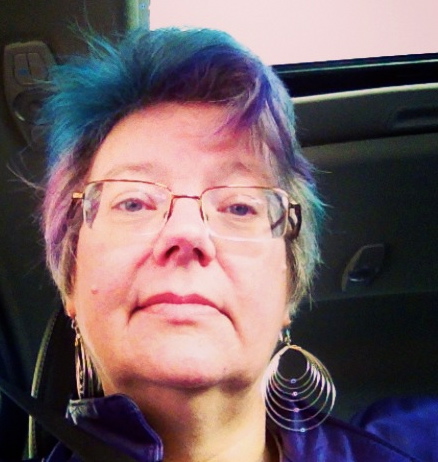


 Website:

 This experienced meaning is, I think, the reason why I’ve had a hard time reducing my novel
2 Responses