
Five Ways
Subscribe to my newsletter and get a free story!
Share this:

Guest Post: Writing Holidays with Evan J. Peterson

Every culture tells stories. We keep our history alive this way. We all have rituals, whether they are secular or deeply religious. When you’re worldbuilding, you can communicate a plethora of culture and history through the traditions and festivals your characters observe.

Coming up on December 10th, I’ll teach Christmas in Narnia: Creating Traditions for Fictional Cultures for the Rambo Academy for Wayward Writers. Pardon the frosty pun, but a fictional holiday is an excellent tip to the iceberg of your world’s history. Consider the wealth of similarities and differences of the festivals of lights that originate from the Northern Hemisphere of our planet alone:

During the season of autumn into midwinter, things get darker and colder in most of the NH. The further north you go, the more stark that dark and cold becomes. Many traditions originating in the Northern Hemisphere have celebrations and rituals revolving around light and warmth at this time. India and its diaspora bring us Diwali and Deepavali, two different but similar multi-day festivals of lights, color, and life. Judaism celebrates Hanukkah as the observance of a historical miracle”“eight nights of light produced from barely any fuel oil. A fun side note: we eat fried foods like latkes and donuts on Hanukkah to represent the bounty of the oil! Who wouldn’t love a holiday that prescribes feasting on greasy carbs?

On Christmas, people celebrate the birth of the Christ child, destined to bring light, love, and goodness into a harsh world. As Christianity spread through Europe, this tradition appropriated, fused with, and replaced several midwinter traditions, such as the birth of God of the Wood on the winter solstice. This nature-based deity literally brings the light and warmth back into the world as the days finally grow longer instead of shorter. In addition to a festival of eating and drinking (lots of drinking), popular Christmas tradition involves putting candles and electric lights on everything, particularly an evergreen tree. That tradition did not come from Nazareth.

Notice that these traditions change over time and will even be different in each family or community. Just as no ethnic group is a monolith, neither is any religious or secular culture. There’s so much room here for worldbuilding, not to mention internal as well as external conflict. Some progressive Jewish families have introduced an orange among the symbolic food (roasted egg, lamb bone, bitter herb, et al.) of the Passover Seder plate, meant to remind us of the struggle of women, lgbtq+ folks, and people of color in Judaism as well as all who face intersectional struggles and are often left out of the popular image of the Jewish community.

I have a Jewish mother and an essentially Unitarian father. I grew up with secular Christmas as well as a heritage-rich Hanukkah, but I’ve always gravitated toward Pagan traditions. As a kid, I was particularly smitten with the Egyptian and Greco-Roman pantheons and stories, and I assume this is because I grew up in Miami, Florida. Flowers, fruit, and flowing water made more spiritual sense to me than the scarcity theme prevalent in Abrahamic traditions. This is the sort of subtlety that can communicate the history of a culture; temperate or tropical traditions are more likely to celebrate abundance and indulgence. Desert cultures are more likely to emphasize struggle, scarcity, and abstinence, but also patience and most importantly, charity. It’s no coincidence that Islam, Judaism, and Christianity share these values and emerged from cultures living under harsh political and geographical conditions.

This brings us to another important subtlety of cultural norms. How hot is “hot?” How cold is “cold?” For that matter, how far is “far?” Does “nice” mean polite and friendly, or does it mean kind and empathic? These are the questions that shape so many nuances of a community and its culture, whether macro scale or micro. And don’t overlook the secular traditions”“what does Tax Day tell us about capitalist cultures? What about the Queen’s Jubilee? For that matter, what about Juneteenth?

For more on this, please join me for Christmas in Narnia: Creating Traditions for Fictional Cultures on December 10th. Happy holidays!

Bio:

Evan J. Peterson is an author, game writer, and Clarion West alum. His latest book is METAFLESH: Poems in the Voices of the Monster (ARUS Entertainment), and recent work includes Drag Star! (Choice of Games), the world’s first drag performance RPG. His writing appears in Weird Tales, Arcana: The Tarot Poetry Anthology, and Queers Destroy Horror. Evan’s serial novel, Better Living Through Alchemy, will be published in 2023 by Broken Eye Books. linktr.ee/evanjpeterson can tell you more.

Site: www.evanjpeterson.com
Twitter: @evanjpeterson
Insta: @evan.j.peterson
Leave a Reply

Your email address will not be published. Required fields are marked *

Get Fiction in Your Mailbox Each Month

Want access to a lively community of writers and readers, free writing classes, co-working sessions, special speakers, weekly writing games, random pictures and MORE for as little as $2? Check out Cat’s Patreon campaign.

Want to get some new fiction? Support my Patreon campaign.


"(On the writing F&SF workshop) Wanted to crow and say thanks: the first story I wrote after taking your class was my very first sale. Coincidence? nah….thanks so much."

~K. Richardson

You may also like...

Announcing The 1st Wayward Wormhole Intensive Writing Workshop

The Rambo Academy for Wayward Writers, fantasy and science fiction’s premiere online learning center, announces a new venture for 2023 – the Wayward Wormhole, an intensive writing workshop with some of the industry’s top teachers.

The inaugural Wayward Wormhole will run November 1 to 21, 2023 at Castle de Llaés, in the municipality of Gurb, Spain. Look northward from the castle to see the Pyrenees and southward to see the rolling hills of Catalonia. Ten students and four instructors will spend three weeks here writing and critiquing, while a virtual component allows other students to experience Wormhole-Light.

The Rambo Academy for Wayward Writers has been in existence for twelve years, serving hundreds of students who have gone on to win awards, honors, and accolades, including Nebula, Hugo, and World Fantasy Awards. “I attended Clarion West, and have taught at multiple workshops now,” says Academy founder Cat Rambo. “While others have delivered the gold standard, I want to stretch to the platinum level and deliver an amazing workshop in an equally amazing setting.”

The Wayward Wormhole instructors for 2023 are Tobias Buckell, Ann Leckie, Sarah Pinsker, and Cat Rambo, all seasoned instructors of the Rambo Academy for Wayward Writers. Details on how to apply for the workshop, costs, and other information can be found at https://www.catrambo.com/waywardwormhole

...

For Writers: Working with Twinned and Twined Storylines

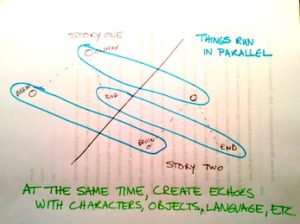
diagram showing that two stories should run in parallel
Diagram or doodle? It’s all in the eye of the beholder.
When I sat down to work out the outline for my Moving from Idea to Finished Draft, I came up with almost two dozen possible starting points for writing a story, including scene, title, taking an old plot, a character, dialog, a particular device, and more. As I finished writing it, those categories shifted around a little, sometimes sliding together, other times diverging, but I did think I’d managed to exhaust the possibilities…

…only to be proven wrong, of course. A week or so ago at the Surrey International Writers Conference I was absolutely delighted when an audience member hit me with a new one that I hadn’t considered at all.

When I teach the class, which focuses on how to take an idea and use it to finish a story, I talk a little bit about story structure and writing process, but most of the class relies on asking participants what the idea is that they’re working with. This time, a woman said, “My idea is a twinned story” and explained that she wanted to write two stories in parallel.

You might argue that it’s a particular manifestation of a frame story, which is something covered in the Devices section of the class, but she wanted it to be more than that: her story was about a couple discovering letters in their attic that tell the story of another couple’s marriage. So let’s look at this according to the structure I use in Moving from Idea to Finished Draft, looking at what it is, what it gives you, what considerations you should take into account while writing, possible pitfalls, next steps, and a few exercises designed to increase understanding of the idea.

What It Is:

A twinned story holds two or more plots running in parallel to each other. The connection between them may be strong or more tenuous and faint, but it must exist. The stories should be distinct and are usually separated by location or time. Usually they are given roughly equal amounts of time in the story; one story may be stressed in importance over the other or they may be weighted equally.

However, I want to note that I am distinguishing this from a single storyline that takes place but is shown from multiple POVs; there are too many differences for that to get lumped in here.

What It Gives You:

The mirror structure actually gives you some very useful things. The first is that if you know the theme of one story, you know the theme of the other, because while it does not have to be an exact copy, it must reflect the other.

Similarly, the action of one story will be echoed in the other, and you may want to look for places where you can create echoes with objects, dialogue, actions, or other elements. If you know one story completely, you should be able to sketch out the other, but it is more likely that you will move back and forth between them, fleshing out elements as they appear in one story and need to be echoed in the other.

Considerations:

That connection between the plotlines is pretty crucial, or else the story will seem pointless and disjointed. It must be apparent to you as well as your reader.

Every time you switch from one plotline to another, you are bumping the reader out of the story and forcing their mental GPS to recalculate their route through it. Give them both the details and the time they need to re-orient themselves in the narrative. Remember that sensory stuff — particularly non-visual — is useful for pulling them back in.

Possible Pitfalls:

As with any device, there must be a reason to use this structure other than “it would be cool to write a twinned story.”

Remember as well that you must carry the plots out to satisfaction and that this will take space. The more plotlines you have the longer your piece will be, and you will need to resist the temptation to skimp for lack of room if you are trying to write to a particular word length.

Remember that you have less space than usual for everything as a result of this, including character development. Make everything count.

If you move about within time inside each of the storylines, providing flashbacks or memories for example, remember that you will need to make sure the reader does not mistake this for a movement to the other story line.

Next Steps:

  • Take inventory of what you have. Where are the blank spots in both that you will need to address? What can each lend its partner?
  • What are the differences between the story? Are there any you need to reconcile in order to make the parallels between them stronger?
  • How will you mark the transitions between the two storylines?
  • Map out the chronology of both storylines; you must know this in order to have them run in parallel.

Exercises:

  1. Figure out some differences between the main location for each story. If time is the difference, what has changed and what existed in the earlier landscape that is transformed or accommodated for in the later one? Along the same lines, if location is the difference and time is not, how is the time of year reflected differently in the two locations? Are there cultural aspects of society that change as well?
  2. Sketch out the main character(s) of each plotline and pair them with their alternate in the other story. List three differences and three similarities between them.
  3. Why are you using this device? List three things that you can do in one story that enhances the other one, such as having the same character appear in each in a way that deepens the reader’s understanding of them, showing how a landscape changes over time, or exploring the idea of inheritance.

In the class material, I try to provide an example of a story that came out of each kind of inspiration, but I don’t have one of these (how can this be?)! So I’m working on one, “The Sheriff Who Dreamed of Astronauts,” which Patreon supporters will get both early glimpses of and a first chance to read when it’s done, and that will get added to the class material at some point.

In the meantime, if you’d like to read interesting examples of this technique, I highly recommend Katherine Blake’s Interior Life for an innovative example, Fried Green Tomatoes at the Whistlestop Cafe by Fannie Flagg for a traditional but highly satisfying example, and If On a Winter’s Night a Traveler by Italo Calvino for something that will really stretch you and make you think while (I hope) delighting you..

If you’d like some interesting audio talk about such things, here is Linda Aronson talking about parallel narratives (unlike me, she includes narratives of parallel characters):

And here is Quentin Tarratino talking about non-linear narrative in a way that may be useful:

...

Skip to content