I believe every human being has dignity and worth. That one should treat others with respect, including their pronouns and the pronunciation of their name. That people should be free to live, worship, and connect with the universe as they please. That decency, ethics, and accountability are core values. That understanding and acknowledging one’s own privilege is part of that accountability.
I believe stories matter. That they shape how people think about and understand their lives and the world at large. That they gift us with hope and empathy.
I believe that all paths to publishing – traditional, indie, small press, crowdfunded – are valid for writers and that nowadays more and more people are able to create their own art and tell their own stories in a new way that has created a wealth of great new writing, including many stories that wouldn’t have been told through traditional publishing.
I believe that historically the publishing industry has – like the world around it – disadvantaged people for reasons of sex, race, religion, disability, sexuality, social class, and a host of other isms, and that this has affected who has and hasn’t been able to be published. Because of that, we all need to continue to push towards an industry – and world – where that is not the case.
I believe my students are a major part of my legacy. They provide me with joy and pride as they work and write and do things in a world that is not particularly kind to people who create art. I try to live my life in a way that will not disappoint them.
I believe in the power of thank yous, because they say “I saw what you did and it’s appreciated”. And I believe in volunteering, because giving back to the community when you have the time and resources is a duty as well as often a joy. The science fiction and fantasy world runs on volunteer power, and acknowledging those volunteers is vital.
I believe that I am the product of many influences, including my Unitarian Universalist faith, which draws in turn from Buddhism, Christianity, Hinduism, Humanism, Islam, Judaism, and Paganism. And all of those influences lead me to believe one should strive to leave the world a better place rather than a worse one.
I believe that claiming to be apolitical is itself a political act, and one bolstered by privilege.
I believe that what is happening in Gaza is wrong, and that there needs to be an immediate, and permanent, ceasefire. Over 40,000 have died in Gaza so far, most of them women and children. That is uncategorically wrong and it is symptomatic of a world where other wars are being waged on those who cannot fight back, primarily the poor.
I believe that a system that drives the vast majority of the wealth up to a specific few, rather than benefiting all, is broken and needs to be replaced. And I believe that those wealthy few are doing their best to foster divisions between the groups they’re exploiting, in order to keep anyone from noticing.
I believe in science and the power of rational thought. And that destroying books, whether by burning, shredding, or other means, is a symbolic destruction of the ability to think and learn.
I believe that people trying to hurt other people in petty ways are often – perhaps even usually – deeply in pain themselves, and that generally it’s better to hope they find the help they need than to try to hurt them back. Hate begets hate, which is sad when that hate is a twisted call for help.
I believe that karma is a force that works in this universe and that continuing to send out good energy and positive vibes will stand me in far greater stead than not. Kurt Vonnegut Jr. said “Be careful what you pretend to be, because you may become it.” I have never pretended to be anyone or anything other than what I am. And that’s what I will continue to be.
Want access to a lively community of writers and readers, free writing classes, co-working sessions, special speakers, weekly writing games, random pictures and MORE for as little as $2? Check out Cat’s Patreon campaign.
Want to get some new fiction? Support my Patreon campaign.
"(On the writing F&SF workshop) Wanted to crow and say thanks: the first story I wrote after taking your class was my very first sale. Coincidence? nah….thanks so much."
~K. Richardson
You may also like...
Nattering Social Justice Cook: Stay the Course
Like many of you, I was taken aback by the results of the recent election, to the point of depression, dismay, and concern for our future. Part of my past week, though, was spent in Chicago at a conference for nonprofit leaders, and that served as a heartening antidote in some ways.
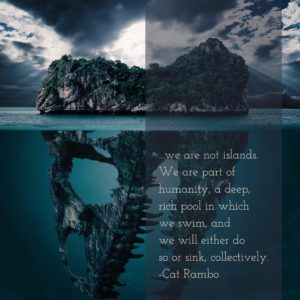
It underscored the fact that we are not islands. We are part of humanity, a deep, rich pool in which we swim, and we will either do so or sink, collectively. The question of where to start with that is one that divides many of those who desperately want to fix things. And the truth is this: that helping wherever and whenever you can is fine, no matter what form it takes. The act of helping others enriches our souls and keeps them nourished.
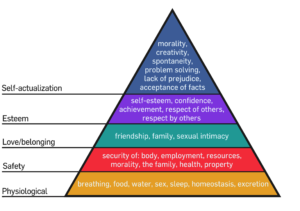
There’s a concept created by Abraham Maslow, a hierarchy of needs. It looks like this:
The principle is simple. The lower on the pyramid, the more important the need. Until that need is filled, the person will not focus on the needs above it. The person with physiological needs like food, sleep, and shelter cannot focus on the needs other than that until those needs are met. Self-actualization needs, like education, creativity, and spirituality, cannot be addressed until all other psychological and basic needs are met.
These are generalizations, obviously. Am I saying that hungry people can’t think about self-actualization? No, but the overall trend — to which there will always be exceptions — is that they don’t. I suspect that the further up the pyramid you are, the more exceptions occur.
That means that almost half of the people responding — which would be a group that probably didn’t include children (who represent a significant chunk of the homeless population) — had less than $400 tucked away in case of the proverbial rainy day. Which could take the form of a medical emergency. Or a car repair. An unexpected hike in tuition, rent, or even groceries. Do not pass Go; do not collect $200.
If you’re not part of that group, take a moment to think about what that means and what that anxiety would add to daily existence. Thinkabout thatanxiety as a lifelong roommate. (If you are part of that group, sorry. I know things are depressing as is. I’ve been there briefly, for what it’s worth.)
There is often an idealism about the Left that is admirable, that is stirring, and that sometimes, unfortunately, clashes with pragmatism and does not emerge the victor. I personally believe human beings are primarily good — but I also know everyone’s flawed, everyone’s got a whiney and entitled inner child, and that sometimes we let that inner child steer the boat when we shouldn’t. And that inner child is more in connection with the needs Maslow talks about than one might like to acknowledge.
Here is a fact that holds true in a complex world, at least in my experience. Social justice falls on different places in the hierarchy depending on an individual’s circumstances. Are you a person who has to worry that if you are stopped by American police you may be shot? Then the Black Lives Matter movement is placed differently for you than for your white friend. You may both support it, but that context is different for the person that actually has to worry about a bullet. Privilege exists, and this is part of privilege.
And here are three important facts about privilege:
One’s personal privilege affects how the world treats you.
That privilege can take many forms: skin color, inherited wealth, education, how a legal system views and treats your physical body, and on and on.
Sometimes (often) our own privilege is invisible to us; we do not perceive it because it is the very definition of “normal” for us, how the world is.
That last one is important because many folks leave it at that, divide everything into normal and not normal. That’s a very easy way of thinking, one that lets us leave it all up to our base instincts, the monkey brain that governs us much more than we’d like to think. The same one whose first instinct with the strange is to throw feces at it.
One of the phenomena that led to the weirdness of the recent election is the use of binary thought, a basic Us vs. Them that does not allow for the fact that human beings are significantly more complicated than a single yes/no statement. I see it being embraced even more strongly now – by both the Left and the Right.
The world is more complicated than that. To fall into that trap is to let yourself be controlled by whoever wields the media around you the most effectively. You must think, you must question. You must figure out where your common ground is and how to use it. This is not the time to be silent. This is a time when how you live and act and speak is more important than it ever has been.
So. Here’s what I’m doing.
I’m listening to the voices that haven’t been listened to and amplifying their message wherever I can. Recommending a wide and interesting range of works for the SFWA Recommended Reading List. Reading across the board and making sure I look for new, interesting, diverse stuff – and then spreading the word of it. I’m nominating and voting for awards and taking the time to leave reviews when I can.
As a teacher, the most important thing I can do is try to show my students how an artist lives and works. Why it’s important to confront and acknowledge one’s own flaws so you understand them in others. How to be a good human, one that is responsible, ethical, open to the world. Feminism is more important now than ever, and being one publicly in a way that redeems the bizarre media stereotypes that have been imposed upon it is crucial to generations to come.
I’m practicing the principles of peacetalk. Choosing my communication goals, paying attention, rejecting preconceptions, staying in tone, not taking bait, helping the other participants maintain face, choosing my metaphors with care, trusting my inner grammar, telling the truth, and above all practicing the skill of skills, joy.
I’m continuing with the volunteer work I do and trying to be a good leader for SFWA at a time when a lot of members are very worried, particularly about their health care. Offering Plunkett scholarships for my classes so I can encourage writers who might not otherwise be able to take them. And maintaining the small practices, like shipping books off to the Women’s Prison Book Project, steering my shopping through the Amazon Smile Program, supporting HumbleBundle and StoryBundle (admittedly, buying books is not really a huge sacrifice), donating to local homeless shelters and food banks, and making charitable contributions for Christmas presents and to memorialize the loved ones lost this year.
I’m practicing gratitude harder than I ever have before. Letting the people around me know how valued and loved they are. Waking up each morning and thinking of someone that I find marvelous about this world, whether it’s marshmallows or goldfish or my friends or that book I read yesterday. Celebrating the tiny victories, like the fact that my Christmas cactus is blooming, and it is beautiful and bright despite the seasonal gloom here in Seattle.
One negative act. I’m not paying any more attention to the dickheads. I used to check out some of the blogs where the hate stew was getting stirred, just so I could see what the current trends were. Not any longer. Life’s too short to worry about the self-proclaimed super genii, who so often turn out to be the Wile E. Coyotes of the world. Let the trolls troll; they’re not worth the breath or brainpower. (And never have been.)
I’m not giving in to despair and apathy. Neither should you.
But! My other great news, somewhat related to that, is that I’ve got an agent now, the excellent Seth Fishman of the Gernert Company. He’s as excited about the novel as I am, and so I’ve been figuring out my rewrite roadmap and planning to devote March to that. Huzzah! Onward and forward.
This is the last day for getting the special deal on the Writing F&SF Story class or Editing Class! Sign up for one of those and you get a bonus class as well. Bonus class options include: the First Pages workshop, Flash Fiction workshop, Everything You Need to Know about E-Publishing, Literary Techniques in Speculative Fiction, Building an Online Presence for Writers, and Art of the Book Review.