
Five Ways
Subscribe to my newsletter and get a free story!
Share this:

Guest Post: Rosemary Claire Smith talks about Collaborating on SAUROTOPIA

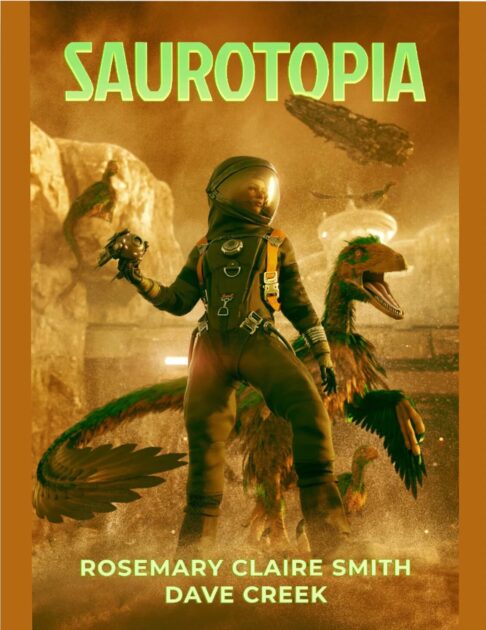
Picture of a human in a spacesuit and a dinosaur, along with the words SAUROTOPIA by Rosemary Claire Smith and Dave Creek.At some convention or other, Dave Creek turned to me and said, “Say, I have some thoughts for a story that we could write together. I’ve got a survey team that enters an abandoned orbital habitat and stumbles across some super-intelligent dinosaurs. You’re the one who knows about dinosaurs.” This sounded intriguing, especially when we conceived of it as a short story that we could send off to a magazine that had published bunches of our stories written separately. Ah, but like that recon team, we had very little idea what we were getting ourselves into. Little did we suspect that SAUROTOPIA would expand to become a whole novel. Or that we’d find a publisher who wanted six books.

Science fiction fans have long enjoyed collaborations. James S.A. Corey’s series, THE EXPANSE, is actually a collaboration between Daniel Abraham and Ty Franck. For fantasy readers, Amal El-Mohtar and Max Gladstone’s THIS IS HOW YOU LOSE THE TIME WAR won the Hugo, Nebula, Locus, and Ignyte awards. Other writers who’ve jointly produced well-received novels include Terry Pratchett and Stephen Baxter, William Gibson and Bruce Sterling, as well as Larry Niven and Jerry Pournelle.

How exactly do writers work together to make this magic? I’m sometimes asked if I wrote the dinosaurs and Dave wrote the humans. That’s a reasonable assumption, especially given that the chapters alternate between human and dinosaur viewpoints. However, for us, this isn’t how it works. Dave created my favorite character, who is an ostrich-like dinosaur best described as a fierce version of Big Bird. The first scene in which this dinosaur appears was Dave’s creation. No, this is not the only dinosaur he created. There’s also the leader of a predatory band of different dinosaurs. Basically, they are feathered velociraptors. I added the parts where they hunt in packs and stalk their prey from branches of trees. Don’t get me wrong, I did create several other characters for both these species of dinosaur as well as some peaceful herbivores.

Here’s another surprise that I learned as we worked together. It seemed natural to suppose that a book can be written by two authors in half the time it will otherwise take them to write it alone. If only this were true! Both Dave and I have a batch of other projects we were working on. I write a regular book review column and am about half way through a different series. Dave has his own series of novels and short stories clamoring to be written. This meant we both needed to find time in between our other work to write chapters of SAUROTOPIA and edit each other’s work.

Then there is the prospect of encountering “creative differences.” Part way through this project I worried about Dave hating my ideas and me hating his ideas. There were certainly times when one or the other of us would come up with something…let’s call it surprising. Looking back, what worked best was for me to sit with his unexpected plot developments. Over time, his new idea would not only grow on me, but I would become really intrigued by where it might take our characters, both the humans and the dinosaurs. Now I am looking forward to the times when he will spring something completely unexpected on me.

If you’ve read this far and are a writer who is wondering whether you might want to collaborate with another writer, I have to say, it can be tricky to figure that out in advance. Even if you have similar approaches, such as you both outline before you start, that’s no guarantee. Nor for that matter is there any assurance that a solo work will come to fruition. So, take another look at those collaborators I mentioned at the start. What the heck, give it a shot.
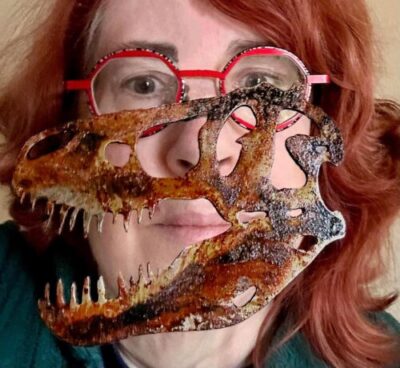


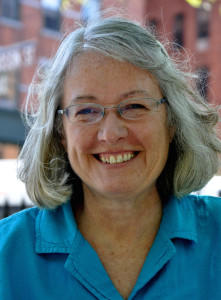
Picture of a red-haired woman with red glasses and a cut out of a dinosaur in front of her face.Rosemary Claire Smith writes science fiction, fantasy, and horror stories showcasing her interests in dinosaurs, alternate history, space exploration, mythology, genetic engineering, time travel, and aliens. She draws on her background as a trowel-wielding archaeologist, reformed lawyer, and keen observer of society. Her other interests include flower arranging, abstract photography, foil fencing, and astronomy.
This was a guest blog post.
Interested in blogging here?

Assembling an itinerary for a blog tour? Promoting a book, game, or other creative effort that’s related to fantasy, horror, or science fiction and want to write a guest post for me?

Alas, I cannot pay, but if that does not dissuade you, here’s the guidelines.

Guest posts are publicized on Twitter, several Facebook pages and groups, my newsletter, and in my weekly link round-ups; you are welcome to link to your site, social media, and other related material.

Send a 2-3 sentence description of the proposed piece along with relevant dates (if, for example, you want to time things with a book release) to cat AT kittywumpus.net. If it sounds good, I’ll let you know.

I prefer essays fall into one of the following areas but I’m open to interesting pitches:

  • Interesting and not much explored areas of writing
  • Writers or other individuals you have been inspired by
  • Your favorite kitchen and a recipe to cook in it
  • A recipe or description of a meal from your upcoming book
  • Women, PoC, LGBT, or otherwise disadvantaged creators in the history of speculative fiction, ranging from very early figures such as Margaret Cavendish and Mary Wollstonecraft up to the present day.
  • Women, PoC, LGBT, or other wise disadvantaged creators in the history of gaming, ranging from very early times up to the present day.
  • F&SF volunteer efforts you work with

Length is 500 words on up, but if you’ve got something stretching beyond 1500 words, you might consider splitting it up into a series.

When submitting the approved piece, please paste the text of the piece into the email. Please include 1-3 images, including a headshot or other representation of you, that can be used with the piece and a 100-150 word bio that includes a pointer to your website and social media presences. (You’re welcome to include other related links.)

Or, if video is more your thing, let me know if you’d like to do a 10-15 minute videochat for my YouTube channel. I’m happy to handle filming and adding subtitles, so if you want a video without that hassle, this is a reasonable way to get one created. ???? Send 2-3 possible topics along with information about what you’re promoting and its timeline.

Show more

Leave a Reply

Your email address will not be published. Required fields are marked *

Get Fiction in Your Mailbox Each Month

Want access to a lively community of writers and readers, free writing classes, co-working sessions, special speakers, weekly writing games, random pictures and MORE for as little as $2? Check out Cat’s Patreon campaign.

Want to get some new fiction? Support my Patreon campaign.


"(On the writing F&SF workshop) Wanted to crow and say thanks: the first story I wrote after taking your class was my very first sale. Coincidence? nah….thanks so much."

~K. Richardson

You may also like...

Guest Post: Rachel Fellman Chews on Bad Food in Fiction

Look, I love to write about terrible food. Life contains so much more of it than good food, or at least my life does. (I have limited funds and poor judgement for risk.) But more than the realism, I’m drawn to bad food because it infuses a scene with context, with a messy pathos. Someone failed before this dish was even served.

I think about the scene in Tinker, Tailor, Soldier, Spy in which the spymaster George Smiley tells the story of his one meeting with his Soviet opposite number, Karla. Sitting in a greasy restaurant with his confidant, he takes a few bites of his chicken, murmuring, “There, that shouldn’t offend the cook.” By the end of the scene, he’s given up on the dish, “over which white flakes of fat had formed like seasonable frost.” I mean, the frost isn’t even unseasonable. It is correct that this is happening; it is meet. That chicken died for nothing and everyone knows it.

The cook may have made an unpalatable dish for a sad, unhungry man, but Le Carré prepares a nose-to-tail butcher’s feast of pathos and waste. One of the points of the scene is that Smiley tried and failed to pull a Not So Different Speech on Karla; he ruined it because he’s honest, and honestly lonely. The chicken fulfills its destiny in a way that’s perfect for the mood. It doesn’t symbolize Smiley’s feelings ““ nothing so cheap. Le Carré is a subtler chef than that. Each grim bite of Smiley’s chicken evokes a universe where no spymaster, no heroic fieldman, no great analyst, no chicken farmer or chicken or roadhouse chef, can catch a single break.

I come from a Patrick O’Brian family, and when I mentioned this post to my brother Aaron, he ran to find the bit in The Far Side of the World where Captain Jack Aubrey serves up a lobscouse on which “the liquid fat [stands] half an inch deep over the whole surface.” Later, a pie leaks “thin blood [thin blood!].” As Aaron points out, the pie is rich with social worldbuilding: “Jack has no cook and he’s had to rely on various sailors who don’t actually know how to provide dishes. He’s high class enough that he can’t cook, but he exists in a social setting where he can make one set of people cook for him and another pretend to enjoy the terrible results. […] I feel like a lot of bad meals in literature say stuff about power. One thinks also of the meals Charles’ dad attacks him with in Brideshead Revisited. First red dishes, then white dishes!”

I am myself, as I have said, a gleeful writer of tragic food. It’s true that my debut, The Breath of the Sun, doesn’t have the worst food I’ve ever written. This is because I cut a scene in which a character orders something called “chicken cogulare,” which beats out a scene from a previous manuscript in which a Potemkin village of breakfast pastries is served by an evil prince.

It’s also because The Breath of the Sun is a mountaineering novel, and the literature of survival has a very specific relationship with bad food: since these stories are about scarcity, they’re also about the miracle of having food at all. I remember a meal of spaghetti and fried garlic bread in Kim Stanley Robinson’s underrated Antarctica, which prompts a character to contemplate that Antarctic food, eaten in “extreme states of hunger,” “often tasted wildly delicious even if it was very plain fare.” By the same token, who could forget the “feast of hot water” with which Genly and Estraven celebrate their ice trek in The Left Hand of Darkness (or the hot beer, oddly pleasant in an ice age, over which they make the first moves of their complicated friendship)? Some of the food on Gethen is very fine, and some of it is bad, but it is always transmuted by the sharing at the hearth.

In The Breath of the Sun, when my characters eat dried chicken and biscuit (singular, because in Arctic narratives “biscuit” is a monolithic item), and when my narrator Lamat observes that this biscuit needs to be heavily hydrated with saliva before it can be swallowed, I want to evoke a purely practical un-food. Dehydrated and preserved, it doesn’t feel prepared by human hands. For my two cranky and embittered heroines, the solitude of climbing is both terrible and delicious, and so is the dried pap you eat from a tube. To climb is to leave the context of the earth, and I use food to stretch out that feeling as far as it will go.

Even a breakfast the characters eat when not on the mountain, served by Lamat’s velvety and brutal ex-husband, has this feeling of detachment. Served on “a dirty white table” in an empty courtyard, it is “an untidy heap of miscellaneous food “” rolls and dates and apples with an unpleasant touch of lemon-juice to them, boiled eggs.” The same preservation, the same detachment, but this time there’s nothing delicious or terrible about it, only a mess of context on a plate.

Lamat’s a bartender and innkeeper when not climbing, and I think the only food she really trusts anymore is what she makes herself. When she imagines the mountain from the city, she can only conjure “a morning like a clear glass cup of tea and an egg.” And when she comes home to her lover, she describes her as “a burning breath of coffee, a sense of solidity and strength […] a steady fierce look like some tame animals have.” Home is the right drink on the right breath, and privacy.

Good food is a joy of literature, of course, just as in life. But for subtle worldbuilding, for comedy, for the interplay of hospitality and power — give me the bad stuff. It is a dish of vertiginous depth. Plus, I don’t have to taste it.


Bio: Rachel Fellman is an archivist in Northern California. She writes sharp, painterly science fiction and fantasy about her various preoccupations: art history, extreme survival, toxic love, queer identity, and terrible moral choices. Most of her protagonists are great at exactly one thing and are continually prevented from doing it. Publishers Weekly called her debut novel, The Breath of the Sun, “an atmospheric, poetic, and occasionally wry and brutal story that moves with the gentle but unstoppable momentum of an iceberg.” She does not climb mountains.

Enjoy this writing advice and want more content like it? Check out the classes Cat gives via the Rambo Academy for Wayward Writers, which offers both on-demand and live online writing classes for fantasy and science fiction writers from Cat and other authors, including Ann Leckie, Seanan McGuire, Fran Wilde and other talents! All classes include three free slots.

If you’re an author or other fantasy and science fiction creative, and want to do a guest blog post, please check out the guest blog post guidelines.

...

Guest Post from Ken Altabef: Designing a Fantasy World Around Inuit Myth

Book cover of Alaana's Way by Ken Altabef
An insatiable fever demon…
A restless Wind spirit…
A treacherous shaman…
A golden walrus…
And one courageous young girl.
Unlike the more familiar Greco-Roman or Norse pantheons which feature vivid characters and well-defined myth cycles, the Inuit myths tend to ramble, skipping madly about with the rapid scene changes of a disjointed dream and likely to end abruptly with a stoic, “˜”Here ends this story.”

The mythology is peppered with impressive spirits with interesting names. But aside from a name and a job description there’s little else to go on. So when I decided to write ALAANA’S WAY, an epic fantasy series about the first female shaman in an arctic world based on Inuit myth, I had my hands full. As shaman it’s Alaana’s duty to negotiate with the great spirits, and they all became colorful characters in the story. Their appearance and personalities were entirely up to me.

Another problem. A nomadic lifestyle, the vagaries of a mostly oral tradition and a fractured tribal system leave little agreement between different versions of the same story. Even the most established figure, Sedna, Mistress of the Sea, owns multiple conflicting origin stories. One version claims she was the daughter of two giants with such an uncontrollable urge for flesh that she tried to devour her parents in their sleep. Another tribe insists she was a young beauty forced to marry an elderly neighbor who turned out to be a monstrous carrion bird, leaving her no route of escape except a plunge into the salty depths. Or perhaps she was a poor orphan girl mistreated and cast into the sea by the other children; her fingers, chopped off as she clung desperately to the side of the kayak, fell into the water to become the walruses and seal. I had to tread carefully here. I decided, in a flash of Solomon-like insight, that all of them were true. I supposed that in the Beforetime, where dreams were reality, she was all those things, lived all those lives. But here and now she is simply Sedna, the Sea Mother who controls all the animals in the ocean.

wind and demon maskAnother established figure is Tulukkaruq, the Raven, who always represents a mischievous spirit in Native American folklore. The Inuit Raven is impressive indeed, having been credited with creating human beings and bestowng the gift of fire on us as well. But really, this one was easy. I gave him the personality of the Dark Knight’s Joker and urged him to plague both my shamanic heroine and her villainous nemesis in equal measure.

But what about the rest? Interpreting an entire pantheon is a daunting task, but I never flinched. I’m a fantasist. This is what I live for.

Tornarssuk
Tornarssuk
Consider Tornarssuk the guardian spirit of the polar bears. The name spoke to me. I pictured an enormous shimmering white bear with starry eyes. He would be fierce and deadly but also benevolent and wise, with a soft spot for human beings as well. Tekkeitsertok is the guardian of the caribou, so a tawny-furred man with cloven hooves and an impressive rack of antlers. I figured he was an old and docile spirit, more interested in sleeping than fighting, but he does get into at least one good brawl before the series’ end. The Whale-Man may appear as a gigantic black bowhead or a Poseidon-like man, and let’s make him the estranged lover of Sedna for good measure. I wrote a scene in book four where the two have a torrential undersea battle, her sharks on one side vs his whales on the other.

What about Erlaveersinioq, the Skeleton Who Walks, a terrifying spirit who loves murder and death above all things? I guess we can chalk him up in the villain’s column. Sila, spirit of the Wild Wind, was a wild card but in the southern tribes he is also the spirit of justice. Let’s put him with the heroes, but leave some question as to whether he’ll really show up to help. As for the snowy owl who leads the souls of the dead across the great divide, she should be petite and cute, with a light as bright as sunlight on fresh snow. Narssuk, who controls the weather, is an insane sky baby who lets down his caribou skin diaper to issue a stormy blast of thunder and snow.

Raven
Raven
Somewhere along the line I found mention of the Tunrit, a race of people who lived in the arctic before the Raven created human beings. A race of prehistoric supermen. I could find nothing more about them except for the name of the tribe, but that was enough. I had found my villain. A promethean figure among the first men, who had wrestled sabre-toothed tigers and brought the sun from the other side of the sky, and who turned to sorcery to atone for that terrible mistake.

So are my versions of these mythological figures accurate? Probably not, since they came mostly out of my own imagination. But they might be. And that’s an important point. In dealing with a cultural belief system, albeit an archaic and disfavored one, I felt a duty to be respectful. My books sit proudly on the shelves of the Toronto Public Library and in a home for wayward Inuit boys in Nunavut, Alaska. In correspondence I’ve received from Inuit people reaction varies from praise for giving these mythological figures new life, to a stoic acknowledgement of the fact that at least I didn’t contradict anything.

That last is not entirely true. A pivotal figure in the series is the Moon-Man. Many Inuit tribes posit the familiar Native American myth that the lecherous Moon-Man chases his sister the Sun across the sky each day in hopes of an incestuous liaison. This didn’t fit in with my elderly, romantic Moon-Man nor my version of the Sun as an extraterrestrial spirit. What to do? I decided to have my shamanic heroine Alaana ask the Moon-Man, on one her soul-flights to his realm, if the story was true. “Oh no,” he says, “that’s just a story people tell.” So at least the contradiction comes right out of the mouth of the Moon-Man himself. Who could argue with that?

Moon Mask
Moon Mask

Want to write your own guest post? Here’s the guidelines.
#sfwapro

Enjoy this writing advice and want more content like it? Check out the classes Cat gives via the Rambo Academy for Wayward Writers, which offers both on-demand and live online writing classes for fantasy and science fiction writers from Cat and other authors, including Ann Leckie, Seanan McGuire, Fran Wilde and other talents! All classes include three free slots.

...

Skip to content