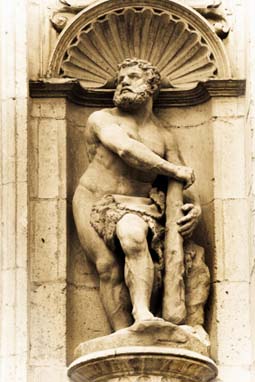
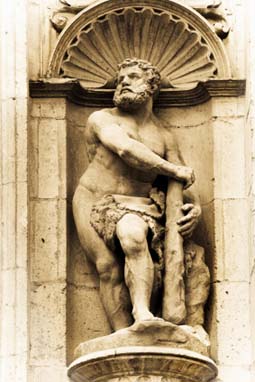
Fen pre-empted any observation he could make about the weather. "The statues will be done by midsummer, they say. Later than anyone had hoped for, but still enough time to get to the coast before winter sets in."
Another Tabat story is brewing, this time explaining one of the city’s architectural features: the ninety-nine statues of figures from the history of Tabat, commissioned by a Duke to be placed along Salt Road. A mystery arises – what is it about the 99th statue that sets it apart from its fellows? Here’s a snippet from the beginning:
It was one of those rainy days that make up most of Tabat’s spring, a day when the clouds hung so low that the city’s upper terraces were shrouded in fog. When Nicolas started up the foot of Salt Road, it was clear, but as he ascended, the white mist around him thickened and he found himself breathing in cold moisture that made his lungs feel as sodden as the thick wool coat he had imprudently chosen that morning, thinking it would snow and he’d want the warmth.
He shivered and glanced sideways and slightly down at his companion. Feniker marched along with his hands in his pockets, smugly dry in his oilskin cloak and waxed leather boots, both brand new. An elaborate cockade was pinned to the black fabric’s breast.
“I see the Duke has chosen to outfit you,” Nicolas said.
Feniker glanced down at himself. “This is what all the expeditions are equipped with. Nothing but the best.”
“Still planning on going?” Nicolas asked. He regretted the words as soon as they left his lips, but Feniker didn’t reply, just nodded and kept on walking.
Nicolas kept his pace in step with his friend’s, despite the discrepancy in their heights. He hunted for a safe topic of conversation but everything seemed fraught, tinted with departure.
By now, they could barely see the street, surrounded by a wall of meaninglessness, robbed of any sign of wall or fence or street-sign. The cobbles underfoot were slick with moisture. Tonight when the temperature dropped, Nicolas knew, they would become black ice, and most of the city would come to a standstill, with only the lines of the trams moving up and down the terraces.
Want access to a lively community of writers and readers, free writing classes, co-working sessions, special speakers, weekly writing games, random pictures and MORE for as little as $2? Check out Cat’s Patreon campaign.
Want to get some new fiction? Support my Patreon campaign.
"(On the writing F&SF workshop) Wanted to crow and say thanks: the first story I wrote after taking your class was my very first sale. Coincidence? nah….thanks so much."
~K. Richardson
You may also like...
WIP: Teaser From "In My Brain Were Stored a Thousand Pictures"
Life in the new place continues pleasant; this morning it is raining, but the construction workers across the way are slicker-clad and working away doggedly. I’ve been listening to Vienna Teng’s album, Aims. Here’s one of my favorites from it:
As I listen and witness the cars passing by on California Avenue – black egieb blue yarg etihw – I’ve been working on a bespoke near future SF piece where I get to play around a bit with ideas of body augmentation, virtual life, and the access to either of them afforded by economic class. Here’s some of this morning’s writing:
Malady could understand the concept of the artificial hand and how useful it could be in this life, but she didn’t understand why they put so much emphasis on it at first.
After two weeks at University, though, she did, because here they spent most of their time in meat life and very little in mind life, even in classes. And when they went into mind life, the things they got there were like the meat hand to Malanie ““ fripperies, seldom used.
Still, even here, plenty of other ways to do things presented themselves: rather than reach your hand for food, have it come to you in a floating dish or handed to you by a helper, probably mechanical but here they even had human helpers, which was truly deeply madly odd to her way of thinking.
She said as much to her roommate Michelle. Michelle was short and peppy and purple-haired today, with turquoise stars over her cat-pupiled eyes. While her appearance changed from time to time ““ she had full mods, the best old money could buy ““ she was invariably a combination of irritated and amused at her scholarship roommate’s oddities. She said, “For gosh sakes, Mal, surely you want to do things for yourself? That’s what humans do.”
“That’s what humans do,” was one of her more frequent expressions, along with “That’s just how it is” and “That’s how they always do it.” The latter two had figured plentifully in her orientation conversations with Malady, who’d spent her flight and taxi ride in her Memory Palace and had only fully come into meat when Melanie demanded it.
This story originally appeared in ChiZine, where it took third place in their 2005 contest. It's dedicated to my Grandmother Nellie, who passed away in 2010.This story, which I’ve offered up as free online fiction, owes much of its inspiration to my actual grandmother and is faintly, ever so faintly, autobiographical.
The sound of the car wheels whispering along the road meshes with Grandmother’s snores and the faint noise of my mother’s humming as she drives. She prefers not to have the radio on during long trips.
Inside the car, it’s cold as a mall midsummer. Cold as a clinic, a hospital, a morgue. I can’t quite see my breath, but I’m wearing a sweater, while outside it’s 97 degrees — according to the dashboard gauge. The air conditioner roars its displeasure as we roll down the highway.
We are traveling with my reluctant grandmother from Mullinville, Kiowa County, Kansas, where she has spent all her life, to a West Coast nursing home near the neighborhood where my mother and I both live. Behind us are: her house, now up for sale; her Chrysler, also listed in the local paper; and her possessions, which my mother and I will return to sort through in a week.
The landscape spreads out with the pancake flatness of Kansas around us. Cottonwoods trace the edges of a meandering creek and its unseen waters. Irrigation sprinklers spread out green circles only visible from above, where a ribboned contrail shows a plane’s progress. Shimmers of summer heat prelude our arrival, as though we chase an oasis that never manifests.
My mother glances over at me. “Can’t sleep?”
“I thought you might want company.”
“I appreciate it. Though I can’t say that the silence hasn’t been welcome.” She rolls her eyes expressively towards the back seat.
“I heard that,” my grandmother says. It is unclear whether she is talking in her sleep or responding, so we wait. More faint snores come from the back seat, so we go back to talking quietly.
It is August, the worst possible month to be driving through Kansas. It is a cicada year as well, and every night at the motels we hear their music swelling. Last night we stayed in Garden City, Kansas, home of feedlot after feedlot; the room was full of flies. A cheap red flyswatter on top of the television said that this was not unexpected.
We all shared the same hotel room. It’s cheaper to do it that way, and my grandmother insisted on paying all the motel bills as part of her martyrdom. She sleeps alone in one bed, while my mother and I share the other.
It’s strange being with them on this trip. We all look alike ““ I can see myself twenty and forty years down the line, unless I take some drastic measure. We even smell the same, although my grandmother’s scent is masked by perfume and cigarette smoke.
Waking, my grandmother leans forward, patting my shoulder. Her eyes are uncertain behind her thick glasses. “Shayla, you know what’s always bothered me?” she asks.
“No, Grandma, what?”
“When you were eight, we went to the K-Mart, and there was a toy there, a stuffed black kitty doll. You wanted it so badly! But I didn’t want to buy it for you because it was a little shop worn. You cried and cried.”
“I don’t remember that,” I said. It’s the truth. I remember trips to the K-Mart as a child. I bought my first album there, Herb Alpert and the Tijuana Brass’s “Talk to the Animals.” I remember the bank of coin-operated vending machines dispensing gumballs, jawbreakers, and wonderful trinkets. I always asked my parents or, on occasion, my grandmother for nickels and dimes, knowing that they’d balk at a quarter. But this cat, somewhere in the shelves of toys K-Mart held, a magic section that expanded like an unfolding poinsettia blossom during the holidays, was not something I remembered at all.
“You cried and cried.”
Beside me, through the glass, row after row of wheat undulate, golden as Barbie doll hair.
“I really don’t remember it, Grandma.”
“Was that at Christmas?” my mother says.
“Yes.”
“I remember that. You cried all evening.”
I shrug. “I still don’t remember it.”
But looking back at my grandmother, I see it for a moment in the rear window: a small stuffed black cat, made with real fur, the eyes luminous green marbles. The retreating roadway framed in the glass behind it shimmers; I blink and the toy is gone.
My grandmother lapses into silence, and my mother begins to hum again. At the sound, Grandmother speaks.
“What do you girls plan on doing for dinner?” she asks.
“I don’t know, Mother. Is there something you would like?”
“Oh, I don’t know.” She pauses. “Maybe some place we could all sit down and get a nice salad.”
“How about the Outback?” I suggest.
There is silence from both of them. I sigh in admiration at the way I’ve been drawn into this game.
“There’s a Roy Rogers just ahead,” my mother counters.
“Oh, there,” my grandmother says.
“They have salads.”
“Not nice ones in bowls.”
I watch the highway signs as we zip along. “There’s a Chinese restaurant coming up,” I cannot resist saying.
“That would be nice,” my grandmother says, and I know, somehow that this has been her plan all along. She looks out the window. “Do you girls know, this is my first road trip? It’s like a movie, just the three of us.”
I can tell she’s seriously jonesing for a cigarette.
We get in another hour of driving after dinner, but don’t want to push on too long. Pulling in at a nondescript motel, $39.95 for a night with privileges to a faded blue swimming pool, we check in and conduct our evening rituals. My grandmother watches “Survivor” in her bathrobe and goes outside on the balcony to smoke during the commercials. My mother pages through a murder mystery, fingers flicking through it in a steady rhythm. She has a tote bag filled with paperbacks; she’ll work her way through them methodically, like a sugar fiend devouring candy bars. The two of them ignore each other for the most part. They have never gotten along, although my mother does not hold the same childhood grudges that my aunt does. My aunt has refused to have any part of this trip besides funding it.
I love my mother, but I feel a great deal of fondness towards my grandmother as well. She is stubborn, and manipulative, but she’s earned that right by living to a ripe 95. Even so, I had to agree, despite her protests, that a nursing home would be better for her than the solitary and sometimes fragile existence she’d been leading until then.
“She drives to Wal-Mart, out on the highway,” my mother had said on the phone, recapping one argument. “I can’t get her to see that it’s dangerous. I can’t imagine what the other drivers think.”
“They’re probably used to the occasional senior citizen,” I said. “Can someone be paid to take her to the store twice a week, or something like that?”
“It’s not just that,” my mother said. “I’m worried she’ll slip in the bath. Or on her front steps, or the basement steps. She’s getting very frail.”
“But she likes it there.”
“I know.”
“What does Aunt Rosie want to do?”
“Oh, she’d put her in a home tomorrow if she thought she could get away with it. Probably has one all picked out.”
I would have laughed, but it was true.
“I’ll come out and help you talk to her about it,” I said.
“Thank you, that makes it bearable,” my mother said. “I don’t think you want to get too much in the way of all the discussions, but I know I could use you for moral support.”
Now, together, half a state away from her home, we say our goodnights and go to sleep. Both my mother and my grandmother snore. Outside I hear mourning doves lamenting, the sigh of wind through the telephone wires, and the whisper of tires, rolling down the darkened highway, moving through the pools of light that define the night’s blackness.
I’ve always been a little freaked out by bathrooms at night. For one, I’m nearsighted, but don’t usually take my glasses with me when stumbling there out of bed. For another, a thought of someone or something reaching up from the toilet to grab my crotch haunts me, even though I know it’s silly. But as soon as I sit down, I think about avoiding thinking it, and then I’m done and standing up while reaching for the toilet paper, not looking at the bowl.
Which doesn’t explain why, blearily sitting on the pot, I see the cat again in front of me.
It is, unlike the rest of the world, perfectly clear in detail. It is covered with rabbit fur, dyed black, and eight inches long. Its legs are well delineated from its body, giving it a crouching appearance. The eyes gaze blankly at me. Neither of us move.
Yes, I would have wanted it as a child: the imitation of life, the softness of the fur, would have enchanted me. My allergies prevented us ever having pets, so I compensated with stuffed animals. I do not want it now, here in the bathroom, inexplicable and surreal.
I almost speak, but what would I ask this toy that sits here chilling me colder than any air conditioning?
Surely when I blink it’ll vanish, but it remains, even when I stand and wipe and flush. My feet are cold, but a bead of sweat crawls its solitary way down my back. I step around it and to the door.
And this time, when I look behind me, it is indeed gone. But the hair on the nape of my neck keeps standing up, bristling hard and insistent.
I see it every night after that. Sometimes during the day. Once, sitting next to my grandmother in the back seat. She and my mother don’t see it, but my grandmother keeps telling the same inconclusive story of her failure to buy it over and over. Most of the time I could laugh her off but this time I was near the boiling point, subjected to the toy’s blank but menacing stare, and I could tell my mother knew it.
“Don’t let her get to you,” she says as my grandmother moved off to the restaurant bathroom.
I sip from my coffee. “I think I’m stressed,” I say.
“About what?”
I shrug, watching wisps of steam curl up from the surface of the drink.
I let her questions slide off me in that way that only a family member can and, as my grandmother returns to the table, she lets it go.
My mother and I try to infect each other with song memes. I start with Afternoon Delight, she counters with Benny and the Jets. I can feel my grandmother listening in the back, wanting to join in but unable to interject herself in the quick flow of banter.
It goes on and on. If I Had a Hammer. The Sesame Street Song. Silver Bells. The Wisconsin cheese jingle. YMCA. It’s a Small World After All. The Lion Sleeps Tonight. Copacabana. Yellow Submarine. Kokomo. I Will Survive. Piano Man.
Finally I pull out the biggest gun I know and begin singing Emily Dickinson poems to the tune of “The Yellow Rose of Texas”.
“Because I could not stop for Death, he kindly stopped for me”¦”
“Argh,” my mother says. “You can stop right there.”
“The Carriage held but just Ourselves – and Immortality.”
“We used to sing that in choir,” Grandmother said. “But with different words.”
And with that the game is stopped, dead. I can tell my mother’s fighting back a smart-ass reply that will spark a fight to last us the next hundred miles. I sink further down into my seat, and rest my cheek against the cold glass. In my head, the words flicker past: “Since then ““ tis Centuries ““ and yet feels shorter than the Day, I first surmised the Horse’s Heads were towards Eternity.”
Without looking back, I know the stuffed cat is sitting on the seat behind me.
The nursing home brochures lie ignored on the backseat as my grandmother stares out the window, watching the sweep of wire from one telephone to the next and counting the road markers aloud. The home is on the outskirts of Seattle, in a small town that acts as a bedroom community for the city. Of all the choices, it offers the most freedom to its occupants: my grandmother can take advantage of daily bus trips to the mall and grocery store, and weekly ones to the library and church. She’ll have a kitchenette and her own balcony.
Still, she’s outraged, and all through the trip she needles both my mother and I, looking for weak spots. When she tries it on me, I become amiably stupid, letting all double meanings slide right past. With my mother, she has better luck; by the time we’re in Idaho, my mother, tired and cranky, is ready to explode when my grandmother refuses the third restaurant with her usual timid demurrals.
With a wild swing of the wheel, my mother pulls over onto the side of the road. The landscape here is spotted with red grass; hills of shale rise up on either side, and a black and white magpie sits on a wire fence, flicking its tail back and forth as it watches us.
“We’re doing this for you!” she shouts at my grandmother. “You might cut us a little slack. We’re not serial killers carting you off to be cut up. We’re your family, trying to do the best we can.”
My grandmother blinks at her in silence.
My mother leans her head on the wheel and takes a deep breath. I rub her shoulder.
“Long John Silver’s would be fine then,” my grandmother says.
“Okay.”
I see the cat as soon as we walk in; a child over by the condiments counter is carrying it around by one front leg. I ignore it.
Both my mother and my grandmother pat my back as we stand in line. I shift my weight forward and focus on the menu.
The cat lies in the aisle, discarded, while its owner stuffs his pockets with packets of tartar sauce. I give them a wide berth.
Before any of us have even unwrapped our food, my grandmother launches into a fresh barrage. “I have a lot of things I need to do, in my house,” she tells my mother.
“We’re selling your house.”
“Before we can sell it, there are things I need to do.”
“Like what?”
“Paint that front railing.”
“I’ll find someone to do it. What else? Shayla, write all this down.” She flaps a hand at me in command and I make a face at her. Grandmother sinks back into her seat, flummoxed by the mocking cooperation. She eats her fish burger in silence under the fluorescent glare.
The drone of the lights is echoed behind her eyes, painful and dry. I’m ready for this trip to be over.
Every night, in every motel we stop in, it comes.
I will not touch it, but its presence buzzes like angry electricity in my head. It looks up at me, dirty and a little shopworn, as my grandmother described it.
Every morning she tells us the reasons why she cannot go to the nursing home. Last night I caught my mother crying in the bathroom; she waved me away with a broad, frantic swoop of her hand.
My grandmother sits playing solitaire on the table by the window. I stand behind her, watching her play. She builds up stacks of cards to win, meticulous and precise.
“Not too shabby for an old woman,” she says, squinting at me.
“I’m sorry, Grandma. If you can think of any alternative, I’m willing to listen to it, but I can’t think of anything and neither can Mom. You can’t live in your house by yourself any more. You almost burned it down and then fell on the steps, all in the space of a day.”
“You’d have been a little shaky too with all those firemen tramping through your yard!”
“I know.” I wait, looking at her, but she doesn’t speak to me again.
We come in up I-5, heading into Seattle and the hospital district. It’s late evening, but there is still plenty of light in the sky, this Northwest endless summer day. The Space Needle is poised against the sky to our left.
“We could go eat dinner first,” my grandmother says.
“Let’s get you checked in, then we can worry about that.”
“You could pick the place,” my grandmother says, her voice pleading. A hard lump rises to the back of my throat, but my mother shakes her head, looking tired and old.
“No.” My mother speaks gently, her hands firm on the steering wheel.
I see the cat on one side, then another. When I look in the back seat, my grandmother sits with it behind her. She catches my eye.
“Do you forgive me for the kitty?” she says.
I reach over the seat to take her hands. They are cold and brittle, so I rub them in mine.
“Of course I do,” I say. Looking at her, I ask, “Do you forgive us?”
My mother stops humming as my grandmother releases my hands and leans back in the seat, looking out the window. The unanswered silence in the car is endless. It continues along Highway 520, and then our turn, and another turn.
“Here we are,” my mother says.
When we pull in and my mother gets out of the car to fetch the suitcase from the trunk, my grandmother leans forward. I see the cat on every side, like shimmers of heat. Through the haze she grips my face, a hand framing it on either side, a touch as light as a phantasm.
“I forgive you,” she says, her voice shaking. We lean our heads together, matching tears.
I do not know what I expected; it was not what happened. I did not expect to see the cat materialize under her feet, to see her trip, fall forward to lie crumpled like a sodden napkin. The cat vanishes as I scramble from the curb towards her, but she is on the ground. She grabs my wrist, and then my mother’s as well as she leans down.
“I forgive you!” she says loudly.
The life goes out of her with the suddenness of a stone sinking into water, and she is gone, along with the cat, and now I remember wanting it. Wanting it more than anything else in the world.