

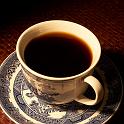
How dare you!” my momma says, her voice high and screeching like a lonely fiddle. “How dare you!” She throws one two three four five coffee cups at me. Percussion smash. Tinkle of white shards on the blue linoleum. We’ll be drinking coffee out of styrofoam for a while, I think. That’s all we have, coffee cup-wise, except for the sixth one, the last thing my daddy drank out of the morning he left, and it’s sitting in the china cabinet in the front room.
She doesn’t aim to hit me, although the fifth cup comes close. It explodes on the floor and a chip dings off my guitar’s gloss. She’s never thrown anything at me before. I watch the way you might watch a television program showing animals doing something you’ve never seen them do.
“How dare you!” my mother says again,. She sinks down in her chair and puts her head in her hands. Her words are muffled as they make their way past the blue sleeves of her workshirt, the one with “Candy” embroidered in red loops on the front pocket. “How dare you put me in that song?”
I don’t answer. She’ll cry for a while, and then she’ll sweep up the pieces, wipe her face with a cool rag, and go to work at the Krave-More Diner, where you can get the finest cup of coffee in this town or any other. I put my guitar in its case, go out the screen door, and head out down the road, raising puffs of red dust puffs around my heels.
It’s morning. Maybe too early to have sprung it on her, when she was still shaking off her dreams. The sky arches over me high and sweet, and I can hear the sighing of mourning doves and the wind in the telephone wires. The air’s cool now, but it’ll heat up later, till you don’t feel much like moving more than your hand on the guitar neck as you sit on the porch swing and try to puzzle out a song or maybe just that chorus that’s been eluding you, chasing it up and down the frets. Back home, my momma’s washing her face. She knows I’m not going far.
I can’t say how I came by my love of honkytonk music. We always listened to classical at my house, enough so I can call up some of the pieces in my mind, the big booming ones that go with the Kansas prairie. But a lot of that stuff’s too tinkly and quick. When you’re driving down the road, the notes fly out the window and bury themselves in the long grass. They don’t stick around and keep you company, the way honkytonk music does.
I taught myself to play on my daddy’s guitar, the only thing he left behind besides that coffee cup. At first my hands were too small and soft to do much more than strum, but they toughened up. I learned to pick fast and easy and the music sounded so lovely, I kept stopping to say to myself, is that me, is that me that’s making those fine sounds?
My name is J.D. Daniels, Jennifer Delilah if you must know, but I go by J.D., the way my daddy did. I don’t mean to make it sound like he’s dead, because he isn’t. My daddy sold insurance and provided for us for eight years. Then a wander itch came on him like a night fever and he packed up his things and left us without a word. Didn’t take him overly far, though. He’s living over in Greensborough with a woman named Amanda who’s cleaned up his act. He doesn’t drink or run around any more, and wears a tie to church every Sunday.
The only present he ever gave me was that guitar, an old steel string no name brand, and I don’t know if the gift was intentional. I came off better than my momma. All she has is a cup.
My momma works at the Krave-More. She brings folks coffee and smiles at them to sweeten up their day. She’s slow to smile, but when she does, it could melt ice from across the room.
I’ll be fourteen next month. Changes coming, my grandma tells me. I know all that stuff. We learned it in health class and there’s no call for her to nod so mysteriously. But I don’t tell her that. She means well by us, and helps out when she can. The house we’re living in belongs to her, and every birthday, she and I dress up in our best and go down to the First Farmers’ Bank and deposit my birthday check in my savings account for college. People ask me what I want to be when I grow up, and I tell them an archaeologist or a country singer or an astrophysicist, but the fact of the matter is that I don’t know. But I pray every night to grow up a good woman like my momma and grandma, and not to be afflicted with a wander itch.
Three months ago I wrote a song. That’s what caused all the trouble. The music teacher, Miss Mopp, told us about a contest sponsored by a radio station in Abilene, Kansas. You wrote a song and sent it in, you singing along with whatever instrument suited your fancy. The radio station would pick the best tape and the winner would come in and record it at their studio. Then they’d make 45 rpm records of it to give away to five hundred lucky souls and play it three times daily on the air.
I thought that sounded pretty easy. I’ve been writing songs ever since I started playing guitar. At first I had a hard time getting them out of my head and into the strings. But I got better. I’d listen in the evenings to the songs on the radio, and I’d fool around until I figured out how so and so got that lonesome sound or how somebody else did that fancy bridge. I’d play a song over fifty, sixty times, until I got it right, but I had to play soft, because my momma hated what I was playing.
“That’s trash music,” she’d snort. “Learn to play something higher tone and I’ll pay for guitar lessons. Better yet, we’ll rent a piano, and you can play all day.”
But by then, I knew enough to play the songs I loved, sad songs that crept out my window and spread across the sky like a million twinkling stars, sorrowful songs about cheating men and hearts worn out with weeping. I could make tears run down my grandma’s cheeks when I played, and there’s no higher tribute she could pay, but my momma stayed dry- eyed.
Miss Mopp let me borrow the school tape recorder. I played three songs, then rewound and listened. My first song was about that coffee cup in our front room and it was so sad it made the soles of my feet itch
But I wasn’t sure. One time I wrote a song about being buried in white roses, because they’re the most romantic things I know. I thought it was a sad song, but my grandma only laughed. Another time I wrote a song about a single candle in the window, and I thought that was a sad song, but my grandma paid it no mind. This song seemed sad, but I couldn’t test it out on my mother, seeing as how she figured in it, which might influence her judgement. My grandma wasn’t handy, and I wanted to turn the song in the next day.
I went ahead and wrote my name, age and school down on a recipe card with a little drawing of jam pots and squash up in the corner, because we didn’t have any index cards. I gave it to Miss Mopp. And then I forgot about it, and that’s the pure and simple truth, until yesterday when Miss Mopp told me I’d won.
I thought my momma would be pleased when I told her the news at breakfast. And she was, at first, until I fetched down my guitar and played that song for her. And that’s when coffee cups started flying through the air.
I walk down the road to my grandma’s house. She’s up and in her kitchen.
“Sit down and play me this prize-winning song,” she says when I get in the doorway. That’s how I know my momma has already called her on the telephone. This is where I go when things get a little hard every now and then. My grandma pours me a glass of milk and puts two chocolate doughnuts on a plate. I sit down, prop my guitar on my knee, and play her that song. She starts crying before the first verse’s halfway through, stands there and dabs at her eyes with her apron when I finish.
“That’s the saddest song I ever heard,” she says. “I can see where it’d fetch a prize or two. But do you understand why your momma’s so upset, J.D. honey?”
I shake my head.
“It’s just a song.”
“But it’s your momma’s song. It’s all her sadness spread out in the air for anyone to hear,” she says, blowing her nose. “And maybe there’s folks she doesn’t want listening.”
I know she’s right. But I wanted to write a song about the saddest thing I knew, and that coffee cup has always qualified.
“It’s my song too,” I say to my grandma. “I live there too.”
My momma doesn’t say anything about the song at dinner. I figure she’ll ignore it, the way she does with things she doesn’t like. She doesn’t say anything at all to me.
Two days later, my grandma drives me into Abilene to the radio station. We figure we’ll record the song in the morning, then have lunch, go visit the Greyhound Hall of Fame and the house Dwight D. Eisenhower was born in. It’s a scorching day by the time we get there, but the radio station, WKNS, your station for Kansas country sound, is air conditioned.
They take me in a room full of fancy dials and buttons. They make me play the song on my guitar, and then they play it back through headphones and I sing along with what I played. I play and sing maybe ten, twelve times before the way it sounds satisfies the man sitting up in the booth drinking coffee. He shakes my hand and congratulates me. His voice is thick and there’s a little bit of water in the corners of his eyes. He says “That’s the saddest song I ever heard. Thanks for letting me listen.”
A secretary gives me papers to sign, which my grandma reads through first, and then a lady DJ takes me in her office to tape an intro. It’s like being inside a big machine, full of toggle switches and dials. She’s got pictures of singers taped up on the walls: Patsy Cline, Kitty Wells, Loretta Lynn.
“Just speak naturally, sugar,” she tells me. She flips a button on her microphone. “So tell me, J.D., how old are you?”
I tell her, and she asks questions like where I go to school and what’s my favorite class and how I learned to play the guitar. Then she says “How did you write that song?”
I take a minute before I answer, “It’s a song about a member of my immediate family, but if you please, I’d rather not say anything more.”
She studies me, and flips the switch off, but she doesn’t ask me any more about the circumstances of the song.
My grandma buys me lunch. We stroll around town and visit the Greyhound Hall of Fame. Eisenhower’s house is closed, so all we do is walk around the outside and look in the windows, which is about as interesting as you’d expect. My grandma gives me a present she’s made, a shirt with “J.D. Daniels: Prizewinning Songwriter” embroidered on the front pocket. I know I’ll never wear it to school, but I like the way it looks, and I thank her. I wrap it up again, carefully, and keep it on my lap as we bounce our way home over dusty roads.
When I get back to our house, nothing’s changed. My momma won’t speak to me much. Meals are awfully quiet. She buys new coffee cups, the same as the old ones. They start playing my song on WKNS, and mail me five of the records. Some of the kids at school tell me they heard my song and say they liked it. But I don’t turn the radio at home to WKNS because I’m afraid if my mother hears what I said on the radio, it’ll make things worse.
Two days later, I come home from school, and there’s my daddy sitting on the front porch. He stands as I come up toward the house. I squint against the sun like I can’t make out who he is.
“Jennifer, is that you?” he says, and before I can nod or shake my head, he picks me up and hugs me tight. I hold myself stiff.
“It’s me, baby, it’s your daddy,” he says and puts me down. I look at him real hard, this being the first chance I’ve had in a number of years, but I don’t say anything. I don’t know what to say.
“I heard your song on the radio,” he says. “That’s the saddest song I’ve ever heard. It touched my heart and showed me how I done wrong by your momma. I’ve come back to the both of you, and you can take that coffee cup out of the cupboard, wash it out, and fill it up again for me.”
That’s a quote from my song, but it sounds different coming from him.
“You’ll have to wait out here till Momma comes home,” I tell him and his face falls, but then he smiles even bigger.
“Tell you what I’m gonna do,” he says, leaning forward and whispering like we were spies in a movie. “I’m gonna go buy your momma some flowers. I’ll be back in half an hour.”
My momma comes home before the dust from his wheels has settled. She sits down at the kitchen table and I pour her a cup of the coffee I have waiting. I don’t know how to say what’s happened. I study on ways to do it. She leans back in her chair and puts her feet up, kicking her shoes clear across the room. She’s still not talking to me much.
He knocks before I get the chance. I follow her to the front door, and there he is on his knees, with a big bunch of red roses. He says, “Candy honey, I’ve come back to you.”
She stares down at him through the wire squares of the screen. I donUt remember his shirt so white, his blue eyes shining, his hair slicked back and shiny. The roses are full open, petals sagging in the heat, sending up a sweet sad smell.
“Jennifer’s song on the radio touched my heart and made me see how I done wrong by you and her.” He smiles up at her. His hair on top is just about gone, and the skin gleams between the strands in the sunlight. He rocks a little, as though the wood under his knees was paining him.
“Does Amanda know you’re here?” she asks.
“Amanda and I, we’re past history,” he says. He smooths his hand through the air. “Water under the bridge.”
She steps back and looks over at me. I shrug, trying to say this wasn’t what I wrote that song for. I wrote it for the sake of writing a song, not so he’d hear it. She shrugs back. He kneels outside in silence, watching us.
My momma looks uncertain at first, but the edges of her mouth quirk up a touch. She turns around, opens the door of the china cupboard, and takes the coffee cup, that goddamned coffee cup, out. I hold my breath.
“I believe you left this last time you were here,” she says as politely as if she were on a commercial, and opens the door enough to hold out the cup. He takes it with a funny grin on his face and starts to speak. My momma closes the door on him and goes back into the kitchen. I follow her. She sits down at the table and adds more coffee to her cup to warm it up. A car door slams outside.
“J.D. honey,” she says to me. “Go get your guitar and play that song for me. I believe I’m feeling more reconciled to it.”