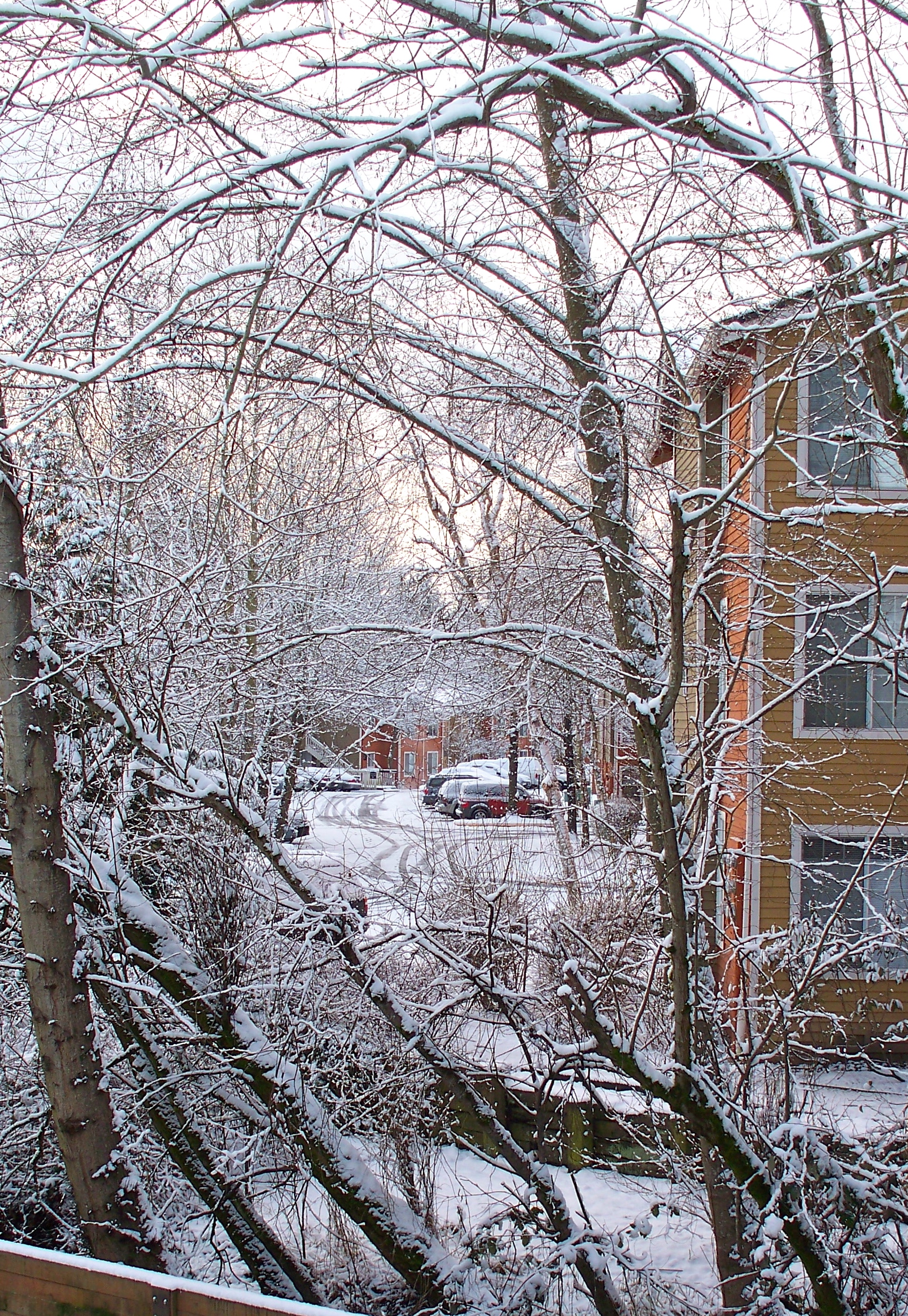
It's not quite the thick coating we see in Northern Indiana, but for Redmond, this is a decent amount of snow.It’s snowy out, the sort of snow I grew up with in Northern Indiana. A clumpy snow, a little wet, so it clings to branches in inch thick lines, making some more snow than branch. Last night I watched it drifting past the light in the parking lot, which illuminated a sphere of falling snow, like an open-air snow globe, the good kind without sparkles or glitter, just evocative white bits that make us think of quiet nights, growing quieter as the snow muffles sound.
Sometimes writers need to stop and look and figure out what makes a scene real, what distinguishes it from one of the many movie backdrops in our heads, so that when we recreate it or take a piece from it or somehow incorporate it into a piece of writing, we can convey that quality. Karen Joy Fowler mentioned that often the most unique detail of a landscape is one of the most transitory: a busker, the shape of a cloud, the noise of the rock concert next door. Right now it’s snow for me. So, I ask you – what’s the most evocative detail of your current landscape?
Want access to a lively community of writers and readers, free writing classes, co-working sessions, special speakers, weekly writing games, random pictures and MORE for as little as $2? Check out Cat’s Patreon campaign.
Want to get some new fiction? Support my Patreon campaign.
"(On the writing F&SF workshop) Wanted to crow and say thanks: the first story I wrote after taking your class was my very first sale. Coincidence? nah….thanks so much."
~K. Richardson
You may also like...
Opinion: When Writers Punch - Up, Down, or Sideways
When a writer publicly calls someone out, they need to be aware of all of the implications, including the fact that the more popular the writer, the more devastating the results can be, not due to any intrinsic quality of the writer, but the number of fans. The more fans, the more likely it is that the group will contain people who, emboldened by the idea of pleasing a favorite writer, can — and will — go to lengths that go far beyond the norms of civil, and sometimes legal, behavior.
As I’ve said earlier, I have a great deal of respect for Baen and hope it emerges from this watershed moment in a way that suits the bigheartedness of its founder. But in the fray, a lot of writers have been egging their followers on to do shitty things in general, and what has emerged include the above specifics.
It’s not okay to point your readers at someone and basically say “make this person miserable.” It is okay to vote with one’s pocketbook. To not buy the books of people you don’t support. That is called a boycott, and it is an established tactic. (One of my consistent practices throughout the years, though, is to read a book by each one before I make that decision, so I know what I might be missing out on. So far, no regrets.) Going beyond that is, in my opinion, is the act of someone who’s gotten carried away and is no longer seeing their target as a fellow human being, and who needs to stop and think what they are doing.
We have witnessed the results of this tactic when it happens in science fiction. Campaigns contacting employers to complain about posts made in someone’s free time, or even when they’re just suspected to be a particular blogger. People feel free to attack economically or via harassment, ignoring collateral damage in the form of their targets’ families. And let’s not forget SWATting or otherwise attempting to use the police against someone.
Someone started a baseless rumor about Sanford having had a book refused by Baen, and assorted unhinged souls have been running with that one in large and frenzied patterns that spell out “it is possible I am projecting” when seen from above, including repeatedly contacting the Ohio News Media Association to demand that Sanford stop beating his wife explain the allegations.
That one’s bizarre to the point of being more comical than serious, but there’s plenty worse, and that’s because of another phenomena. Free-floating online trolls cluster onto these situations like leeches, doing their best to drive people at best to shut down their social media, at worst to what those trolls see as an ultimate victory: suicide. They’re not in it for politics; they’re in it to feed on the festering hatred being stirred up and to use it as a justification for their own behavior.
I am not overstating things, and anyone who thinks that I am might want to go for a remedial course in Common Sense About the Way Shit is in 2021, as opposed to 40 years ago, which would be when I was first floating around on one of the first message boards. In all sorts of senses, I’ve continued to engage with the world rather than letting someone else moderate it for me, and I don’t know that I had a choice in that but have dealt with a lot of bullshit from people trying to up their visibility in one way or another. I’ve been doxxed so many times it’s lost any scare value. I learned to shoot a gun a couple of years ago because of one doofus sicking his followers on me, and in some situations I carry a taser in my bag. Given some of the stuff that’s happened, it’s not an overreaction.
A person should not have to go to these lengths in order to speak their mind; intimidation aimed at silencing someone overall, rather than a particular platform, is the true damage to free speech. I said it before and will say it again (and again and again, I suspect):
What “if you can’t stand the heat, get out of the kitchen,” aka “people who are too weak should avoid this discourse” says is “only certain people get to speak here.” And that’s shitty, no matter how many noble words you try to dress it up with.
In researching my first two pieces about Sanford’s report and the resultant furor, I talked to a number of people who’d been driven off the Baen discussion boards over the course of the last decade. The most prominent being Mercedes Lackey, who was dogpiled on after she suggested, post 9/11, that maybe unmitigated hatred for Muslims wasn’t the best approach. The posts driving her away came not just from the fans on the boards but some of her fellow authors. [I have removed information here that I believe is either in error or incomplete. See the comments for further info. -Cat]
Lackey had a good bit to say on the subject, including an angle I hadn’t thought of, which is that it can be dangerous to your readers to be pointing them at people:
People these days are crazy. Seriously, dangerously crazy. Crazy enough to send SWAT to someone’s house over a video game (and people have died). Crazy enough to track down your boss and try to get you fired. Crazy enough to show up in person and hurt or kill you or someone you love over an online post. Don’t take my word for it, do a news search.
So suppose you unleash your fans on someone who is that crazy. And he doxxes some of them and SWATS them. At the least they have a broken down door and several hours of horror. At the worst, someone is dead. Or maybe he just tracks the harassment to its source and comes after you. And it’s you that gets SWATTED or fired or has the Drug Cops trashing your house looking to put you in jail.
(I snipped a paragraph here with points covered elsewhere in this piece. -Cat)
The very, very, very best answer to that impulse to send your hordes of minions out to do your bidding? Put your enemy in a story. You’ll get revenge, and better yet, get paid for it.
Lackey also pointed me at this excellent essay on tolerance which has, I think, good points about why groups — including communities formed around discussion groups — cannot contain members attacking other members:
We often forget (or ignore) that no right is absolute, because one person’s rights can conflict with another’s. This is why freedom of speech doesn’t protect extortion, and the right to bear arms doesn’t license armed robbery. Nor is this limited to rights involving the state; people can interfere with each other’s rights with no government involved, as when people use harassment to suppress other people’s speech. While both sides of that example say they are “exercising their free speech,” one of them is using their speech to prevent the other’s: these are not equivalent. The balance of rights has the structure of a peace treaty.
Much of the hoorah has led me to re-examine some beliefs just to make sure I wasn’t crazy, most notably my ideas about professionalism. Professionalism is something I’ve always tried to abide by. It involves a certain amount of dignity and detachedness, and it also requires not throwing verbal lumps of shit at people, particularly colleagues. I dunno, is this old-fashioned? It doesn’t mean not calling out bad behavior, it doesn’t mean I don’t often disagree with others. But I treat them with respect, overall, even when it’s hairy dude-bro looming at me to demand why I don’t do something about some matter that I have nothing to do with, because they are fellow human beings and we are all stuck here on spaceship Earth together.
Being a bad passenger and using your fans to attack a fellow voyager is unprofessional. It gets you known for being unpleasant to work with in any form, because there’s always the worry you may turn it on the person the next seat over. You’re the person that has no qualms about waving live grenades; people don’t want to be around when they don’t know where you’re going to throw it, or even if you’re going to accidentally drop it.
Perhaps a lot of the confusion between professionalism and being “authentic” has to do with the relationship between writers and social media, which can feel mandatory at times. Kacen Callendar notes:
It’s dehumanizing that I or any author should be afraid to speak about our dehumanization, about the boundaries we want and need to set for our health, dehumanizing that we should be scared our work won’t be accepted unless we play along with commodifying ourselves.
When you know that any admission of weakness will be used against you by online trolls, that something like the death of a family member or pet will signal a new barrage of harassment playing on that grief, it becomes even more fraught. And those trolls go for the most vulnerable people — any vulnerability is like blood in the water to them. Can you be authentic and armor yourself at the same time? It takes some maneuvering and a certain amount of don’t-give-a-fuck-ery, and not everyone can do it.
Overall, should any writer cry “release the kraken!” and send these folks after a supposed “enemy”? No. No, and no amount of arguing will ever convince me otherwise. Instead, they should learn to be professional perhaps, because in this heated kitchen, we’re working chefs, not home cooks, and should comport ourselves with a little goddamn dignity.
Nattering Social Justice Cook: Celebrating Rainbow Hair
One place recent culture wars have been being played out has been the virtual space occupied by Twitter and its adjacent social media. Examining a particular hashtag or recurring phrase often provides insight into what the topic of the moment is, as well as what tropes and memes are being deployed.
A common adjective in many of the more conservative, alt-right, and other theater-of-outrage rants I’ve seen in the past couple of years is “rainbow-haired,” never in a positive sense. It’s usually paired with some form of “social justice warrior,” and often accompanied by an emotional catch-phrase or verbiage like “feels” or “drinking the tears.” There’s a lot of interesting stuff built into that particular fixation. So let’s dig around to find what’s contained in the phrase and its use in this pejorative sense.
The rainbow itself has plenty going on, symbology-wise. In many mythologies, it’s the bridge between heaven and earth, used by gods, heroes, and shamans. In the Christian allegory of Noah, it’s the sign of God’s covenant with humanity. Leprechauns hide their gold at the rainbow’s foot, Indra uses it for his bow, and in the Australian Dreaming, it adorns the scales of the Rainbow Serpent who created the world. It’s also got a maxim built into it: something positive that cannot appear without something negative happening first. There are no rainbows without rain, at least a little of which must fall into every life.
In 1978, this metaphor for something containing a multitude of variations became associated with gay pride and diversity, through the efforts of artist/drag queen Gilbert Baker, who said of it: “We needed something beautiful, something from us. The rainbow is so perfect because it really fits our diversity in terms of race, gender, ages, all of those things. Plus, it’s a natural flag””it’s from the sky! And even though the rainbow has been used in other ways in vexilography, this use has now far eclipsed any other use that it had.”
And we should not forget Skittles and the slogan “verb the rainbow.”
What happens when it becomes hair color that makes it particularly hate-worthy for dour conservatives? It’s something I’m fairly familiar with, since I started dying my hair with streaks of pink in 2006 when I found Loreal’s Color Rays on a Bartell’s shelf. The dye requires no pre-bleaching; it is alarmingly, wonderfully bright when it first goes on, and fades over the course of the next couple of months. While it only comes in three colors rather the multitudes other lines hold. I have yet to find another dye that lasts as long and well. I’ve tried plenty over the years, including Manic Panic, Ion, Arctic Fox, and Vibes. I wrote at length about the (over a decade-long now) experience in The Pink Hair Manifesto so I’ll avoid saying anything other than it’s something I anticipate continuing to do, particularly since it’s become part of my authorial brand.
Let’s ground the recent phenomenon of chemically-colored hair plumage historically, since it happened a few decades earlier than my decision. Fabulous colors required science to make it possible, but the earliest adopters were the punks, particularly Cyndi Lauper. This was considered pretty shocking; I can remember a girl at my high school dying a small patch of hers blue and having her father threaten to kick her out of the house as a result.
Rainbow hair, rooted in a counter-culture movement, revels in individuality and a certain DIY spirit (there is no shame in going to the salon for it, but I find it much more fun to do my own). It celebrates one’s appearance, draws the eye rather than shrinking away from it. It is something beautiful that those who don’t fit inside normal standards of beauty can have. It is playful, joyful, delightful at times.
Very recently it has spread like wildfire, and many of the people adopting it are millennials. This gives the anti-rainbow hair sentiment a double-whammy, providing an “oh these kids nowadays” moment while slamming anyone older for acting overly young. (Which implies that’s a bad thing, which isn’t a notion I agree with).
Here’s something that I think also often makes conservative minds bristle: it confuses gender norms. In traditional thinking, men aren’t supposed to care about or celebrate their appearance in the way women are. But rainbow hair appears all over the gender spectrum. Pull in the strand of meaning associated with gay pride, and the objectionability quotient increases.
There’s a reason alt-right and other manifestations of conservative trollish rhetoric so often focuses on appearance, on fat-shaming or fuckability or even how a new Ken-doll wears their hair. It’s a reversion to the schoolyard insult, the way insecure children will be cruel to others in order to try to build their internal self-worth, a behavior many, but sadly not all, outgrow. Worthy of an essay in itself is the fact that it’s also behavior advantageous to advertisers: anxious consumers who want to fit in are willing to spend money in the effort.
This strategy of playground taunts based on a) something most people have little control over and b) a rigid set of norms is curious when we go back to the associated ideas of emotion and “feels” (I do want to talk about what additional stuff is built into the latter, but let me return to that in a second.) Emotion is traditionally seen as the domain of women and children; men keep a stiff upper lip and a silent heart of winter. Often emotionality is built into the verbs used to describe speech: shrill, shriek, and scream are favorites.
It would be nice if pointing out the gender and other biases BS built into such language defused it entirely, but certainly it’s easier to keep it from affecting you if you’re aware of it. Life for many non-mainstream groups is a constant course of avoiding the particular lumps of low-level radiation scattered throughout our daily landscape. I’m aware I’ve got some shielding from that denied others.
So what’s built into “feels” beyond that? It’s a denigration of the memespeak and emoticons of the millennials, as far as I can tell, a curious mockery of Tumblr and lolcat culture. And there’s a reason that they fear that group, which is better (IMO) at seeing through the clouds of Internet argument than some of the other generations.
Literally four decades ago, when I was a kid, we saw football player Rosey Grier singing that it was all right to feel things:
Which leads me to my conclusion, which is that it seems like an ineffective and overly dour point to hammer on. Overall, I can’t read any of the negatives being packed into rainbow-haired as actual negatives. Celebrate the rainbow connection, I say, and close accordingly with that.
Who said that wishes would be heard and answered when wished on the morning star?
Someone thought of that and someone believed it.
Look what it’s done so far.
What’s so amazing that keeps us stargazing and what do we think we might see?
Someday we’ll find it, the rainbow connection.
The lovers, the dreamers and me.
One Response
A songbird and a bluejay conducting a contest outside my window. 😀
Ah, such snow. I guess we had ours three-ish weeks ago. Yesterday I laid out sunbathing. Go figure.
Best!