So I read a great piece of flash fiction a few months back, in a world where children stepping on cracks really does break their mothers' backs and so the big struggle for women is whether or not to bear children, knowing that they may well end up crippled by it eventually. Does anyone remember this piece and remember the title or author?
Want access to a lively community of writers and readers, free writing classes, co-working sessions, special speakers, weekly writing games, random pictures and MORE for as little as $2? Check out Cat’s Patreon campaign.
Want to get some new fiction? Support my Patreon campaign.
"(On the writing F&SF workshop) Wanted to crow and say thanks: the first story I wrote after taking your class was my very first sale. Coincidence? nah….thanks so much."
The Wizard Niccolo was not happy. At the age of 183 — youthful for a wizard, but improbable for an ordinary human — he had thought certain things well out of his life. Sudden changes in his daily routine were one. And romance was another ““ even if it was his familiar’s romance, and not his own.
“Could make an omelet with it, I suppose,” he grumbled to his familiar, the tiny dragon Olivia. She sat on the cluttered mantle, wrapped around her egg, still marveling at its production and entirely too pleased with herself. A pair of alabaster candelabra sheltered her in a thicket of gilt spirals, and a stuffed salmon, labeled “First Prize ““ Thornstone Village Centennial Celebration,” regarded her with a sour gaze.
“Master,” she said, blinking luminous eyes. “Have I not served you well?”
“For the most part,” he admitted.
She stayed silent and after a pause, he said, “Yes, invariably, Olivia. But who will hold your loyalty, that egg or I?”
“Both,” she said and stoked her scaled cheek along the egg’s smooth surface. “But I will never value it higher than my service to you.”
Wizards’ familiars are unnatural creatures. Some are much like any other animal: a cat, perhaps, with black fur, a droop-winged crow, or a snake with emerald scales. Others look less innocuous and more fantastical ““ homunculi and tiny, perfect dragons like Olivia, or shaggy-warted mandrake plants. Given this, it is surprising that two of them managed to have compatible body parts, let alone produce an offspring. And yet, three months after a purely platonic sojourn of Niccolo with a sorceress whose library was vast enough to entice all sorts of other mages to her door, this had happened. Niccolo had been researching how the gods manifested themselves, and the library tomes had been unfamiliar enough to hold all his attention. Enrapt in ancient texts, he had overlooked Olivia’s activities.
Niccolo scowled at her. “Do you intend to make a habit of this?” he demanded.
“Oh, I don’t know,” Olivia said absently. “I didn’t like the last part, the laying. The getting ready to lay, though”¦”
Niccolo put up his hand. “I do not want to know.” He turned away. “How long till it hatches?”
“I don’t know,” Olivia said. “I’ve never done this.” She crooned deep in her throat, an unsettling noise Niccolo had never heard her make before.
Grumbling, he stalked out. It’s probably not even viable, he thought. How long would Olivia fool herself into believing it would hatch? When he had created her, coaxing her winged form from a malachite shard, a bit of bone and a lizard’s scale, he had endowed her with a sardonic wit and a capability for banter ““ requisites for any wizard’s familiar. But he had always prided himself that Olivia was smarter than most. Smarter than this deluded maternal ambition would seem to indicate.
Had he erred when making her? Familiars were repositories for wizards’ emotions, one of the means by which they stripped away their humanity and became immortal. Perhaps he’d put too much in her, though. He considered thoughts of a new familiar, but reluctantly. At times, when Olivia rested on his shoulder or curled in his lap, he felt the struggle of his emotions, the desire to pet her like a cat warring with a shrinking away, a don’t-touch-me shudder. He was still young for a wizard, still trying to learn what magic meant. Still trying to become more than human.
He sighed. After a few months, he’d try to get Olivia to see reason and abandon her effort.
***
Three months later, Olivia still spent most waking hours curled around her egg, drowsy contentment evident in the set of her wings. Niccolo had resigned himself to her absent-mindedness. He had been working on a set of experiments involving aqua vitae and a supposed phoenix feather, coaxing bits of down away from the shaft. He hoped to evoke fiery gold, but so far all he had was soggy fluff.
He looked up from the alembic on his worktable as Olivia chirped.
“I’ve told you before, don’t make noises while I’m”¦” he began, but she ignored him.
“It’s hatching! It’s hatching!” She unwrapped herself, backed away from the egg, eying it. “What do I do?”
“It’s your egg!”
“I’ve never done this before!”
They both gazed in fascination as the egg wobbled.
“Should I get some hot water?” Niccolo said.
“What are you planning on doing, cooking it?”
“They always seem to fetch hot water for babies.”
The egg rocked back and forth as its occupant shifted.
“Maybe it can’t get out,” Olivia worried. “Should I help it?”
“Give it time,” Niccolo said.
They stared as though mesmerized. The egg tipped, tottered”¦toppled from the mantelpiece. Olivia shrieked even as Niccolo dove for it, his heart almost stopping.
The egg shattered in his hands and what he held there almost made him drop it. For an instant he thought it dead. Then the tiny lizard mewled and Olivia’s wings were fluttering in his face even as he tried to set the infant down. Chaos reigned for a moment before Olivia was curled around her offspring while Niccolo crouched on his knees, ignoring the arthritic twinges.
The baby was, despite all of Niccolo’s thoughts about mutants and monstrosities, perfect. Like Olivia, it was a miniature dragon’s form, with frilled, lacey wings that stretched out now, trembling, to dry. Glistening amniotic fluid hung in thick strands from them.
Niccolo took a damp cloth and tenderly cleaned the wings as Olivia fussed and twined around his hands.
“You did well, Olivia,” he admitted, looking down at her child. “You did well.”
***
Almost all wizards have hobbies, and they refuse to taint these grand obsessions with magic. Niccolo’s was fishing. He knew every trout stream in the forest surrounding his retreat, and his favorite was an unnamed brook that chuckled its way through beech groves and sandy sloughs, past a stand of willows whose roots had gnawed away at the bank, creating holes and riddles where trout might lurk in the hot afternoons, waiting for evening. A fallen tree formed a bench where Niccolo could sit, his creel beside him, lined with fresh moss and ready to hold his catch.
He threaded his rod and attached a caddis fly lure Olivia had helped him create. He wasn’t sure that using her to assist didn’t count as magic, but his fingers shook, and she was still as deft and nimble-clawed as when he had first created her almost a century ago. The lure’s underbelly was yellow as daffodils and its wings were bits of brown feather. Deep in its guts was the hook, barbed to catch hold of a trout’s tender mouth and let Niccolo coax it ashore.
Hours passed as he cast and drowsed, waiting with the patience only a fisherman knows. A few times he felt the tentative twitch of the hook and paused but the trout were wary and skittish that day. With the coming of dusk, he knew, though, they would grow hungry and strike hard at the insects lighting on the water, his lure whirling among them.
His purpose was not to catch fish, but to think. He contemplated Olivia. Every wizard needs a familiar, like a second voice speaking the things that she or he has left behind, the barbs and commonplace facts of life that a wizard tries to divest themselves of in the quest for immortality.
Familiars were like second souls, advice you could trust. You could make a familiar, as Niccolo had, and place bits of yourself in it, but it was hard. Few had accomplished it, and most wizards relied on familiars already fit to speak. Ravens were popular, and a line of talking cats in Loudontown had furnished familiars for the wizards’ school there for decades.
Talking. That was what distinguished familiars from most animals, aside from various prophetic creatures. It worried Niccolo that the offspring, which Olivia had named Hrist, had yet to speak. Was it possible that unlike its parents ““ it lacked intelligence? As the months passed, he had watched it, trying to determine what was passing through its mind. It seemed to respond to words, to “no” and “dinner” and such, but after all ““ a well-trained hound might do as much. Had Hrist lapsed to an animal’s natural state, lacking the spark that his parents had possessed?
Olivia rejected this notion when Niccolo proposed it to her that night over a dinner of fresh-caught trout and bread from the nearby village.
“Hrist is as smart as you or I,” she said indignantly. “Perhaps even more so, in your case.” She looked over at Hrist.
By now, the winged lizard extended six inches from snout to tail, half his mother’s size. He lay on the windowsill in the sun, regarding his reflection in the dust-flecked glass with a placid gaze.
“Indeed,” Niccolo said dubiously.
Hrist swiveled his head, looked Niccolo in the eye, and nodded once.
Niccolo blinked, astonished.
“If he can understand us, why can’t he reply, Olivia?” he said.
Olivia’s tail swished. “He can’t talk,” she said.
“You and his father both have fully formed ““ perhaps even more so, in your case ““ vocal apparati. There’s no reason why he shouldn’t.”
Of course, there was no reason why Hrist should exist in the first place, Niccolo thought, but Olivia would become even more furious if he said that.
And Hrist was, Niccolo admitted, a charming little creature. He loved to hunt and would spend hours in the vegetable garden, haunting the zucchini and pepper plants in order to eat squash vine borers and yellow and black striped cucumber beetles.
As the little dragon grew, Niccolo worked at teaching Hrist how to write instead. The dragonling quickly learned, using his long tail much like an ink pen, dipping it with a sinuous twist in the inkwell and employing the pointed tip to scrawl on parchment. He shared his mother’s quick and sometimes sardonic wit, but his observations were written out in a meticulous, careful hand.
He took to reading like a duck to water, and Niccolo would find him draped over a volume, carefully scanning the words and turning the pages with his flexible, almost prehensile tail.
“I don’t know why I can’t talk,” he wrote when Niccolo questioned him. “I try to speak and nothing comes out but air.”
He could make noises, the hisses and chirps and rumbles that Olivia regularly engaged in, which comforted Niccolo somewhat. But try as he might, he could not give his familiar’s child a voice.
“What will he do?” Olivia worried. “No wizard will take him on as a familiar if he can’t talk.”
“You don’t know that for sure,” Niccolo argued, but in his heart he knew that Olivia was right. Wizards were proud. No one would want a defective familiar. Familiars were reflections of one’s heart and soul.
Still, he would try.
***
Niccolo consulted one of the few non-human wizards he knew. Most of the magic users he was acquainted with shunned Slith, a wyvern’s child whose scales, slit eyes, and sinuous, boneless grace unnerved them. His tower, perched halfway up a volcano, was rarely visited and as Niccolo ascended the mountainside, he wondered whether Slith blamed his race or his location for his isolation.
Slith listened, his golden eyes considering, as Niccolo described Hrist’s condition, concluding, “How will any wizard take him as a familiar? He’s defective!”
“Have you ever thought,” Slith said, “that your problem may be your solution?”
Niccolo looked, puzzled, at the other wizard and Slith’s eyes took on a self-congratulatory gleam. Wizards love riddle games, and confounding another wizard was a rare prize in that competition.
“A familiar’s powers develop in response to their wizard,” Slith said. He nodded towards his own familiar, a lop-eared, brindled tomcat named Slasher.
Slasher yawned and said, “It’s true. Before I became a familiar, I couldn’t talk.”
“Truly?” Niccolo said. He was not well-versed in familiar lore. Most wizards weren’t, but rather took their familiar for granted, a tool like an athame or a well-crafted amulet.
“Truly,” Slith said. “Find the right wizard and the problem will no longer be a problem.”
***
“Get the house ready,” Niccolo told Olivia. “We’re going to take on an apprentice.”
She gaped. “But Master, you don’t like apprentices! You’ve always said they were more trouble than they were worth!”
Hrist was outside, chasing bumblebees, so Niccolo spoke freely. “Yes, but what do apprentices grow up to become?”
Olivia was quick-witted as ever. “Wizards! You think that one of them will”¦”
“Perhaps,” Niccolo said. “Don’t get your hopes up too much, Olivia.”
“How will you get them here?”
Niccolo tapped the thick envelope on his desk, which had arrived that morning. “I’ve offered to instruct them in hydromancy,” he said. “I knew the College had no one specializing in it. It’s obscure enough that the Dean couldn’t justify the expense, but I’ve agreed to allow myself to be hired, for a small fee, to instruct them. Each will arrive, spend one month learning its basics and then depart. Sooner or later, the right one will arrive for Hrist.”
Olivia’s eyes held admiration, and Niccolo allowed himself to run a fingertip along the smooth skin of her sides in an almost-caress. Surely, Niccolo thought, there was no harm in the trace of affection he felt. Wasn’t that the basis of sympathetic magic, after all, a fondness of one thing for another?
***
The first apprentice was Albert. He had red hair that stuck out like a ransacked haystack and bright, merry blue eyes. Hrist hated him on sight, and Albert bore out the little familiar’s judgement in full measure.
Niccolo, unfortunately, liked him. The apprentice reminded him of Olivia in the quickness of his quips, the slight barb to his wit. Much like Niccolo had been at his age, before he put away that side of him to focus on magic. Albert’s pranks amused Niccolo more than he wanted to admit, despite Olivia’s exasperation with household upsets, with salt in the sugar bowl and spiders in the tea.
Albert sensed Niccolo’s mood, and his pranks expanded exponentially, knowing that punishment would not fall on him. Albert went so far as to involve the elderly wizard as a conspirator at times, much to Olivia’s fury, since she or Hrist were the target.
And then one day as Niccolo and Albert were working out the Seven Aquatic Principles, Albert said, “I have a fine idea for a prank on the Dean of Loudontown.”
“What’s that?” Niccolo asked, intrigued. The Dean was a stiff and formal woman, and Niccolo found the thought of her discomfited in some way an appealing one.
“We’ll ship Hrist to her and say that he’s under a curse, that’s why he doesn’t talk. Either the Dean will try to lift it herself or she’ll set it to someone as a test.” Albert laughed. “Imagine how much time they’ll spend on the runt, thinking they can fix him!”
“Hrist”¦is not broken,” Niccolo said slowly.
Albert didn’t catch the warning undertone in his teacher’s voice. He continued, “Might as well use him for something, he’s useless for much else besides catching spiders.” He laughed.
“Pack your things,” Niccolo said. “You’re going back to Loudontown. And if you want to be a wizard, Albert, you’ll put away this sense of humor. When you have a familiar that you can store it in, you’ll understand.”
And so, bewildered, Albert departed to play his tricks elsewhere.
***
The second apprentice was Chloe. Niccolo had to admit, he was pulling for her as well. She was clear-eyed and grave, and wore her pale hair tightly knotted atop her head. She played chess well, and she and Hrist would sit for hours over the chessboard, the dragonling studying the pieces from a higher vantage point before fluttering down to move a pawn or bishop with his tail.
And yet, once Chloe had finished her studies with Niccolo, she came to him and said, “I do not want Hrist as a familiar.”
Niccolo found himself awash in denials . “I didn’t”¦I mean, we weren’t intending”¦”
Chloe’s eyes were remote. “You want to find him a wizard. I picked up that much. After that it was simply a matter of thinking why a wizard who had never shown any previous interest in teaching would have suddenly acquired it. It’s very kind of you.”
He was not sure whether or not the words were a compliment.
But Chloe was young enough that they were the praise they seemed ““ though she might not think the same in another century or two. She smiled at him.
“Have you ever thought,” she asked, “that Hrist might find some path other than familiar?”
“I had,” Niccolo said. “More than once. But Olivia has her heart set on it ““ she doesn’t want him to become “˜some ordinary pet,’ she said.
“A chess-playing dragonling whose penmanship is as good as any monk’s?” she said. “I do not think anyone will ever consider Hrist ordinary.” She smiled again and Niccolo decided it was a good thing that she was moving on, perhaps. Chloe made him think of altogether too many human things, and that would be good for neither of them.
***
The third apprentice was Ibbi, who had a rounded face and the merest intimation of fuzz on his cheeks.
He was a disaster. He arrived with the bottle of brandy the Dean had sent to Niccolo shattered and dripping through his luggage, which retained the smell of expensive alcohol for weeks. He broke three plates, a mug, and Olivia’s favorite candlestick washing up the first night. Things went downhill from there. He could not master the simplest cantrip that Niccolo set him, his pronunciation of Latin was atrocious, and his fingers seemed all disjointed thumbs.
Hrist adored him. And so, despite misgivings, Niccolo let him stay and be taught. And at the end of a month, when Ibbi had failed to learn even the simplest water-based charm, Niccolo lied to the Dean and said that Ibbi was doing so well that he intended to keep him an extra month, continuing through till Samhain.
Privately, he thought perhaps a clumsy wizard and a defective familiar might fit well together. Perhaps Hrist could give Ibbi the assurance he needed. And Ibbi”¦well, Hrist needed a voice.
But the days went by, and Ibbi showed no signs of improving, or of bonding with Hrist.
Samhain was celebrated in the nearby village, and when Niccolo went there a few days before it, he saw the preparations underway: festoons of ivy disguising the doorways, plump jack-o-lanterns set to illuminate the square, wood piled for the holiday’s bonfire. When he mentioned it at home, Olivia clamored to attend, while Ibbi’s eyes sparked with enthusiasm. Even Hrist seemed intrigued, asking question after question on a parchment scroll as Ibbi tried to answer.
“Why is this celebrated?” Hrist wrote.
Ibbi stammered, “It’s when the veil between worlds is torn. Barriers drop on Samhain.”
“Barriers?” Hrist wrote the word in a single twist and flick of his tail.
“Barriers,” Niccolo said. “Things are thinner on Samhain. Things disguise themselves as each other, and alliances that might not be made on other nights are enabled.”
“The God of the Darkest Night, Cerunnos, appears,” Olivia said. “He will grant one boon. But no one ever asks.”
“Why?” Ibbi said.
“Have you learned nothing? Because gods twist wishes,” Niccolo said. “It takes a well-trained mind to construct a wish that a god can’t weasel out of. They split hairs finer than any lawyer. So the god appears and blesses the participants, and then we are done.”
Ibbi gave him an uncertain look. Increasingly he was nervous in the older wizard’s presence, as though he sensed Niccolo’s growing disappointment with his performance. Niccolo felt a surge of compassion and for once did not try to battle it back.
“We’ll all go for the bonfire,” he said. “You will need a costume, Ibbi. Samhain is a day for pretending to be something other than you are.”
“Will you wear one as well, Master?” Olivia asked.
Niccolo snorted, but Olivia was not to be deterred.
“You’ll make the villagers uneasy unless you do,” she said. “I’ll find something.”
***
Early on Samhain eve, Olivia presented Niccolo with his costume. He snorted once again, but put on the dress and wig. She had chosen to clothe him as a tavern maid, and he thought irritably that if he could still feel the emotion of embarrassment, he would have objected. But Samhain was a day for fools and opposites, and he would play along, for her sake and that of Hrist and Ibbi. Olivia had clearly taken care with his costume. The dress was snug, but he could fit in it, along with a false bosom. He drew the line at the cosmetics she had somehow procured and laid out. He made an ugly woman, he thought, looking in the mirror, but that was mostly the beard.
Olivia had outdone herself, though, with Hrist and Ibbi. Ibbi wore a scaly cloak, and green mask, while Hrist simply wore a tiny wizard’s hat and clutched a matchstick wand.
“You’ve disguised them as each other!” Niccolo realized, and Olivia nodded, looking smug. She had chosen to drape herself with beads and jewelry till she was simply a glittering heap.
“What are you?” Niccolo asked.
Olivia peered out from between the links of a tarnished golden chain. “A dragon’s treasure horde!” she announced. “Can’t you tell?”
Despite himself, Niccolo laughed.
***
Cheerfulness continued to buoy him, despite his best efforts to dampen it, as they made their way to the village. Niccolo was not the only person to have chosen a costume that depended on gender. Several other men minced about in dresses even more gaudily decorated than his, and the owners of the local tavern, the Greasy Eel, wore gentlemen’s dress coats and buckled breeches.
Usually the villagers were standoffish (except when making their way to his cottage to ask for luck charms or philters to ward off disease) and Niccolo was pleased to note that his costume dissolved some of the usual social ice. Olivia rode his shoulder, jingling and jangling like a paste and brilliants brooch, and Hrist stayed curled around Ibbi’s neck, occasionally jabbing his ear with the point of his cap.
As the darkness grew and the bonfire blazed, as the mugs of cider were passed around with potatoes roasted in the embers, Niccolo fought to keep from enjoying himself. Instead, he watched Hrist, whose presence fascinated the village children. One held Hrist in his hands, holding him up to admire him in the firelight and the little lizard permitted it, his mother looking fondly on from Niccolo’s shoulder.
“Master?” she whispered in his ear. “Master, you can construct wishes. You are a well-learned man. Could you not ask Cerunnos that my child be given a voice?”
“Don’t be ridiculous, Olivia!” Niccolo snapped. “I thought you claimed you would not put the egg before me, and now you’re asking that I meddle with a god on its behalf? Have you no concern for my well-being? I am a poor enough wizard as it is, letting emotions sway me as I have!”
“But”¦” She subsided into silence as he scowled at her.
“We will hear no more of this,” he said.
In the fire’s dancing light, her eyes glittered like the jewels in her costume, but he could not read the emotion there.
At midnight, the crowd gathered around the fire, and masks were doffed. Niccolo took off his wig, sticking it under his arm. Ibbi stood beside him, having reclaimed Hrist from the reluctant children.
The faces across the fire were horns and feathers, slips of skin and eager eyes that stared, like Niccolo and his tiny group, into the heart of the fire, waiting for the God.
He grew so slowly from the flames that no one knew when he arrived. Great curling ram’s horns, dripping with ash and fire, sat his shoulders. His cloak was night, and its lining gleamed with subdued stars.
He did not speak, but looked about the circle, waiting. There was resignation in his shoulders. Niccolo wondered how long it had been since anyone ignored the thousand cautionary tales and asked the god for a boon.
And then, from his shoulder, impossibly, Olivia spoke.
“Cerunnos, hear my plea!”
“No,” Niccolo said, and grabbed at her with panicked fingers, but all he caught was a netting of gilt and rhinestone, and she was hovering in the air before that patrician figure. “Olivia, no!”
The god gestured, and Niccolo could no longer speak. The massive face, still as a statue, listened.
“My child”¦and my master,” Olivia said. “Let them be what they want, what they aspire to! Grant me this, Cerunnos!”
Fire coursed through Niccolo, chasing away the panic.
The god considered, spoke. “No matter the price?”
“No matter the price,” Olivia said, and Niccolo knew she was doomed. He was being pulled into the fire, with Hrist, and somehow Ibbi, the three of them among the flames but not burning. He glimpsed Hrist, the doll-sized wizard’s hat askew, clinging to Ibbi, and hope surged in him before he was pulled inside the shadow of Cerunnos’ cloak, and darkness overtook him.
***
After the god had gone away, after the villagers had scattered, as the dawn began to glimmer over the forest like an uncertain plea, Niccolo raised his head and spoke to Ibbi and Hrist beside the smoldering ashes of the fire.
“Well?” he said. His words were rough. In his hands was Olivia’s body, broken by the magic that had surged through her in answer to her prayer.
Ibbi and Hrist stared at each other. Then Hrist spoke. “I can speak. But I am still not a familiar,” the little lizard said.
“No.” Ibbi stretched out his hand and suddenly laughed. “But I am no longer a wizard.”
“What?” Niccolo said, trying to understand.
They turned to look at him in eerie unison. Olivia was heavy in his hands.
“I am a familiar,” Ibbi said, and looked at Hrist.
“And I the wizard,” Hrist said. “You will bear the sorrow for me, Ibbi.”
So Ibbi wept obediently as Niccolo and Hrist buried Olivia’s tiny form in the garden, between the rows where Hrist had hunted flies and pill bugs in the summer sun. They placed her finery beneath her, as though she were in truth what she resembled, a dragon curled on a horde of gems and coins and precious metal and a caddis fly lure. She lay with her snout laid atop her paws, eyes closed and tail curled about her as they took handfuls of dirt and closed her into the earth’s darkness.
Ibbi wept.
But Hrist and Niccolo were true wizards now, and they felt nothing at all.
The End
Enjoyed this story? My Patreon supporters will be getting a fresh one, starring another familiar, this time in 1890s Baltimore in the steampunk world of Altered America. Want to get the same private look they do? Sign up to support me!
Patreon Post: Laurel Finch, Laurel Finch, Where Do You Wander?
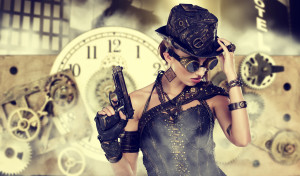
If you’d like some NaNoWriMo inspiration, check out my Character Building Workshop, which features writing exercises tailored to fit in with your current projects.Happy Monday to everyone. Here’s a piece of fiction for you, “Laurel Finch, Laurel Finch, Where Do You Wander?” It’s steampunk, and it fits into the world I think of as Altered America, a steampunk setting where one of the pivotal events, referenced in this story, is Abraham Lincoln deciding to use zombies in the Civil War.
Other pieces of this world are shown in Rappacini’s Crow, Her Windowed Eyes, Her Chambered Heart, and Snakes on a Train. At some point this will become a novel — you may notice characters are converging on Seattle, where most of the action will take place, and I’ve got some stories in the works, most notably a novella, “Blue Train Blues,” about a high stakes race between car and train across a landscape plagued with vampires.
Jemina noticed the Very Small Person the moment the little girl entered the train. The child paused in the doorway to survey the car before glancing down at her ticket and then at the other half of the hard wooden bench, high-backed, its shellac peeling, that Jemina sat on. Jemina tucked the macrame bag beside her in with her elbow.
The child was one of the last passengers on, which was why Jemina had been hoping against hope to have the bench to herself, at least for part of the two day trip to Kansas City. The train began to roll forward, a hoot of steam from the engine, a bell clang from the caboose at the back of the train, the rumble underfoot making the little blonde girl pick her way with extra caution, balancing the small black suitcase in one hand against the pillowy cloth bag in the other.
She arrived mid-car beside Jemina and nodded at her as she struggled briefly to hoist her suitcase up before the elderly man across the aisle did it for her. She plumped the cloth bag in the corner between sidearm and back and sat down with a little noise of delight as she looked around. Catching herself at the noise, she blushed, fixed her gaze sternly forward as she folded her hands in her lap, and peeped at Jemina sidelong.
Jemina tried to imagine how she might appear. She knew herself thin but nicely dressed and pale-skinned. The lace at her throat was Bruges, the cross around her neck gold, the gloves on her hands white and clean. She looked like a school-teacher, she imagined, but not a particularly nice one. She felt her lips thin further at the thought.
The child, interpreting the flattening of Jemina’s mouth for disapproval, fished in her bag and took out a small black bound Bible. She opened it to the first page.
“Oh, it’s all right,” Jemina said. Her boldness surprised her, but this was a child, after all. “I’m Jemina Iarainn and I’m a scientist, headed to work at the War Institute in Seattle. Who are you are and where are you going?”
The smile bestowed on her could have lit a room. The Bible slid back into the bag. “Oh thank goodness! I’m Laurel Finch and this is my very first train ride ever, up to Seattle too, and I was hoping I’d have an agreeable companion on my voyage.”
She stumbled over the solemnity in the last words. Jemina said, “Trips are much, much nicer with someone to talk to. Where are you going in Seattle? To visit relatives?”
“To the Soldiers’ Orphans’ Home there,” Laurel said, and her mouth drooped before she summoned her smile again. “I’ve been staying with my uncle for the last three years but he is traveling to China as an ambassador. It’s all right, he’ll come back for me, but in the meantime I’m to live there for a few years.”
“Seattle is very nice,” Jemina said. Her mind raced along the years before this child, living among orphans with no chance of adoption herself. Bleak, as bleak as any of Jemina’s childhood years. “You will meet Princess Angeline, Chief Seattle’s daughter. She lives down near the market and is a real Indian princess.”
“Do you know Seattle well?”
Jemina shook her head, then nodded. “My twin sister is out there already and she has been writing me long letters.”
“Is she also a scientist?”
“She writes for the newspaper.”
“Oh! Like Nellie Bly!” Laurel clapped her hands and Jemina sighed internally. A daredevil reporter was more exciting than a scientist, but she was the one constructing giant killing war machines, after all, even though she was not at liberty to talk about any of that.
The train was rattling along steadily by now, the countryside rolling past the windows as they left Baltimore behind. Someone towards the back of the car broke out a pipe, blue smoke creeping up to hang near the wooden ceiling, painted red with tiny stars speckled along it in a single long stripe. It was officially late morning now, and Jemina wished she’d been able to bring her tea with her.
“Have you always lived in Baltimore?” she asked Laurel.
The child nodded. “What about you?”
“I grew up in Connecticut, but I came to study at Johns Hopkins here.”
“Were you there during the last war?”
Only three years back now, the great War between the States, which might have gone so differently if not for Lincoln’s decision to treat with the Emperor of Haiti, to bring over necromancers who raised the dead, no matter which color of uniform they wore, to fight on the Northern side. And now they were at war with Europe and the alien forces that had appeared in those countries, the fairies, werewolves, and vampires.
“I was there and actually helped with the effort,” Jemina said, trying not to puff up a little. She had worked side by side by the necromancers, learning as much as she could, pulling that knowledge into her own studies. It was why she was headed to the War Institute there now. The last scientist-necromancer, McCormick, had died on a train like this one six months earlier. Jemina thought she would make it, but who knew? She played on a bigger game board than she ever had before.
To her disappointment, Laurel didn’t ask what she’d done for the war. She realized that the child’s parents must have died due to some military action. No wonder she didn’t want to talk about it.
“I have a book,” Laurel said. “Other than the Bible, I mean. Will you read it to me?”
“Surely you are old enough to read?”
Laurel sat up straight. “Of course I am!” She let herself relax. “But sometimes it’s nice to hear it read and that way we can both enjoy it.”
“What’s the book?”
Laurel fished in her bag. “Alice’s Adventures in Wonderland.”
***
As the train made its way along, they voyaged through the book, occasionally pausing to talk about its contents. Laurel confessed to missing the kitten she had left at her uncle’s, which she had named Abraham Lincoln after the President. Her uncle’s landlady had taken Abraham Lincoln, and had promised to write about his adventures.
At this point, Laurel’s lip quivered to the point where Jemina hastened to tell stories of the entirely fictitious six kittens her own equally fictitious landlady had been hosting. In truth, Jemina had been living in the grey buildings of the East Coast’s War Institute, and was not particularly looking forward to their counterpart on the West Coast. The Institute had promised her a handsome wage and an actual house to live in, though, near the campus where she’d be working.
Around noon, Jemina’s stomach growled.
“I am going to the dining car,” she said.
“Oh. Have sandwiches. My uncle’s landlady made them for me. They’re not very nice,” Laurel said with more honesty than tact.
“My treat,” Jemina said.
She watched with amusement as Laurel worked her way through fried chicken, mashed potatoes, biscuits, and two helpings of apple pie chased down with a tumbler of milk. She ate tea and toast herself, the teabag left steeping in the hot water till it was tannin bitter, dark as oak-lemonade, and every sip sent caffeine singing through her nerves. It didn’t matter if she indulged in stimulants here on the train; she wouldn’t be able to sleep anyhow, only doze for four days till her destination.
“My cousin,” Laurel announced as she mopped milk from her upper lip, “said many of these trains get attacked by werewolves.”
“My cousin,” Jemina said, leaning forward, “who is a Pinkerton agent, said that the kind of werewolves that attack these trains are very different than the kind that live in England.”
The conversation had obviously not gone in the direction that Laurel had expected. She eyed Jemina. “How are they different?”
“They are shapeshifters, who can take on a number of different forms, wolves being only one of them.”
Worry flashed on Laurel’s face. “So someone here could be a werewolf?” she asked, looking around at the other diners.
“Probably not,” Jemina said. “These cars are warded with silver.” She indicated the top of the window. “See the little star? That’s real silver and keeps out negative magics.”
“You mean evil?”
Jemina shook her head. “There’s not really such a thing as good and evil. There is, though, positive and negative. Negative magic drains things.”
“What were the zombie soldiers that won the war?” Laurel said.
This was not territory in which Jemina had thought to wander, or which she found particularly hospitable. “It depends on which side you were on,” she said.
Her mind flashed: a zombie hand, pale nailed and blunt, groping out from the iron cage where it had been confined, in an early war experiment before they’d learned to tame them.
She shoved the thought away before it went anyplace worse.
“Do you ever take off your gloves?” Laurel asked.
The directness of the question startled her. “No. I have a skin condition that I prefer to keep masked.”
“Are you sick?”
“No!” she said, more sharply than she meant to. The teapot was silverplate, some of the luster worn away by use. She poured more tea into her cup and drizzled in cream, the white devoured by the darker liquid.
They ate in silence.
Finally, pushing back her plate and crossing knife and fork atop it, Jemina looked to the window as Laurel ate the last bite of pie. Outside were plains, great seas of long grass tipped with the purple fuzz of seeds, shifting in the afternoon light to ripple in undulating waves that ran away to the edges of the horizon. Far above in the relentlessly blue sky, a hawk hovered on outspread wings, dipping down, then riding an updraft higher, again and again, in great swings like a broken pendulum.
The waiter appeared at her elbow.
“Everything to your satisfaction, ma’am?” He was an older, wool-headed man, eyes deferential but solicitous of Laurel as he removed her plate. Jemina smiled at him and shook her head.
She folded her napkin in a neat quadrangle before rising and holding out a hand to Laurel.
“Shall we go back?”
***
Each time they stepped on the swaying platform between the cars, Laurel paused. Jemina couldn’t blame her. There was an exhilaration to the wind’s buffet, the swing underfoot, the wild landscape flashing past.
They stopped outright on the last platform before their car. Laurel clenched the railing, shoulder-height for her, with both hands and looked out. Her hair lashed in the wind like a Medusa’s tangle.
“Will we see Indians?” she said.
“Quite probably”
“And buffalo?”
“Undoubtedly.” Jemina had, as was her way, researched the trip well before embarking on it. She knew the distances between cities, and had the route plotted out on the map of the United States that hung in her head, colored with elementary school dyes, unfaded over the years. Accounts of life in the West were plentiful, and she’d read enough of them to think she’d gleaned at least a few truths amid the wild lies and tall tales.
Laurel took a deep breath of the prairie air, sweet grass mingled with coal smoke, before reluctantly moving to the door.
Jemina stepped after her. They nearly collided with the passenger coming out, who divided an oleaginous smile between them. He was dressed in the Western style, with high-heeled boots elaborately tooled and set with silver spurs, and the tuft of lace at his untanned neck, a dandy’s puff, set Jemina instantly against him and his slicked-back ebony hair, his thin line of a moustache.
She’d seen his kind during the experiments: wealthy merchants come to examine the way Lincoln proposed to win the war, aided by his Haitian allies, lending him their knowledge in order to keep their country from American meddling somewhere down the line. Men who examined the horrific with cold, calculating eyes while they smoked cigars and chatted about tax rates.
One of them had even asked about the possibility of zombie factory labor.
She’d stood with the President at one point, watching. He was a tall man, towering over her, dressed in a sooty black suit. His eyes were sunken, sleepless.
Perhaps they might have discussed the ethics of it all at another moment. But times had been desperate, and full of chaos and hard choices.
How did they test whether the Confederate dead would turn on their fellow but living Johnnies? They’d put them in together and at first Jemina had thought they meant to take out the living prisoners once the point had been proved and then she realized they had no intention of doing so. She’d turned her head, unwilling to watch, but she could hear screams and then worse sounds, thick, meaty sounds and gulping, and smell the hot tang of blood-
The man said, “Watch your step, little lady,” and handed Laurel through the door. He was trying to impress her, Jemina decided, and she shook off his assisting hand as she followed Laurel.
Unexpectedly, he laughed as the door closed after them. Not an unkind laugh, but as though amused at the way she’d brushed past him. Her cheeks warmed as they made their way back to their seat.
They settled back in. The high-backed wooden bench lacked any cushioning, but Jemina rolled up her shawl and laid it against the wall for a pillow and let Laurel settle against her, a slight warm weight, as comforting as a kitten in one’s lap.
They stayed that way in silence for a while as the car chugged along, but the rumble of the train, the back and forth of other passengers did not make for rest.
Or so Jemina thought but she found herself soon enough in a thin sleep, dreaming of being awake. The back door of the train car opened and she turned her head towards it in agonizingly slow motion through the too-thick air, already knowing what she would see there: the encarmined teeth, the glazed eyes, the staggerstep of the broken boned.
They hadn’t let her keep the charm. They’d all worn them during the experiments, the ones that warded off the undead. Expensive to manufacture and strictly regulated, because every soldier to enter the battlefield had to wear one or go down beneath the cold teeth belonging to his own side.
When she got to Seattle and began her work, they’d give her another. But here and now — little to protect her — she raises her hand as though to point a finger at the zombies coming so close she smells the carrion stink of them, the smell of rot that had made her eventually burn the clothes she’d worn when daily working with them…
She was awake.
She jolted upright, disturbing Laurel, who said something drowsily. Jemina stroked her hair with her right hand, settled the child back into her lap. Her heart still hammered uncomfortably.
She looked out the window into the darkness and could see only the reflection of the car’s interior for a moment. Then as her eyes picked out detail, she saw the stars hanging far overhead, the blaze of the Milky Way, a curdle of starlight spilling over the plains that rolled out as far as the eye could see.
Chuggadrum, chuggadrum, the sound of the wheels underfoot, the everpresent vibration working its way through her body as they hurtled through the night towards Seattle.
They’d promised her a laboratory of her own. A budget. Assistants.
Things she could do without interference. That was worth a lot, for a woman in a field that held so few other of her sex.
“I have nightmares sometimes too,” Laurel said.
Jemina’s hand sleeked over the curve of Laurel’s skull, cloth sliding over glossy hair.
“We all do.”
“What are yours about?”
“The war. What about yours?”
Laurel lay silent so long that Jemina thought she had gone back to sleep. But finally she said, “How my parents died.”
Jemina’s fingers stilled. She waited.
“We were in the house and they came,” Lauren said. “My uncle said they were supposed to stay on the battlefield and no one knew they went the wrong way.”
Her voice was subdued, thoughtful.
“Mama was upstairs singing to me. She sang a song she made up, “˜Laurel Finch, Laurel Finch, where do you wander?” She had a pretty voice, Mama did. It would have been all right, but papa heard them at the door and he went and opened it. That was how they got in.”
Jemina saw it in her mind’s eye, despite her attempt to force it away: the man mowed down, devoured with that frightening completeness that zombies had, before they moved on to the rest of the house…the song faltering, the mother trying to hide her child from the ravenous attack.
“How did you get away?” she asked.
“I jumped out the window and ran. I tried to get my little brother first, but it was too late, so I ran.”
“Your brother?”
“He was just a baby. He couldn’t run.” Laurel moved her head in slow negation. “Too late.”
Jemina closed her eyes, feeling the story wrenching at her heart.
These things happened in war. They were sad, yes, but unavoidable. They happened, and no one could prevent them.
The wheels screeched as the train slowed. Both of them sat up to look out the window. A group on horseback stood beside the tracks. Jemina couldn’t see whatever had made the train come to a stop.
“Who are those men?” Laurel asked.
“I don’t know.” But she did, given the fact that the group had bandanas tugged up around their faces, and that many had pistols or Springfield rifles in their hands.
“They’re bandits!” Laurel’s voice was excited.
“Yes,” Jemina admitted.
This was how her fellow scientist McCormick had died. An ambush, a shot to the head from an unknown foe. Was this group looking for whoever had been sent as his replacement? Was someone devoted to keeping the War Institute’s faculty from reaching it?
They waited. Around them, everyone was abuzz, but stayed in their seats. The front door of the car swung open and two men entered, both holding pistols, red cloth masking everything except their eyes. Both were hatless, stringy hair matted with dust and sweat.
“We’re looking for a fellow name of J. Eye-ay-rain,” one called to the car at large. “You here, Mr. Eye-ay-rain? If not, I’m going to start shooting people one by one, cause according to the manifest, you’re in this car.”
Jemina held up a hand. “I am Jemina Iarainn.” If they were there to kill her, let them do it and get out before anyone else was endangered.
Her gender astonished them. They squinted at her before exchanging glances.
“You headed to Seattle and the War Institute to work? Some kinda necromancery?”
“Yes to Seattle, yes to the War Institute. No to necromancy. I hold joint degrees in medicine and engineering, specializing in artificial limbs.”
Exasperation kept her calm. Why should these dunces not believe a female scientist could exist? And necromancy — she was, by far, tired of that label. She worked with devices for the products of such technology, but she wielded the forces of science, of steam and electricity and phlogiston.
“Right then.” The speaker had made up his mind. “You come with me and my friend is going to talk to these nice people and collect their cash.”
“Pretty little girl,” the other said, smiling at Laurel, a smile that chilled the base of Jemina’s spine.
“She comes with me,” she said, putting her right hand on Laurel’s shoulder.
“She your daughter?”
“Yes,” she said. Laurel’s hand reached up to steal into hers, trembling.
“Wait,” someone said from behind them.
Jemina gathered Laurel behind her skirts, watching the gun, the deadly circle that was the barrel’s end, black as oblivion, rather than looking to the voice. She recognized it nonetheless: the dandy they’d met on the platform.
“I’m Miz Iarainn’s guard, escorting her to Seattle,” he said.
This time, surprise at the claim prompted Jemina to look around. He had a derringer in his hand as well but his posture was easy, relaxed, where the bandits’ was not.
“We don’t need you interfering,” one bandit said.
“All I’m going to do is follow along and make sure Miz Iarainn’s visit goes well,” he said. “You taking her somewhere, I’ll just meander thataway with you.” He cast a glance at Laurel. “Do some babysitting if need be of Miz Iarainn’s…daughter.” He winked at Jemina.
That was all she needed, some other random factor to complicate the equation that this peril posed. At least it was someone else for the guns to point at, she reflected.
The bandit said, “All right, but not with that gun in yer paw. Give it here.” He held out a hand.
The dandy said, “You give me your word that I won’t be harmed?”
“Sure,” the bandit said. “I mean, of course.” The dandy hesitated, but in the end, laid the tiny derringer in the other man’s palm. He nodded at Jemina as though to say, “See, I’ve got it all under control,” and she refrained from rolling her eyes.
They exited the train in a small group, Jemina and Laurel preceding dandy and first bandit while the second bandit remained behind.
Once off the train, she could see what had stopped it. A wagon had been driven across the tracks. The cowcatcher was within inches of it. If they’d been going any faster, there would have been a crash. A chill ran through her. These men didn’t care who got hurt here. If the train had crashed, they simply would have plucked what they wanted from the wreckage.
Another dozen bandits stood with the horses. The engineer and conductor both knelt in the long grass, fingers laced behind their heads, elbows poking out to point at the horizon. Other men came from the other cars, most of them carrying canvas sacks that sagged and clinked.
The bandit preceding the group walked up to a man who was one of the few unmasked. He sat atop a spotted horse, watching the crowd with a sleepy expression that reminded Jemina of a cat pretending not to see the mouse hole under his nose. His guns were tucked away in black leather holsters studded with silver skulls, and one of his ears was missing, ending in a ragged stump.
“Boss…” the man on the ground said hesitantly.
The man on horseback looked down. His brows knitted. “This the fellow?” he asked. “You brung his family along? What for?”
“The lady’s the fellow,” the bandit said. “T’other fellow says he’s her guard.”
“That so?” the unmasked man said. He drew a revolver and pointed it at the dandy’s head. “And why do you think she needs a guard?”
The dandy smirked. His gun remained trained on the bandit that had brought them. “I’m just…” he began.
The other man’s gun barked. The dandy’s eyes rolled up in his head and he slumped to the ground. Laurel shrieked; Jemina’s hands tightened on her shoulders, but she did not react otherwise. The two bandits standing beside her exchanged glances.
The leader studied her. “You’re the scientist?”
“I am.” The levelness of her voice pleased her. “You’re the boss here?”
He laughed, a whip crack of a sound. “No. You’ll meet him, back at the camp.” He whistled shrilly. “Saddle up, boys.”
***
It felt as though they rode for hours through the relentlessly flat landscape. As they did so, Jemina realized there were folds and wrinkles to the land, and once or twice a distant smudge of trees marking, she presumed, a water source. It was, though, inhospitable territory, dry land where weeds grew only in the shadows of the rocks, where they could gain a foothold. Lizards and snakes slithered underfoot from time to time, and twice they stirred a covey of quail, who rose in a flurry of beating wings.
They came on the camp in one of the folds, so abruptly that the cluster of tents and shacks surrounding the yawning cavern mouth barely registered before they were stumbling down a slope and being hauled down off the horses.
Jemina’s hands had been tied in front of her. She wiped at her face, leaving streaks of dust on the crumpled white gloves. Laurel pressed close.
“Come on,” the man who’d shot the dandy said.
He led them through a cluster of tents, spurs jingling as he strode along. It was almost noon now, and the sun pushed down with impatient heat. When they entered the largest tent, it was cooler there, but there was an undertone to the air that Jemina recognized, a sour sweet smell of carrion. It made her skin crawl and the hair on the back of her neck prickle, memories tugging at her with insistent claws.
But the creature that sat in a makeshift throne made of powder kegs and chests was not a zombie. She’d known it couldn’t be. A zombie wasn’t capable of the organized thought commanding a troupe of bandits required.
Instead, a ghoul, a flesh-eater that consumed only the dead. She’d seen a few during the war, come to feast after battles, but they had been easy enough to drive away. Now here was one that had co-opted humans to serve it. Judging from the chest that spilled out currency and gold to one side, it had no problem with finding its hirelings.
The face was red-eyed, the nose too broad, the cheeks too thick to seem human. The rasping voice seemed equally monstrous, hesitating over the words as though trying to pick them out from a trap.
“You are the one traveling to the War Institute? We were given word you were coming.”
“Yes,” Jemina said. She put her tethered hands so they surrounded Laurel, gathering the child to her. She could feel Laurel trembling at the ghoul’s pallid regard, trying not to look at the corpses lying in the corner, bites torn from their more delicate parts, flies crawling over entrails. Jemina tried to focus.
“You are a necromancer then?” the ghoul said.
She shook her head. This again. “No. I am an engineer specializing in artificial limbs. I’m going to Seattle to work with the War Institute on a new effort.”
The red eyes studied her. “What sort of effort?”
“I’m not at liberty to say.” But really, how hard was it to guess? Zombies plus specialized limbs. Super soldiers.
The lips pursed in disappointment. “I wanted a necromancer. An engineer is no use to me.” It flapped a hand. “Take them to a cell. I’ll eat them later.”
The second-in-command, who had remained to the side through all of this, escorted them. He seemed nonchalant, smoking a hand-rolled cigarette and refusing to reply to any of Jemina’s sallies as he led them into the cave and along the narrow shaft carved into the rock. He stood aside to let them step into the cell made by a rocky corner set off by iron bars embedded into the stone. A plink of water touched Jemina’s face as they entered. She held out her hands, and after a moment’s hesitation the man undid the bonds, scowled, and slammed the door shut from the outside, locking it before he strode away again, footsteps echoing on the chill stone, playing counterpoint with the drop drop of water.
“He’s going to eat us,” Laurel said and burst into tears.
Jemina shook her head. “He’s not going to have the chance,” she said.
“Why not?”
They were locked in but alone. Jemina felt through her pocket for chalk. “Because I’m not a necromancer, but I am something better.”
“What’s that?”
“They call me a necromantic engineer.”
“What does that mean?”
Jemina hesitated. “The zombies that killed your parents. If you saw one again, and this one was your friend, would you trust it?”
Laurel’s eyes widened, impossibly big in the tiny, thin face. “But zombies are bad.”
“Not all of that,” Jemina said. “Some can be controlled.”
As Laurel watched, Jemina used a hatpin to tear open the ragged scar in her arm, painting the floor with blood and chalk in the intricate, unreadable script she knew, muttering under her breath, reaching out to forge the magical bonds she knew so well how to create.
***
When the explosion came, Jemina scrambled to her feet, despite the fatigue pulling her down. Out of the cloud of smoke, a figure stumbled.
Laurel screamed. “A zombie!”
“A summoned zombie,” Jemina said. She felt tired and old. Her forearm throbbed. “It lit the throne. Foolish to sit on a powder keg if you don’t expect it to blow up on you.”
Step by staggering step, the dead man came forward, wearing an apron of exposed entrails like ragged lace. His hand gripped the keys, stuck out in front of him. When they extended into the cell Jemina reached out to take them. As she did, she locked eyes with the dead, infinite stare.
“Be at peace,” she said, and watched as the body fell.
She unlocked the cell. “Come on. We’ll see if there are any horses. Even if there’s survivors, they’ll be busy enough that no one should stop us.”
“You would think so,” a voice said.
The ghoul. It stood there, scorched but intact. The eyes were bloodshot, burning.
Laurel screamed.
The ghoul eyed her. Deliberately it licked its pointed teeth, exposing withered gums, as the cold white tongue passed over them. “You will taste sweet,” it crooned to her. “Your bones will crunch like candy, and I will suck the marrow from the ends. I’ll finish with your eyeballs, I’ll roll them over my tongue like gumdrops and taste your tears on them.”
“Foolish woman,” the ghoul said. “What can you hope to do?”
“This,” Jemina said, pointing her left hand at him. The white glove fell into scraps as the bullet left the hollow chamber of her finger, revealing the brass and copper limb underneath, shining as he gaped down at the spreading crimson wound on his chest. Fiery tendrils splayed out, wrapping his form before it fell away, leaving only a pile of singed rags where he had stood.
“Silver bullet,” Jemina told the dust. Stepping over, she rifled through the pockets of the crumpled clothing, removing valuables.
“Are we going to Seattle now?” Laurel asked.
“No,” Jemina said, filling her pockets with what she’d gleaned. “I’m done with all this.”
“Then where will we go?”
“Anywhere,” Jemina said and held out her human hand.
After all, this was a wild new world, even if parts of it were war-wracked. This was the Mechanical age, and its practitioners would be welcome in almost any town.
“Laurel Finch, Laurel Finch, where will we wander?” she said.
Laurel took her hand.
THE END
No more classes in November! Instead I’m enjoying my birthday, attending Orycon, and finishing up Hearts of Tabat as my NaNoWriMo effort. If you want to get advance news of classes, sign up below:
#mc_embed_signup{background:#fff; clear:left; font:14px Helvetica,Arial,sans-serif; }
/* Add your own MailChimp form style overrides in your site stylesheet or in this style block.
We recommend moving this block and the preceding CSS link to the HEAD of your HTML file. */




2 Responses
Hi Cat,
Could it possibly be Christines piece from class? The one where the kids had to fill out the cracks?
😉 Judith
That assignment was inspired by reading the first piece, which I am really, really wishing I’d bookmarked now.