Prefer to opt for weekly interaction, advice, opportunities to ask questions, and access to the Chez Rambo Discord community and critique group? Check out Cat’s Patreon. Or sample her writing here.
Want access to a lively community of writers and readers, free writing classes, co-working sessions, special speakers, weekly writing games, random pictures and MORE for as little as $2? Check out Cat’s Patreon campaign.
Want to get some new fiction? Support my Patreon campaign.
"(On the writing F&SF workshop) Wanted to crow and say thanks: the first story I wrote after taking your class was my very first sale. Coincidence? nah….thanks so much."
~K. Richardson
You may also like...
To Write Short Stories, Read Short Stories
It's hard to pick favorites, but I did in this post.I find that when I read short stories, more short stories of my own come to me and I believe Delany when he says that you can’t write anything better than the best stuff you’re reading. Here’s ten of my most accessible favorites, mostly speculative fiction, but with a few lit writers in there as well.
Kurt Vonnegut, Jr. – Vonnegut is the best of the best, and I don’t just say that because he’s a fellow Hoosier. Welcome to the Monkey House is a great collection to start with and one that I read over and over in high school, but I’m also fond of Look At the Birdie, published posthumously.
Carol Emshwiller – Also amazing, also doing things so skillfully that plain language manages to become part of such a lovely construction that the grain of the words seems ornamental as well as story material. I just love Emshwiller, and getting to publish one of her short stories during my time at Fantasy Magazine was a highlight. I particularly recommend I Live With You and Report to The Men’s Club.
James Tiptree Jr. – For some of the most wonderful titles around, for some of the most subversive and interesting spec fic ever, look no further than Tiptree, aka Alice Sheldon, who shaped the field to the point where they named an award after her. Her Smoke Rose Up Forever and Brightness Falls From Air are both good starting points. (Julie Phillip’s biography, James Tiptree, Jr.: The Double Life of Alice B. Sheldon, is a fascinating read that brings even more to the stories.) And the award anthologies are FULL of good stuff that shows some of the best in the field.
Philip K. Dick – Dick does ideas, and amazing ones, but he’s also a really solid writer. Start with the volume edited by Jonathan Lethem, Selected Stories of Philip K. Dick. Like Tiptree, this is one of the people who didn’t just subtly shape the field of spec fic but banged their name into the side of it with a sledgehammer.
Donald Barthelme is one of the writers that falls into the literary side of things, but spec fic readers that like slipstream will find him well suited to their tastes. Sixty Stories should be sitting on your shelf.
Grace Paley is also literary, but holy cow, just go buy her three slim little books of fiction (which is all we have, sadly) and read them. Enormous Changes At the Last Minute, The Little Disturbances of Man, and Later the Same Day are the titles. Having Grace at my dinner table asking for a second helping of the pumpkin cheesecake and warning us all that at some point of the meal her false teeth might fly out of her mouth and that if that happened, the last thing she wanted was for anyone to pretend it hadn’t happened, was one of the greatest moments of my time at Hopkins.
O. Henry is a classic, prolific short story writer. Some stories have aged better than others, but going through his collected works is a good use of time for a short story writer. Three things he’s good at: plot construction, pulling on the heart strings, and dialogue.
Joan Aiken did more than write some great YA fiction. She’s also got a ton of good short stories. Many are adult, but The Serial Garden, which contains all her Armitage family stories, is full of good fantasy.
Theodore Sturgeon was prolific and has done some amazing speculative stories t. The nice thing if you’re a bibliophile is that North Atlantic Press does a complete edition of his short stories (which I covet and wouldn’t mind for Christmas if any spouses named Wayne are reading this), starting with Volume I, The Ultimate Egoist.
James Thurber is another writer that I hit in high school and who I read over and over. His letters are actually one of the books that shaped my life: his good humor in the face of adversity shines in them. Flash fiction admirers should check out Fables for My Time.
Prefer to opt for weekly interaction, advice, opportunities to ask questions, and access to the Chez Rambo Discord community and critique group? Check out Cat’s Patreon. Or sample her writing here.
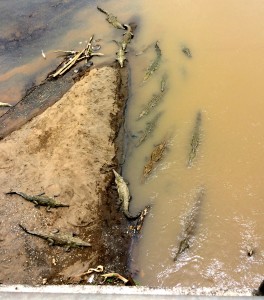
Why crocodiles, of all things, to accompany a post about writing? Because there's so many things out there waiting to eat your writing time, to gobble it down and leave you with only the shreds. Tried the balcony out for writing last night. Here’s a blog post that emerged.
For a long time I listen to the ocean, a background of some chirping insect, shrill arcs of sound going out against that massive, constant grumble. That is what life is like, singing out against that gray and empty grind, not caring what it sounds like, because singing is the only thing you can do.
I can feel my shoulders relaxing as I type, the guilt of several weeks (over a month, really) of getting little done, not just because of the traveling or the distractions but because I let myself get lazy and forget that what a writer does is write. If you want to call yourself one, that’s what is necessary and while that’s a hard standard to maintain consistently sometimes in the face of a multitude of crises of the mind or body or world or family, it’s one I hold myself to, first and foremost.
A confession: I am not one of those writers who “have to” write, the ones seized with such a fervid muse that they cannot exist without words spilling out of them. I envy them, and sometimes in my heart, get irritated by a smugness that is really an interpretation imposed by my own insecurities.
But I have always defined myself as a writer, even in the days when I wasn’t writing so much and was pouring all that energy into writing for an online game or technical documentation or some combination of the two. So when I don’t do it, it’s not so much that it’s the writing building up. In fact, some days I’m digging the words out, and they’re obdurately clinging to the inside of my skull so I have to wrestle them onto the keyboard. Even now, I want them to flow and they’re halting, the flow coming in fits and spurts while all the time the ocean softly roars, as though it can’t help itself at times, perhaps getting just a little too excited, a little too enthusiastic in its mutterings.
Here’s the thing. When I’m not writing consistently, when I’m not hitting solid word count on at least most of the days of the week, I feel unmoored, adrift, unsure of my center. What good is a writer who isn’t writing?
There’s also an awareness of time creeping up on me. Often I wish I’d done more with those early years “” though who would have known in all that young adult thrashing about? While I don’t want to let guilt consume me, it’s not a bad goad. I believe it was John McPhee that said any motive for writing is valid, even spite and malice.
And it’s a goal that I know is doable, to hit two thousand words “” and more when I’m being motivated, which often coincides with felicities of mind or body. I don’t worry about whether they’re bad or good, all that matters is that they’re words that actually make it from my mind to the page. Right now I’m adding these words into the count, even though I don’t usually count nonfiction, because right now the focus is warming up, priming the pump, getting myself back into that productive groove.
It’s the days when I get no word count, not even a page written in a notebook, that really bug me, so when the words are flowing, there’s a point where all is well, when I can feel myself assembling words to express what I want to say and they’re falling into place quickly, one at a time but in a constant patter, like raindrops falling on the keyboard.
So tonight is swell and good. We’re here for a month, then probably onward to another country to try a few weeks there. I can get into a routine that feels productive and which includes some of the things that help ensure my mood is good and I’m undistracted by feeling unwell, such as good solid walking bouts and not eating junk food and getting enough sleep.
So what will I work on this month?
First and foremost is finishing up the YA novel I’ve been working on, along with several stories, two for anthologies and a couple for the Patreon campaign. While the stories will be fun and I do want to get them finished, the novel is what I want to be spending most of my time doing. I’ll be posting snippets and word counts as I go, keeping myself accountable. Because that’s another thing for a writer — you have to hold yourself accountable, because there’s nothing out there, really, to do it for you.
Good writing to you all. I hope you’ll get some words today as well.

 All taken from http://www.helpineedhelp.com/#/


3 Responses
I got 99 problems and plotting ain’t one. http://t.co/tXJlmcQO0G #amwriting
RT @Catrambo: I got 99 problems and plotting ain’t one. http://t.co/tXJlmcQO0G #amwriting
RT @Catrambo: I got 99 problems and plotting ain’t one. http://t.co/tXJlmcQO0G #amwriting