What are the documents of Tabat? In an early version of the book, I had a number of interstitial pieces, each a document produced by the city: playbills, advertisements, guide book entries. They had to be cut but I kept them for this purpose. I’ll release them at the end of April in e-book form; careful readers will find clues to some aspects of Beasts of Tabat in them. -Cat
An Instructive Listing of the Pests of Tabat, being Pamphlet #2 of the fifth series of “A Visitor’s Guide to Tabat,” Spinner Press, author unknown.
The newcomer to Tabat will find the pests they are accustomed to: fleas, lice, and rats are no strangers to the city. But several creatures indigenous to the area may cause the unwary traveler distress.
In late summer nights, the gold and orange wings of phoenix moths will be visible in their mating swarms. Despite the beauty of the phenomenon, the creatures are destroyed whenever possible, for the flames created when they deposit their eggs and immolate themselves in order to harden the casings can lead to larger fires.
Marsh flies are prevalent on the city’s eastern side when the wind is from that quarter. The fierce bites of these insects have been known to drive even the most placid creature to the brink of madness. Citronella and other scented candles and lamp oils are the most popular remedy for these creatures, along with bed netting in the summer months.
Parasitic Fairies have, for the most part, been eradicated, but clusters of the minute Fairies known as slavemakers still exist in the farmlands. While they rarely if ever make their way into the city, those traveling in the areas directly around Tabat should be aware of the danger they pose.
Mandrakes are neither animal nor Beast, but rather a plantlike intelligence found only on this continent and capable of ambulation in their early stages. Mandrakes kill larger mammals, using the corpse as a plant in which to root themselves and propagate and are, like parasitic Fairies, only a danger to those venturing outside the main city.
Due to Tabat’s damp weather, a myriad of molds thrive in untended corners. Scarlet mold, toxic to animal and human, may appear and is invariably accompanied by black mold worms, whose bite produces severe hallucinations.
***
Love the world of Tabat and want to spend longer in it? Check out Hearts of Tabat, the latest Tabat novel! Or get sneak peeks, behind the scenes looks, snippets of work in progres, and more via Cat’s Patreon.
Want access to a lively community of writers and readers, free writing classes, co-working sessions, special speakers, weekly writing games, random pictures and MORE for as little as $2? Check out Cat’s Patreon campaign.
Want to get some new fiction? Support my Patreon campaign.
"(On the writing F&SF workshop) Wanted to crow and say thanks: the first story I wrote after taking your class was my very first sale. Coincidence? nah….thanks so much."
~K. Richardson
You may also like...
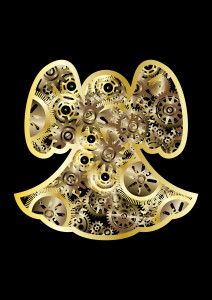
Patreon Post: Seven Clockwork Angels
If you enjoyed this piece, you might also enjoy “Clockwork Fairies.”This is a children’s steampunk retelling of Sleeping Beauty; I originally wrote it for the Fairypunk project, but I wanted to get it out here and figured there’s plenty of other fairy tales I can tackle when it’s time.
Seven Clockwork Angels, All Dancing on a Pin
If a clock has ticked, it must tock, and thus time moves along. And in every tick and tock, there’s a story, and sometimes more than one.
Once upon a tick and tock, there was a great Lord and a greater Lady, who were Patrons of the Arts and Sciences. They endowed libraries and laboratories, and commissioned portraits and poems and marvelous machines that could play chess or spin a silk thread so fine you could barely see it or that could even build their own, tinier machines to make tinier machines in turn, and so on and so on, until they produced the head of a pin inhabited by seven clockwork angels, all dancing.
The Lord and Lady loved the works they commissioned, but they yearned to produce something of their own. And one day it came to pass that the Lady announced to her Lord that they had collaborated very well indeed, and that she would soon produce an heir.
Their daughter was fine and fair. They named her Aurora, after the Aurora Borealis, and to celebrate her christening, they invited all the scientists and artists and musicians and philosophers and inventors they had helped.
The day of the christening, Aurora was given amazing gifts: a pair of spectacles that could see everything from the smallest cell to the farthest star; a flowering garden whose trees produced avocado pears and pineapples, cherries and peaches, all from the same branch; a clock that could tell her the time on the moon and predict the next three days’ weather with reasonable accuracy; a talking parasol that recited cheerful limericks in the morning to amuse her and long, languorous epics in the evening to lull her to sleep; and sundry other delightful devices and contraptions, each more cunning than the last.
But the Lord and Lady had neglected to invite one guest, a scientist named Artemus Scuttlepinch (who might have been omitted on purpose, for he was very bad at dinner conversation) and he stepped forward at the end.
“I have a gift as well!” he announced. “Behold the Cabinet of Dreadful Fates!” He whisked his dinner cape aside with a flourish, revealing a squat box painted a malignant black. Brass dials and switches covered its face.
Scuttlepinch steepled his fingers as though preparing a classroom lecture. “I have harnessed various eldritch and magnetic energies,” he said. “Whatever fate the machine pronounces for an individual, will come true, with 98% accuracy. And”¦” He sneered here, and would have twirled his moustache if it had been long enough. “The fates are never pleasant ones.”
Before anyone could stop him, he said, “This is for Aurora!” He pressed a switch.
The machine clicked and clattered ominously, and then clicked some more, finally producing a slip of paper. Scuttlepinch snatched it up and read it aloud. “On her eighteenth birthday, Aurora will prick her finger on a spindle and die!”
“Poppycock!” shouted the Lady. “No one ever died of a pin prick!”
“Preposterous!” shouted the Lord. “The spindle is an obsolete technology!”
He signaled for the guards, who took the cackling Scuttlepinch by the arms. Another seized the machine and raising it overhead, dashed it on the ground, where it shattered, revealing a series of gleaming tubes and poisonous green lubricant, which roiled like drops of mercury on the floor. Scuttlepinch only laughed the harder; the sound sent shivers down the spines of the witnesses.
But another scientist, Miss Mariah Fleetthought, spotting Scuttlepinch, had lingered in the back of the crowd, fearing just such an occurrence. She now stepped forward, clearing her throat with a diffident manner.
“Here,” she said, “perhaps this will help. My own research has led in a similar direction. This is the Good Luck Gizmo, instilled with the computational power of a Babbage engine and possessing its own chemistry of droplets distilled from wishing wells, the sap of seven leaf clovers, and another liquid whose origin I cannot disclose. It cannot avert dreadful fates, but it may alleviate them.”
She set the box she held on the floor, and it unfolded into a clockwork kitten, which picked its way through the shards and droplets to leap nimbly into Aurora’s crib and curl there, its green eyes glittering watchfully despite its position of repose.
After that, the Lord and Lady took comfort in the raising of their daughter and avoided thinking of her possible fate, although they were instrumental in passing a bill that banned spindles outright. She was a bright and sunny child, and their delight in her outweighed all other considerations, until the marvelous machines produced under their patronage were bundled into a cellar to sit unused and dusty.
Aurora was talented and well-tutored, and had all the social graces as well. Her only flaw, which no scientist counted an actual weakness, was a driving curiosity and a craving to know how things worked, which led to her taking many things apart before she learned how to put them back together.
In all of this, she was companioned by the clockwork cat, which haunted her footsteps and watched with wise green eyes as she dismantled things. They came to call it Gizmo, and sometimes forgot that it was not a living creature, for it seemed as cat-like as any cat, despite its devotion to the child.
On her eighteenth birthday, they held a party for Aurora, and invited many young people of her age. But she found them boring, preferring to talk to the scientists about her own discoveries and eventually, bored, she slipped away, trailed by Gizmo.
She made her way down to the cellar, where she was in the process of taking apart a particularly marvelous lace-making machine, because she was curious about the patterns it produced. Gizmo did not approve of this particular machine, which was curious, and today, as she continued to explore its inner workings, the cat grew increasingly agitated, swatting at her with a paw and meowing in its tinny voice, till she pushed it aside more roughly than she meant to.
As she did so, her balance slipped a little and her hand pushed farther into the machine, where it met a certain inner part that spun thread, something that any seamstress might have called a spindle.
She withdrew her hand with a cry of pain, looking at the drop of blood on it. Dizziness overcame her and she sat back on her heels. Darkness pressed in on her vision, but she could hear Gizmo nearby, its head pushing hard against her, purring. Her heart faltered, but the rhythm of the purrs soothed it, made it slip into a slower but still existing rhythm as she fell asleep.
Crouched beside her, the cat opened its jaws and glittering motes flew out. Anyone wearing Aurora’s spectacles might have seen them: tiny clockwork angels with shining spindles, setting to work.
Bit by bit the angels spun, and the air became glass. First filling the room, suspending the sleeping Aurora, then spreading outward from the cellar, catching the mansion’s inhabitants till they were suspended as well, unmoving, but still in the attitudes of life in which they had been captured: the Lord and Lady holding hands as they walked in the garden among the partygoers, looking for their daughter; the cook putting the final layer of icing on the seven-layer cake intended to cap the evening; the butler tending the enormous furnace that heated the hot-water, even the flames, all caught in glass.
Scientists came from all over to study the enormous lump of glass in the middle of the city. They tried drills of diamond and moon metal, and acids that would burn through almost anything, and certain frequencies of sound, but the glass stayed, obdurate and unyielding. Some set up camp in order to study the phenomenon; after a few decades an open-air university sprang up there, devoted to unlocking the science behind the glass’s appearance. In time, everyone forgot what lay inside the glass as its surface dulled and clouded with years.
Till one day, a new scholar appeared at the University, which by now had been built so far that it completely encased the block of glass. He was a young man of modest garb and humble demeanor, but he brought with him a black leather satchel of the kind doctors often carry.
When questioned, he indicated that he wished to study the glass at the University’s heart. The other students derided him. By now they had forgotten about the glass, since no study of it had ever yielded the slightest result, and it was regarded a fruitless and outmoded subject. But he persisted, and eventually they took him to the corridor that led to the glass enclosing the mansion’s front door.
All he did there was open his satchel. Nothing came from it at all, but after it had been opened for a moment, he smiled and closed it again, before inviting them to go drinking with him.
He and his fellows drank all through the night. And while they did, the tiny clockwork butterflies, too small for the eye to see, that had risen from his suitcase, clung to the glass and slowly ate away at it.
In the morning, the students that had been drinking heard a great crash. The center of the University, an immense airy structure used to study the movements of the stars, had fallen in, lacking the glass upon which its slender struts had once rested.
They rushed to the corridor and found the glass gone. Pressing inside, they found the building, the confused partygoers wandering about among the wreckage covering the garden, the Lord and Lady among them, dressed in antiquated clothes and speaking in accents that had not been heard in a century.
Some pushed on, into the still intact mansion, and wandered its hallways in turn, until they came to a cellar door guarded by a clockwork cat. Inside, the new student sat watching the sleeping Aurora, patiently waiting for her to stir.
Which of course she did. But that story must wait for another tick of the clock, when the angels dance again.
-The End-
If you enjoyed this piece and want to support the creation of others like it, please consider supporting me on Patreon, buying a book, or passing along word of my work.
For Writers: How to Blog Without Really Trying But Still Managing Not to Be Half-Assed About It
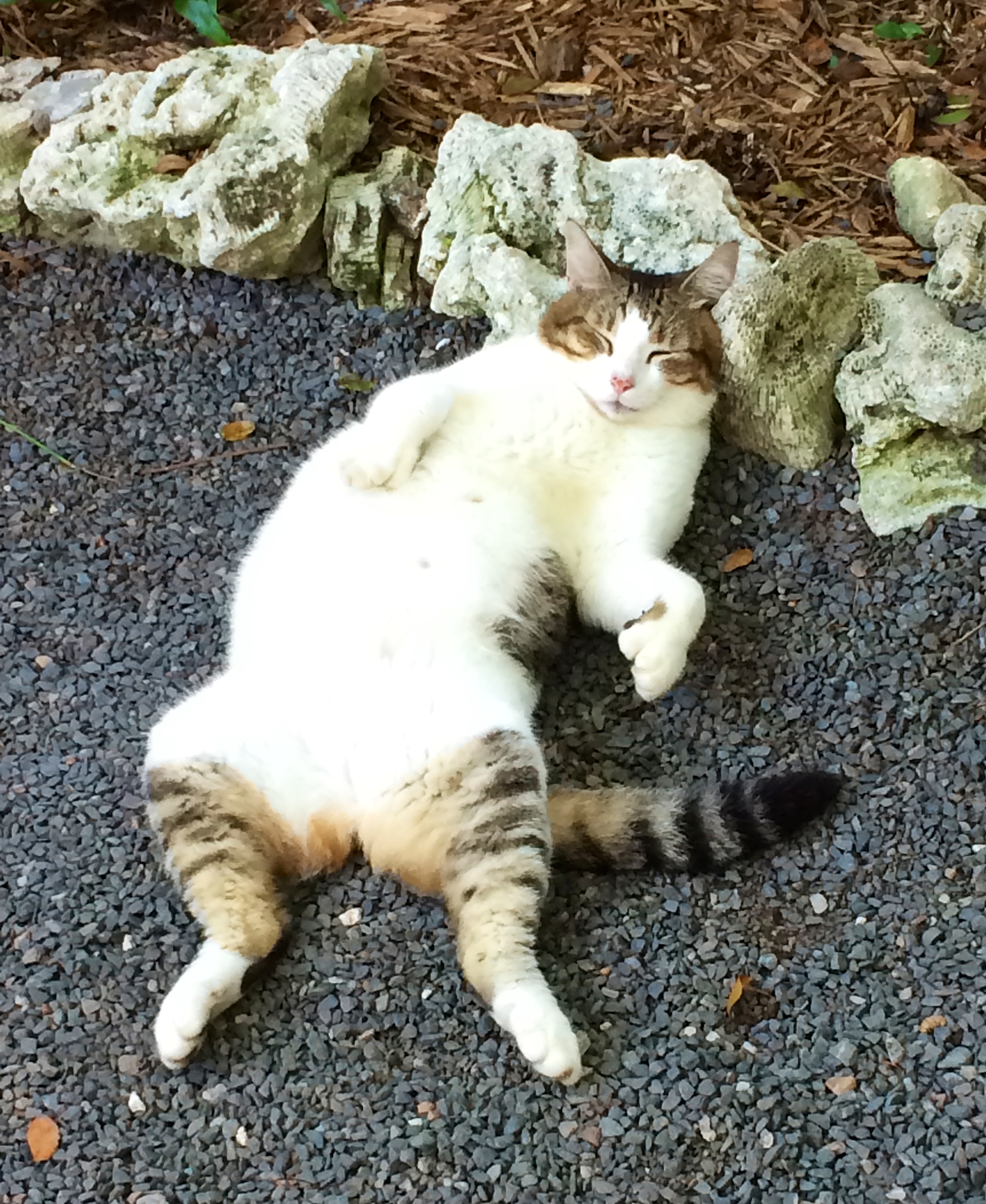
This cat isn’t blogging. Should they be?I’m teaching my Creating an Online Presence Class this weekend and also going through a madcap rush to update the accompanying book. The class and book are aimed at helping people tame the bewildering timesink of social media, website, pocasts, search engines, and other facets of online existence for writers. One of the things I try to teach how to use online time efficiently, because writing and editing time is precious and time spent doing other things is time you’re not writing or editing. So here’s some things about blogging.
Is A Blog Mandatory?
No. But it’s advisable. You do want readers to be able to find you online and, more importantly, to find your work. You do want a website (and a mailing list, but that’s another post), but your website can be a static presence, something you put up and don’t update very often. In fact, if you have very minimal time to invest or otherwise want to limit your online presence to the bare bones, don’t include a blog. Few things look sadder than a blog with a single entry from five years ago, usually about trying to make oneself blog.
Something You Can Always Blog About
One reason to blog on your website is that it means the website is being updated frequently, which makes the site more likely to turn up on search engine results. So here’s two ways you can generate a weekly post. The first depends on having a social media presence; the second does not.
Social Media version: If you’re posting links and observations on social media, you can collect the best of those into a post. They don’t have to be related to writing; you’re allowed to have other interests. Five to ten links with one or two sentence explanations as to why you picked them. There you go. Shazam, you have a post.
Non Social Media version: Every week, pick an interesting chunk (I suggest 300-700 words) from what you’ve worked on the past week and post it.
Your own writing is something you can speak about with authority. Pull out a passage that you’re particularly proud of, or that you definitely want input on. Pick an interesting moment or intriguing scene.If you want to be thorough with that second approach, you can place it in context for readers. Here’s some possible questions to answer.
What is the project, the genre, the inspiration?
Are those the final character/setting names or placeholders?
What’s the title and how does it relate to the story?
What’s the setting based on? What are you trying to accomplish in this bit?
What are you particularly fond of?
What do you definitely plan to go back and fix in the revision?
What aren’t you sure about?
What do you intend to do with the piece when you finish?
What would you compare the piece to, either in your own work or that of others?
What do you want readers to get out of the piece?
Certainly there are ways to get the most bang for the effort out of these posts: include an image, have a good tagging system, make the most of keywords. But those are advanced techniques, and unnecessary to this basic effort.
If You Only Hate Writing about Writing
As I mentioned above, you do not have to blog about writing. In fact, the world is full of posts about avoiding adverbs, and you probably do not have anything to say on the subject that has not already been said. So blog about something else.
Blog about your adventures in learning how to pickle vegetables or speak Mandarin. Document some longterm project like your garden remodel or the bookstore your partner is opening. In a pinch, you can always fall back on writing about the books you’re reading. The most interesting and effective blogs out there don’t just show you the writer’s writing, but something about them as a person.
Always Be Closing is NOT a Good Axiom for Writers
While all writers need to think about how to help readers find their work, if they are too pushy about forcing them to it, those readers will balk and go no further. Don’t make your website all about sell sell sell. Don’t make it your social media focus nor what you blog about over and over again. You will be wasting your time and driving away fans.
That’s why showing readers scraps from your writing is effective. You are giving them something that is (hopefully) genuinely interesting here and now. If they like it, they may look for it later on when it comes out. Let your writing and its quality do the work of selling for you and don’t worry about the set of steak knives. Just write.




3 Responses
Cat Rambo: Documents of Tabat: Pests of Tabat http://t.co/Zm0gJBSR2L
RT @Catrambo: Pests of Tabat: http://t.co/eTw3KwNQh6
RT @Catrambo: Pests of Tabat: http://t.co/eTw3KwNQh6