

Five Ways
Subscribe to my newsletter and get a free story!
Share this:

Being Epic

I’m getting ready to head off to the Nebulas in about an hour. Ten years ago at this time, I was getting ready to go off to Clarion West for six weeks. I’d quit my job at Microsoft and my husband had agreed to shoulder the mortgage solo for a while so I could follow my dream.

Now it’s a decade later. A lot of stuff has happened. I’ve had some stories published. I got to read in New York at the KGB bar with Chip Delany. I got nominated for awards a few times. I edited some cool stuff. I ran for Vice President of SFWA and won, and now I’m coming up on being President. And I published a novel.

And now that novel is here in a big wonderful bundle of fantasy, curated by Kevin J. Anderson. Here’s a picture of all that epic goodness:
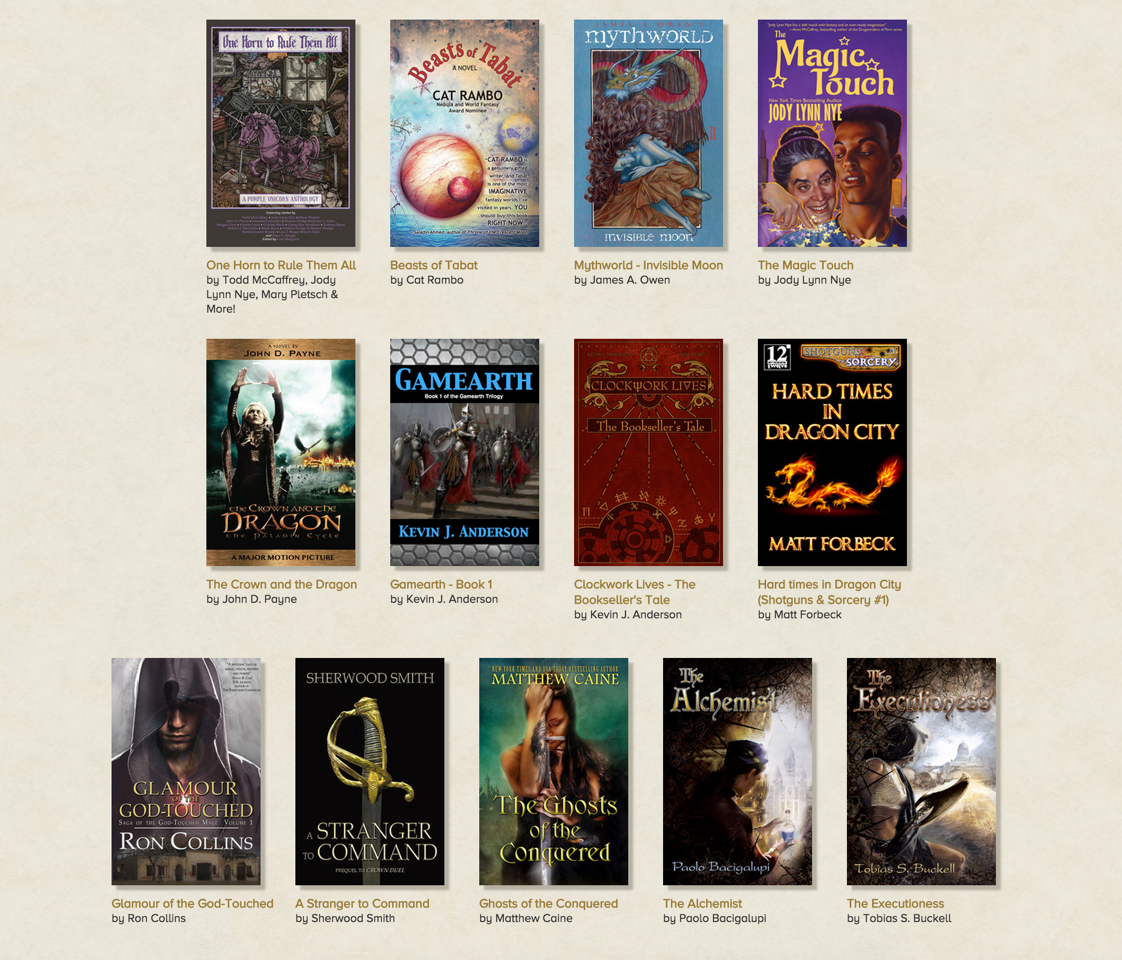
covers

StoryBundle lets you adjust your own price to get a whole bunch of epic and excellent titles. A minimum bid of $5 gets you the basic set of six books: The Magic Touch, by Jody Lynn Nye; Gamearth, by Kevin J. Anderson, The Crown and the Dragon, by John Payne, One Horn to Rule Them All, edited by Lisa Mangum, Invisible Moon, by James A. Owen, and Beasts of Tabat. Make that $15 and it includes A Stranger to Command, by Sherwood Smith, Hard Times in Dragon City, by Matt Forbeck, The Alchemist, by Paolo Baciagalupi, The Executioness, by Tobias Buckell, The Ghosts of the Conquered, by Matthew Caine, and Glamour of the God-Touched, by Ron Collins. There’s also a bonus story by Kevin J. Anderson and Neil Peart from Rush, “The Bookseller’s tale.”

Want it? I’ve got five bundles to give away and I’m trying to a Rafflecopter giveaway. Spread the word and you can win!


a Rafflecopter giveaway

22 Responses

  1. Thanks for the opportunity! I’ve just bought the Write Stuff bundle, I’m looking forward to read both of them!

Leave a Reply

Your email address will not be published. Required fields are marked *

Get Fiction in Your Mailbox Each Month

Want access to a lively community of writers and readers, free writing classes, co-working sessions, special speakers, weekly writing games, random pictures and MORE for as little as $2? Check out Cat’s Patreon campaign.

Want to get some new fiction? Support my Patreon campaign.


"(On the writing F&SF workshop) Wanted to crow and say thanks: the first story I wrote after taking your class was my very first sale. Coincidence? nah….thanks so much."

~K. Richardson

You may also like...

What I'm Working On: The SFWA Cookbook

Picture of a watermelon cake.
Watermelon cake: cake or watermelon? I don't think we'll have this recipe, but among what's been promised is tobacco-infused tequila hot chocolate (Kevin Hearne), Muddle-in-the-Middle Mojito (Kay Kenyon) and Elf BBQ (Jim Hines).
Beside all the convulsions of moving and prep for travel, I’m doing the usual writing (working on a YA novel and have a slew of stories I’ve been asked for), but I’m also working on a nonfiction project of a type I never thought I’d work on: a cookbook, which I’m co-editing with Fran Wilde.

It’s a SFWA project, and I’m excited about it for a number of reasons.

  1. It’s following in a SFWA tradition. There were two previous cookbooks, both edited by Anne McCaffrey, Cooking Out of This World and Serve it Forth.
  2. Next year is SFWA’s 50th anniversary, so this will be part of the celebration. Accordingly, it’s a party-themed cookbook with sections on savory snacks, sweet snacks, alcoholic and non-alcoholic drinks, and dishes to take to potlucks.
  3. It’s a (hopefully) noncontentious effort that celebrates SFWA’s community, a community which is for me one of the benefits of being a member.
  4. It’s a great chance for me to touch base with a lot of fellow members. I’m fairly certain I’m SFWA’s next vice-president (barring the event of a successful write-in campaign for Randall Garrett) and it’s wonderful to have a reason to interact with them other than problem-solving. I’ve been contacting a few members in advance (there will be a general solicitation to the members next month) and it’s been a lot of fun seeing some illustrious names in my inbox. I’ve talked to a few who I didn’t know had left, and I hope that maybe it’ll persuade some to give the organization another chance.
  5. We get to test a lot of very interesting recipes.
  6. As with so many SFWA projects, I’m learning a lot in the process.
  7. Who doesn’t like a party?
  8. It’s a chance to share my Welsh rarebit recipe with the world. 😉

We’ve got a lot of cool plans that will be revealed over the coming months, so stay tuned.

...

Zen and the Art of Spiral-Carved Incense Burners

Stone Lantern
A stone lantern sits along the pathway, waiting to be sold to a Kadian merchant.
This essay originally appeared in the February 2001 issue of Imaginary Realities. The crafting system in Armageddon is something we worked towards for a long time. The implementation may not have been the most efficient (I still, vividly, remember making hundreds of arrow objects so we could have them with every possible color combination of fletching) but getting it into the game was a huge source of satisfaction.

One of the desires expressed at the very first Armageddon player-staff meeting I ever attended was a yen to move away from “a hack and slash economy,” where players made their income by selling the gear off NPCs (and the occasional PC) that they had killed. How, one immortal noted, could the world be realistic when there was no coded reflection of the material underpinnings of it? How to create this economic reflection was a question that remained in the air for several years, and it was not until discussion of implementing crafting code came up that such a move seemed possible.

We laid the groundwork for crafting by first creating ways to get the raw materials. I reviewed what was produced from skinning the various creatures in the game, both to make sure that players could skin most corpses and to ensure that what was being produced was reasonable. We implemented skinning difficulty: some things, such as pelts, are harder to extract from a corpse, as opposed to cuts of meat. Beyond that, we added a forage command, allowing players to find rocks and wood. Later, this was expanded to add other arguments: artifacts, salt, and roots. Forageable objects differ according to the sector type of the room and in order to make this reflect geographical differences, we added some more sector types, such as thornlands, salt flats, and ruins. Salt can only be foraged in the salt flats, for example, and roots are only available in fertile land (hard to find on a desert planet).

Once the ability to gather raw materials was in place, a couple of initial crafting skills were implemented: basket weaving and tanning. Basket weaving, admittedly, started out as a bit of a joke, but it served its purpose: to allow us to discover flaws. Both skills necessitated the creation of the objects to be crafted: a series of baskets for basket weaving, and tanned versions of various pelts and hides. With each, I tried to make sure there were incentives to use the skill: tanning a hide made it both more valuable as well as sometimes adding wear flags, while baskets included some objects that were wearable on the back or otherwise handy. I included the ability to craft an object, a numut vine sash, that had vanished from the game when the city of its origin was destroyed, and this in turn led me to wander through the database to find other objects that could be recycled and used for the code. As part of this effort, I ended up adding a component crafting skill for the magic users in the game in order to use a series of objects left over from an immortal project that had never been fully finished.

Although some objects could be recycled in this fashion, many others had to be made for the crafting code as we began to implement additional skills, including bow making, knife making, cooking, dyeing, leather working, bandage making, etc. Occasionally, obsessiveness got the better of me: after creating four different types of arrowheads, I decided that people should be able to make striped fletching for their arrows, so they could, if they wished, make arrows using their clan or House colors. This required me making some 300 or so arrow objects in a madcap building session that left me not wanting to ever type the word “arrow” again. Here, planning out the entire effort in detail ahead of time and having used a different structure for coding the items would have paid off, instead of having added bit by bit as I went along. For example, I found myself regretting the variety of gems one could forage in the game when I ended up making multiple bone dagger items, each with a different gemstone in the hilt. Having the entire structure sketched out ahead of time, rather than adding in skills as they occurred, might have been helpful, although some of the skills came from player suggestions after they’d been exposed to the new code.

As the skills began to be more fleshed out, we started making them available to the players. Cooking was a skill everyone got, while others were fitted into the skill trees (Armageddon has a branching system) where appropriate, with merchants ending up the vast beneficiaries overall, going from a possible 13 skills to 38. Some additional skills grew out of the effort, such as analyze, which allows a player to determine an item.s component parts, and armor repair.

At the same time, we added a secondary guild system, which allowed players to flesh out their backgrounds further, by adding a few skills, usually crafting. The secondary guilds were not the same as the regular guilds but intended to reflect life experiences or talents, including stone worker, bard, house servant, guard and mercenary, and I enjoyed putting the packages together in a way that made sense, such as giving the house servants pilot, flower arranging, and a high cooking skill or the mercenaries ride, knife-making and an increase in their ability to hold their liquor.

Inevitable questions and problems arose. On Armageddon, skilled merchants can often identify the style of an item via the value command, if it came from a specific region or culture, and in order to accommodate this, I made the crafting of some items dependent on materials available to only those groups. Shopkeepers began to be glutted with some items (nothing is sadder than a Kadian merchant laden with nothing but spiral-carved green marble incense burners), but this allowed us to check and adjust item prices by monitoring the shops to see what items were appearing at what costs.

For example, since wood is more expensive in Allanak than in the Northlands, some players were cashing in wildly by making and selling wooden spears to House Salarr, which I hadn’t realized would happen till I noticed them selling for 300 sid (Armageddon uses obsidian for its coinage) in the shops.

The experiment still continues and new items, many contributed by players, are added every few weeks. Currently, there are some 3000+ possibilities, crafting wise, coded, and there are still gaps. When I initially did the dyes, for example, I left out the color orange, which means that I keep getting inquiries about implementing variations with that color from the players. The fact that it would require writing up another 300 or so objects has stopped me so far, however. But the players are using the code right and left, and some are actually supporting their characters with it. Though there is still a limited market for incense burners.

...

Skip to content