As we all know, the true purpose of the Internet is the collection of cat photos, and StumbleUpon is a great source of them. This is Raven, emerging from a box
StumbleUpon is a social bookmarking site. Users submit links to content they want to share, an act that is called “stumbling” the link. Other users can give a link a thumbs up or a thumbs down using the StumbleUpon toolbar, which a user can install when registering a StumbleUpon account. Content is tagged according to interests, and users randomly browsing content (also called “stumbling”) will see more popular content more often.
StumbleUpon is an addictivepastime, particularly for bored workers. They’re stumbling for stuff that they’re actively interested in, and I know as a writer that there’s plenty of engaged speculative fiction fans in that pool of users.
StumbleUpon’s paid attention to the growing number of people accessing the Internet through mobile devices, a trend that will only continue.
Basic StumbleUpon tips:
As with any social networking or bookmarking site, quality is crucial. An account that has a long-time record of interesting sites will do better than a new account with a handful of suspiciously similar links. Don’t stumble your own stuff more than occasionally (at most).
Set up a complete profile.
Stumble other people’s content.
Connect with other people by following them.
Join channels pertinent to your content.
Include images.
Use the service.
Use the Stumbleupon shortlink, as Kathryn Hawkins details here.
Want access to a lively community of writers and readers, free writing classes, co-working sessions, special speakers, weekly writing games, random pictures and MORE for as little as $2? Check out Cat’s Patreon campaign.
Want to get some new fiction? Support my Patreon campaign.
"(On the writing F&SF workshop) Wanted to crow and say thanks: the first story I wrote after taking your class was my very first sale. Coincidence? nah….thanks so much."
~K. Richardson
You may also like...
Preorder Page! Plus Some More Talking About Book Promotion Progress
I’ve been working on the jewelry, which got pretty much finished up today. We’ll be giving away 30-35 of those at the party, plus books, stickers, CDs, and handmade journals.
Here’s a bunch of the pieces laid out: Here's most, but not all of the pieces. There's still about twenty to be done at this point.
And here’s closeups of some of the same image. One thing is for sure — each of these is unique!
The various jewelry accoutrements came from the Redmond Ben Franklin's. This early batch has some blotchiness, which we learned to avoid in subsequent batches by laminating the paper onto the tile or into the finding before resin was applied.
I’m working on a piece for the SFWA Blog about promotional giveaways. What are the best — and worst — ones you’ve seen? What resources would you recommend to people? The stickers are the interior art, done in a nice size that’s big enough not to lose but small enough to be able to use in a number of places.
These are waiting to get filled with resin. They'll take a few days to cure, but when ready will look like glass, and all the roughness here, created by brush marks in the mod podge, will be imperceptible.
Guest Post from Anne Leonard: Writing "Strong Female Characters" in a Patriarchal Secondary World Fantasy
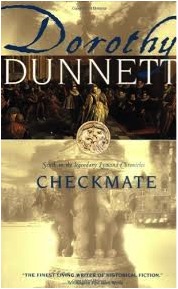
In Dorothy Dunnett’s sixth book, Checkmate, we get this passage:
She had been led into behaving like a female. And she was being dismissed as a female. But she had charge of his good name, although he might not know it; and she had work to do, although, like a fool she had lost sight of it.
Here we see the character of Philippa Somerville in all her complexity: determined, strong, imperfect, aware of her role in her culture and refusing to be limited by it. Philippa is a prime example of the “strong female character” existing in a patriarchal world, and although the novel is historical rather than fantasy, it and its companions have a lot to teach about writing strong women without giving up the conventions of a patriarchal social structure.
Yes, this is another post about writing “strong female characters.” I am coming to this issue from the position of someone who likes traditional epic fantasy with pseudo-medieval (or at least pre-industrial) cultures. This is my comfort read, and it is what I like to write. This is partly because that was what I grew up on, partly because I’m enough of a romantic to still have a soft spot for heroes, and partly because I like to interrogate that social structure. For me, interesting female characters are the ones who have to face social oppression ““ the same social oppression I do ““ and who fight against it within the limitations of their own beliefs about their roles. Feminist fantasy with matriarchal or egalitarian societies isn’t as interesting to me as a writer because it avoids the very problems I want to get my teeth into ““ what is a woman to do when oppressed? What if she doesn’t know she’s oppressed?
Agency
One of the problems faced by fantasy writers who consider themselves feminist but like to write about secondary worlds based on historically patriarchal cultures is the disconnect between the oppressive culture and the strength of the female characters. This disconnect is why people tend to fall into the assumption that a strong female character has to be a Brienne of Tarth, acting like a man.
That assumption leads to the argument that a strong female character is not historically accurate. Under this logic, because there aren’t lots of historical episodes of women going around acting like epic heroes, there’s no need for a strong female character in epic fantasy. Aside from the silliness of saying fantasy has to be historically accurate, the problem with this argument is that there are lots of different kinds of strong women in history. What makes a woman a strong character is not her physical prowess (though it could be); it’s her agency. The character’s agency is where the clash between oppression and strength is negotiated.
Consider The Handmaid’s Tale; most of Offred’s narrative is describing how she is being subjugated in Gilead and remembering what it was like before. She’s not fighting back or leading a revolution. No one would say she’s not a strong female character, though, because she has voice, feelings, thoughts, memories, and choices. Her agency is internal, in how she responds to the situation in which she is caught. (And if you haven’t read The Handmaid’s Tale, why not? Go read it!) Even if the character accepts the stereotypically gendered roles of her culture, she has to make decisions, and these decisions have to have consequences. This is almost a basic rule of writing, regardless of the character. Something needs to be at stake to move her story forward.
Examples
Some of the best examples of dealing with the disconnect between a patriarchal power structure and a strong female character are historical novels about real women with real power. The Lymond Chronicles (6 books, beginning with The Game of Kings) by Dorothy Dunnett are far and away my favorites.
Set in Scotland, England, France, Turkey, Russia, and some other places during the period between Henry VIII’s death and Elizabeth I’s accession to the crown, Dunnett’s books are amazing for their historical detail, storytelling, intelligence, and characters. In the fourth book, Pawn in Frankincense, Dunnett writes one of the most devastating scenes that I have ever read, leaving George R.R. Martin looking cuddly by comparison. (The books can be read individually, but the reading experience will be much richer taking them in sequence.)
The women’s stories include the growth of Philippa Somerville, a gentleman farmer’s daughter, from child to adult; the consequences of a love affair 30 years past; estrangement between a mother and her son; the unhappiness of a young merchant woman who despise herself and the people around her; and a woman who endures abuse because of her devotion to the cause of an independent Ireland. One woman is a courtesan who has considerable power over powerful men. Several women are queens or courtiers. These books show how women with power wield it (the mother of Mary Queen of Scots is described as having “the thick oils of statesmanship” oozing through her veins), and they also present women who don’t necessarily have political or legal power but have power of personality and rich, complicated lives.
Significantly, the women are not all likeable. (Nor are the male characters, for that matter.) Mary Tudor comes off as rather pathetic, Margaret Douglas is scheming and power-mad, the Dame de Doubtance is a creepy astrologer without a shred of empathy. The younger Philippa is at times frustrating to read because she is absolutist who makes some bad decisions with significant consequences. The strong female character doesn’t have to be the heroine. She doesn’t have to be perfect. But she does have agency, and her choices matter.
These women also aren’t the sixteenth century equivalent of suffragettes or bra-burners. They don’t question the sexual double standard, they don’t don armor and go to battle, they don’t talk about being oppressed or fight overtly against it. (And yes, in one sense it’s kind of absurd to talk about a queen being oppressed ““ but on the other hand, it’s quite clear that no one is very comfortable with power lying in a woman.) While some of them engage in activities that don’t fit our idea of what women did in the sixteenth century, that’s only a part of them. They are living full and complex lives within the patriarchal society, rather than rebelling. A strong female character can, like Philippa, be aware of being “led into behaving like a female” and put that behind her without questioning her internalized conception of being a female. A strong female character is something feminist readers want, but the character doesn’t have to be a feminist to fit the bill.
Dunnett is not the only writer of historical fiction with strong and interesting female characters. Here are a few recent other books which should satisfy anyone looking for “historical accuracy” in trying to decide what role women should play in epic fantasy:
Hild, by Nicola Griffith. This is based upon the life of the woman who became St. Hilda of Whitby. Set in 7th century Britain, the book is thick with historical and physical detail. It presents the life of women who are family of the Anglo-Saxon kings, including slaves and women of lower rank. Hild is a mystic who both does women’s domestic tasks and leads men in battle. She is bisexual; she is listened to by men but is forced into a marriage; she has complicated relationships with the people around her.
Shadow on the Crown and The Price of Blood, by Patricia Bracewell. These two books are about Emma of Normandy, who in 1002 was married as a teenager to AEthelred the Unready and became a queen of England. In many ways Emma does not have power compared to the men around her, but she fights for what she can get and she uses it. She is a survivor — she was a Queen of England for over 30 years, to two different kings.
Theodora ““ Empress, Actress, Whore and The Purple Shroud, by Stella Duffy. These two books chronicle the life of Theodora from her childhood as a sex slave to her death as the Empress of Byzantium in 548. The title The Purple Shroud refers to a speech made by Theodora which is said to have inspired Justinian to put down a revolt rather than to flee Constantinople. Theodora is an interesting character because of how she rises through the social ranks and because of her forceful personality.
Wolf Hall and Bring Up the Bodies, by Hilary Mantel. Although these books are largely the story of Thomas Cromwell, advisor to Henry VIII, they include as characters Catherine of Aragon, Anne Boleyn, Jane Seymour, and Cromwell’s wife and sister. They depict the ways women interact with powerful men. The relationship between Cromwell and his wife Liz is nicely drawn, and Liz, like Dunnett’s Philippa Somerville, is a good example of a woman on the fringes of political power who has her own agency.
Sharon Kay Penman has written too many historical novels about English royal families for me to list here, but her first, The Sunne in Splendour, is notable for its portrayal of Anne Neville, wife of Richard III, which is almost 180 degrees from Shakespeare’s portrayal of the same. Edward IV’s wife Elizabeth Woodville is also a strong ““ and unlikeable – character. Penman’s novel When Christ and His Saints Slept is about Matilda of England (Empress Maude) and her war to gain the English crown in the early to mid 12th century.
In sum, the writer of epic fantasy can keep full-blown patriarchal power structures and ideologies as part of the world-building. But history is rife with stories about women in such worlds who also have power, agency, and complex lives. Putting such characters into the epic fantasy world is only going to enrich and deepen it.
Bio: Anne Leonard has been writing fantasy and other fiction since she was fourteen and finally, after a career with as many detours as Odysseus, published her first novel, Moth and Spark, in 2014. She has a lot of letters after her name that are useful when trying to impress someone. She lives in Northern California. Her website is www.anneleonardbooks.com. She can be found on Twitter at @anneleonardauth and on Facebook at https://www.facebook.com/anneleonardbooks.









One Response
wild whore