Want access to a lively community of writers and readers, free writing classes, co-working sessions, special speakers, weekly writing games, random pictures and MORE for as little as $2? Check out Cat’s Patreon campaign.
Want to get some new fiction? Support my Patreon campaign.
"(On the writing F&SF workshop) Wanted to crow and say thanks: the first story I wrote after taking your class was my very first sale. Coincidence? nah….thanks so much."
~K. Richardson
You may also like...
Retreat, Day 21
Feeling a bit more caught up, some solid word count today. If I can bank a little more tonight, I’ll give myself a treat tomorrow and go down to check out the Santa Cruz boardwalk.
Today’s wordcount: 5102
Current Hearts of Tabat wordcount: 119160
Total word count for the week so far (day 2): 10976
Total word count for this retreat: 57637
Worked on Hearts of Tabat, Bloodwarm Rain, “Blue Train Blues”
Works finished on this retreat: “California Ghosts,” “My Name is Scrooge,” “Blue Train Blues.”
Time spent on SFWA email, discussion boards, other stuff: 45 minutes
From Blue Train Blues, completed today in first draft form:
The next obstacle presented itself a few miles further on. Fog covered the road, and the car swam in and out of it, a submerged salmon leaping through foamy water, curls and tendrils swirling in its wake. My lord drove slower, but barely, and more than once we swerved to avoid an incautious cow or deer. I tried not to think of how many things stood too low to be spotted through the fog.
We ascended to a hilltop and saw a basin of fog in front of us, an immense white bowl. I started to say something about the odd flapping noise that was just starting to creep up on my consciousness but before I could begin, my lord shoved me sideways, then rolled in the opposite direction himself. A massive claw flashed in the space between us and rasped against the metal before the dragon swooped back upward.
“Hold tight.” We leaped down the hill and into the fog.
My lord steered with face tense, watching the road flash by mere feet from our front wheels, not slowing. Overhead we heard the flapping of the wings.
Then the hoot of a train, off to the right, somewhat ahead.
“What are you thinking, sir?” I asked. “That’s not the Blue Train. It’s the train to the western coast.”
“I know,” he said. “But the crossing is up ahead, I can hear it.”
“But not see it.” Fog thickened and lessened around us; sometimes I could see his resolute face, other times he was lost to me. Overhead those wings flapped, and sometimes fire coiled, once a great wash of it directly overhead accompanied by a foul, sulfurous stench. My cap had blown off my head many miles ago, and I felt the hairs atop my head singe and vanish.
“Hold tight!” my lord yelled over the roaring of the wind and if he added anything to that, it was lost in the howl of the train and the sudden flap of wings and then somehow we were soaring through space just ahead of the train, so close I could count every bar in the cowcatcher in front of it and there was a vast scream and crash as the dragon and the train collided, and then a whoosh of flame, exploding outside, that cleared the world of mist and revealed chaos.
One of playwright Anton Chekhov’s most quoted maxims is this: If in Act I you have a pistol hanging on the wall, then it must fire in the last act. If you establish an expectation in the reader, particularly a strong expectation, you must fulfill it.
The truth is that every story has things in it that must be fired, a multiplicity of tiny guns whose discharges help create the ending, guns that have been primed and loaded over the course of the story.
These are sometimes subplots: the heroine’s best friend is also looking for a love interest and at the end their expectation is either fulfilled or thwarted but it is never neglected, because the reader will exit the story wondering about that, and all the impact of the story will be thwarted.
But not always. They may be an object that is reprised throughout the work: the lily that signals Death’s approach, the clerk who sold a traveler their tickets.
Let’s look at some of this at work in a story that will be familiar to many, James Tiptree’s The Women Men Don’t See. If you are not familiar with the story, I advise reading it beforehand.
This is the ending. My comments appear in parentheses.
By noon we’re back in Cozumel. Captain Estéban accepts his fees and departs laconically for his insurance wars. (Tiptree accounts for this major character and moves him offstage.) I leave the parson’s bags with the Caribe agent who couldn’t care less.(Another character, who appeared toward the beginning, is checked off the list.) The cable foes to a Mrs. Priscilla Hayes Smith, also of Bethesda. I take myself to a medico (the narrator has been injured in the course of the story, an injury severe enough that it shapes the action and therefore must appear in the final moments) and by three P.M. I’m sitting on the Cabanas terrace with a fat leg and a double margarita, trying to believe the whole thing. (Notice that this creates space in which the reader, like the narrator, can think back over the story and draw conclusions.)
The cable said, Althea and I taking extraordinary opportunity for travel. Gone several years. Please take charge our affairs. Love, Ruth.
She’d written it that afternoon, you understand. (The reader has seen this moment, but not what she wrote. Now it’s delivered.)
I another another double, wishing to hell I’d gotten a good look at that gizmo. Did it have a label, Made by Betelgeusians? No matter how weird it was, how could a person be crazy enough to imagine–?
Not only that but to hope, to plan? If I could only go away… That’s what she was doing, all day. Waiting, hoping, figuring how to get Althea. To go sight unseen to an alien world…
With the third margarita I try a joke about alienated women, but my heart’s not in it. And I’m certain there won’t be any bother, any trouble at all. Two human women, one of them possibly pregnant (here a storyline with Captain Estéban is being resolved), have departed for, I guess, the stars; and the fabric of society will never show a ripple. I brood: do all Mrs. Parsons’s friends hold themselves in readiness for any eventuality, including leaving Earth? And will Mrs. Parsons somehow one day contrive to send for Mrs. Priscilla Hays Smith, that grand person?
I can only send for another cold one, musing on Althea. What suns will Estéban’s sloe-eyed offspring, if any, look upon? “Get in, Althea, we’re taking off for Orion.” “A-okay, Mother.” Is that some system of upbringing? We survive by ones and twos in the chinks of your world-machine…I’m used to aliens. (Here a conversation is being reprised, and its payload, set up earlier, is now being delivered.) She’d meant every word. Insane. How could a woman choose to live among unknown monsters, to say good-bye to her home, her world?
As the margaritas take hold, the whole mad scenario melts down to the image of those two small shapes sitting side by side in the receding alien glare.
Two of our opossums are missing.
The conversation has been loaded here, midway through the story:
“That’s fantasy.” Her voice is still quiet. “Women don’t work that way. We’re a –a toothless world.” She looks around as if she wanted to stop talking. “What women do is survive. We live by ones and twos in the chinks of your world-machine.”
“Sounds like a guerrilla operation.” I’m not really joking, here in the ‘gator den. In fact, I’m wondering if I spent too much thought on mahogany logs.
“Guerrillas have something to hope for.” Suddenly she switches on a jolly smile. “Think of us as oppssums, Don. Did you know there are opossums living all over. Even in New York City.”
How do we emulate that sort of thing as writers? I suspect this is something that most of us will be adding in the rewriting and revision stage, going back through the story to see what pistols our unconscious mind has scattered about throughout the narrative. Recently, for example, in the course of writing a space opera novel, a particular element emerged that shapes things — while I took account of it in writing everything after that moment of realization, I’ll need to go back and tweak the earlier parts to make sure I’ve loaded that object as fully as I can before it delivers its payload in the final scene.
Check what you’ve loaded the story with and make sure it’s all primed and ready to go off.




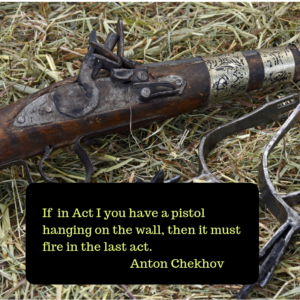 One of playwright Anton Chekhov’s most quoted maxims is this: If in Act I you have a pistol hanging on the wall, then it must fire in the last act. If you establish an expectation in the reader, particularly a strong expectation, you must fulfill it.
 The conversation has been loaded here, midway through the story:
2 Responses
Cat Rambo: Ten More Plots Taken From Other People’s Problems https://t.co/iAABxz9JST
RT @Catrambo: Ten More Plots Taken From Other People’s Problems: https://t.co/GwlRvE6ChH