

Five Ways
Subscribe to my newsletter and get a free story!
Share this:

My Report: Pittsburgh 2017 Nebula Conference

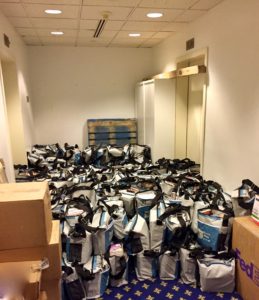
Swag bags assembled and awaiting distribution.
I got back late last night, after a trip back that included a lost reservation, my luggage being overweight (how could that be? oh, look at all those books) so I had to repack a bit at the counter under the check-in agent’s impatient gaze, and the poor kid beside me throwing up steadily all the way from PIT to IAD. It’s always weird, the day after travel, because one feels as though you’ve been simultaneously on vacation and yet working harder than most days.

I cannot begin to enumerate all the ways that weekend was wonderful. It was a great joy to see months and months of planning finally bear fruit and now we can relax for at least a couple days before thinking about next year. The programming was, in my opinion, outstanding. My only quarrel would be that there was so much good stuff that I could not get to every panel I wanted to, and that I could not spend enough time with the fabulous SFWA events team of Kate Baker, Terra LeMay, and Steven H Silver, who are responsible for everything that was wonderful.

One of the challenges for the Programming Team, led by Mary Robinette Kowal, was making sure the programming had something for all writers, whether they were tradpub, small press, indie, or hybrid. There were so many terrific, in-depth panels, including a wealth of shadow programming additions and office hours with writers and other publishing professionals. It made me think back to a Nebula from several years when I was on a lackadaisical panel about writers block that was, I think, so much less useful than it could have been and realize just how far the Nebula Conference has come from the days of “let’s all get together in a hotel and hand out the awards and then drink a lot.”
Literally the busiest person at the conference: SFWA's fabulous Executive Director Kate Baker
Literally the busiest person at the conference: SFWA’s fabulous Executive Director Kate Baker
Sarah Pinsker did a great job with the mentoring program, which matched up literally dozens of folks for mentoring sessions that were, for a number of folks, a major highlight of the con. I am sure many of the relationships formed there will last long after this weekend; I know I picked up two of my mentee’s books and am looking forward to reading them.

The book depot structure, so adeptly administered by Sean Wallace, meant that everyone had a chance to have their books there. That had been an issue for a number of the indies last year and it was gratifying to see that problem addressed. I apologize for being one of the people who brought a stack of books in at the last minute; Sean was very patient with the number of us who did so.

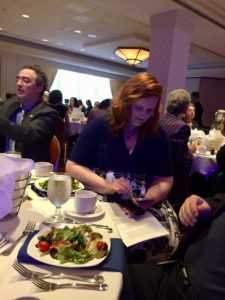
I will not claim everything was perfect; I think I’m one of the people most acquainted with every behind-the-scene misstep and/or perceived slight that needed smoothing over. But so many of the small touches were stellar. The centerpieces on the banquet tables were charming robots assembled from vintage materials by artist Don L. Jones. There were plenty of chances for networking with partners and finding new and interesting opportunities. The gender-neutral bathroom was there, and usable, and in a place where people could find it. The Volunteer Breakfast on Sunday was lovely; we had a great turn-out and people liked the appreciation certificates and special SFWA temporary tattoos. (I still have a lot of these and am happy to mail them to SFWAns.) Toastmaster Kjell Lindgren was charming and smart and loves SF as much as any of us; he even showed us the books that drew him on his lifepath.

Speaking of reading, the swag bags were STUFFED with great stuff; I was making a number of happy noises while unpacking mine. I also enjoyed pointing people at the excess tables towards books that I knew were terrific, like Sarah Kuhn’s The Heroine Complex or Alaya Dawn Johnson’s Spirit Binders books.

Picture of SFWA President Cat Rambo holding a small robot sculpture
I brought a robot home with me.
I got to wear several of my more high-end thrift store finds from this year, and also learned how to pack garments that consist mainly of chainmail-like layers of sequins. I also learned that such things really end up being heavy when you accumulate a few in one suitcase. My banquet dress was a big hit; I’ve never been asked before “who were you wearing?”, which amuses me and may underscore the lengths to which I will go in SFWA’s service.

I did indeed announce that SFWA will be giving out a game-writing Nebula. Not an award with a separate name, like the Andre Norton or Ray Bradbury Award, but a Nebula. Why? Because game-writing deserves to be right up there in the ranks, not treated like a special case (no disrespect is intended there to either of the named awards). If you’re a gamewriter interested in providing feedback on how SFWA can help/serve gamewriters — or better yet, if you’re interested in helping make that happen by volunteering — I’d love to hear from you, and you can find my contact information here.

Next year’s Nebulas will again be in Pittsburgh and at the same hotel. Overall, they did a pretty solid job (with a few overwhelmed restaurant bobbles) and I know the manager and the events team sat down together on Sunday and went over everything that went wrong and how we can avoid them next year, down to details like marking the ramp’s edges with white tape so next time no one trips and has a bad fall over that invisible edge.
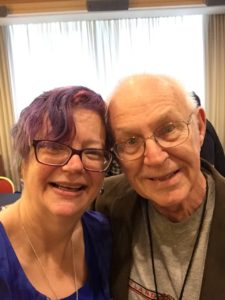
Selfie with SWA's CFO, Bud Sparhawk.
Selfie with SFWA’s CFO, Bud Sparhawk.
The business meeting on Saturday went smoothly; I don’t think there were any real surprises for anyone. The officer election results were announced; thank you and welcome to incoming officers Curtis Chen, Andy Duncan, Jeffe Kennedy, and John P. Murphy, with special thanks again to Erin M. Hartshorn for agreeing to take up M.C.A. Hogarth’s sparkly war axe. The most contentious discussion was a member who felt that some members might prefer to write letters to the editor in the e-newsletter The Singularity in order to communicate with fellow members than use the discussion forums; the agreement was made that should anyone wish to write such a letter, we will include it in The Singularity. Afterwards we had a panel in the same room about all the stuff SFWA offers writers; the challenge was that we didn’t have enough time to cover it all.

I don’t often get to surprise Steven H Silver, and yet Kate and I managed to keep the fact that Walter Day had made one of his awesome trading cards for him secret until the banquet. Walter’s trading cards are so nifty; he’s up to over 200 of them now and they were one of the nifty features of the swag bags. He also presented Jane Yolen with a special blown-up version of her new one. Jane gave a lovely speech, finishing with her Sally Field moment, and just generally was awesome and generous with her time all throughout the weekend.

The Super Nebula Showcase HumbleBundle has one day to go. So far it has raised more money for the SFWA Givers Fund, which administers grants to promote F&SF writing, than the Fund gave out last year. If you haven’t checked it out — there’s an awful lot of good reading in there.

Liz Argall did an adorable cartoon about the weekend, and another based on my closing words, which I hope she’ll post at some point, but I will reiterate them. It was so lovely to see you all. You are my people and I appreciate the trust you’ve given me. I’ll keep trying to steer things in a reasonable direction, but you’re the ones powering the ship. Thank you.

Many thanks to the Future Affairs Administration for live tweeting the Nebulas — they had over 4.5 million page views, which is awesome. I hope to be in Chengdu this winter to meet some of those viewers.

I am sure I have left out so much, and I suspect I’ll be updating this post throughout the next couple days as things occur to me, but I wanted to get a post up so peeps who weren’t there got to see some of the pictures. Here’s a few more.

Robots awaiting distribution to the banquet tables.
With our fabulous Toastmaster.
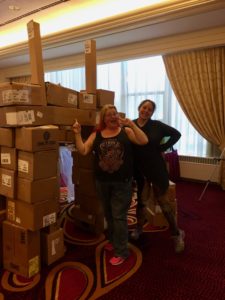
Walked into the SFWA office to find Seanan McGuire had built us a castle.

2 Responses

Leave a Reply

Your email address will not be published. Required fields are marked *

Get Fiction in Your Mailbox Each Month

Want access to a lively community of writers and readers, free writing classes, co-working sessions, special speakers, weekly writing games, random pictures and MORE for as little as $2? Check out Cat’s Patreon campaign.

Want to get some new fiction? Support my Patreon campaign.


"(On the writing F&SF workshop) Wanted to crow and say thanks: the first story I wrote after taking your class was my very first sale. Coincidence? nah….thanks so much."

~K. Richardson

You may also like...

Possible Upcoming Changes to SFWA Membership

The Science Fiction and Fantasy Writers of America, an august non-profit on whose board I have served in the past, held its business meeting in January of this year, and since it was virtual, I had the chance to attend, which was a nice chance to see some familiar faces, meet some new ones, and hear what the organization has been up to in the past year.

An interesting development for SFWA that seems to have been flying under most people’s radar is that the organization’s members will be voting on whether or not to change the membership requirements in a way that the organization has not previously done. This may be one of the biggest changes made to the membership yet in the organization’s 50+ years of history.

The new qualifications: a writer can join as an Associate member once they have earned $100 over the course of their career, and as a Full member at the $1000 level.

That’s a huge and very significant change from the current, somewhat arcane membership requirements of $1000 over the course of a year on a single work to become a Full member. Particularly when you think that one of the most contentious propositions on the discussion boards in the past has been the idea of re-qualification, of making people prove they qualify on a yearly basis. Moving away from a system so complicated SFWA had to create a webform to walk people through whether or not they qualified to something like this is a big win in so many ways.

Why I’m absolutely voting yes:

  • This change makes SFWA available to more people in the earlier stages of their career, which is often when they most need that community, support, and advice.
  • More and more varied members will make the Nebulas a heck of a lot more interesting and perhaps combat some of the logrolling that I’ve witnessed over twenty or so years.  This has the potential to really shake things up in a good way.
  • More and more varied members means more volunteers and budget and that’s huge. One of the best things about admitting indie writers was the wealth of knowledge, experience, and enthusiasm added to the organization overall. This is even more of that.
  • That also means more people talking on the boards. I’ve been a moderator on those boards for a long, long time, and they remain a source of community, news, and information for me. The more the merrier, in my opinion. 
  • This change also opens up the game writing qualifications in a way that answers a lot of the existing issues. SFWA’s admitting game writers has been a bit bumpy, mainly because of the incredible variety of ways that writing can manifest.
  • On a small personal level, it may mean I’ll witness less truculent bullshit from people personally affronted by the existence of the past requirements, although people will continue to think SFWA is a gelatinous cube.

For this to pass, enough of the full members need to vote on it. If you are a full member, I urge you to check your email for the mail with the voting link, which would have come on January 15, with the subject “[SFWA] 2022 Call for SFWA Board Candidates & Bylaws Vote”. The cut-off date for getting this done is February 15, a rapidly approaching deadline.

One other change from the board meeting answers the question of how this affects the idea of “SFWA qualifying markets,” which has in the past been used as a way to make sure fiction markets increased their rates every once in a while. We’re going to see a fiction matrix that looks at a number of factors, including pay, but also response time, quality of contract, etc. It’s very nice to see this long overdue project finally manifest, and I bear as much guilt as anyone in the long overdue part, since I was around when it was first proposed and should have kicked it along significantly harder than I did. I’m very happy to see this and ten thousand kudos to the people who made it happen.

There wasn’t much else to the meeting that surprised me. Like a lot of the F&SF organizations in 2021, live events have been a problem. (This surprised me given that SFWA was one of the first organizations to put on a pandemic version in a way that really showcased what a virtual event could be.) But hotel and event stuff has been problematic for a lot of events, to the point where some seem moribund or seriously endangered, and given that, it’s unsurprising that cancellation costs of the event have wounded the SFWA budget.

Overall though, SFWA remains pretty robust financially, and the Emergency Medical Fund, Legal Fund, and Givers Grants programs are still doing stellar work. You’ve seen some of that continue to play out in the DisneyMustPay campaign. I will remind people that it’s a good place to direct charitable donations, and that you can also support it through the Amazon Smile program, buying SFWA’s Storybundles and HumbleBundles, or even by buying one of those cool secret decoder rings.

...

Why SFWA Should (IMO) Admit Self-Published Writers, and Some Thoughts about the Process

Photo of Cat Rambo with Dark Vader and stormtrooper
Preparing to take on the challenges ahead.
SFWA, at its usual slow lumbering pace, is heading towards answering the question of whether or not the organization should allow self-publishing as a way to qualify for membership. For those unfamiliar with the current requirements, it involves sales to traditional publishing markets: three stories or a single novel advance at a specified rate (current 6 cents per word for stories and a $2000 advance for a novel, from a market listed as a SFWA qualifying market).

Do I believe results with self-publishing should qualify someone for SFWA? Yes, absolutely. To me the only question is how to define those results in a way that makes them comparable with the existing criteria.

The Economics of Being an Author

I believe that increasingly a 100% traditional publishing model is not as economically rewarding for most authors as one which combines it with (or may even be restricted to) self-publishing. Some authors will be able to make that approach pay, but the jury’s still out as to which way that trend will go in the future. However, I believe that SFWA members who follow a path restricted to traditional means will at some point be the minority — if they’re not already. Certainly the results of the poll we took show a lot of SFWA members (43% of responding Active members, 38% of Associates) are pursuing one form or another of self-publishing.

Sometimes people mention the self-publishing “bubble,” with the implication that all this newfangled stuff like e-readers is just a fad. I don’t agree. The experience of reading is undergoing a sea change. While physical books aren’t going away anytime soon, e-books are here to stay.

Are the Traditional Gatekeepers That Crucial?

Some of the arguments I’ve seen focus on the importance of the traditional gatekeepers (editors, publishers, and (to a lesser degree) agents) to the qualifying process. The argument falls along the lines that those gatekeepers are necessary because their economic investment in the text is the most acceptable way to certify quality. This argument also tends to be made primarily by editors and publishers.

While it’s true that self-publishing makes the author the sole and obviously biased person to answer the question whether something’s worthy of publication, luckily there are other ways to determine whether or not something is “professional-level” or not: an economic-based criteria that is already in the qualification rules.

To rely entirely on economic criteria is a more than adequate answer. SFWA already has them in place with the definition of minimum advance and per-word dollar amounts. Beyond that, what a publisher deems “good enough to be published” boils down to economic concerns as well: it means that the publisher believes it will make them enough money that an initial financial investment is worthwhile.

I should point out that, beyond the initial investment of time and creative energy, the self-published writer often — usually, in fact — invests financially in their books, in the form of hiring editing and proofing services, cover art, book design, audio production, advertising, etc. This should not be overlooked when considering the “average” self-published writer, who is very much a professional.

But in any case, it’s really the sales that matter. Whether or not readers want to spend money on the words. Asking self-published writers to prove sales comparable to the existing figures is reasonable as well as a simple and intuitive algorithm: the amount of money a traditional sale must make in order to qualify should equal the amount a self-published piece must make.

How we get people to prove sales is an important question. That and the actual criteria are the two most important decisions SFWA will be making.

Answering Objections:

In answer to some of the various objections I’ve seen.

SFWA shouldn’t do this because it will result in public feuds between traditionalists and the self-published.

Well, yes and no. A few diehards and zealots on either side will lock horns. As happens, and has happened on a regular basis since SFWA’s earliest days, there will come Heated Discussions. I believe this is par for this particular course, which is a lumpy, untended one full of straw men trying to play through.

But that group will be fairly small although loudly vocal. Most of us (and I say us because this is the camp I fall into) realize a number of things:

  • As professional writers who want to make a living at writing, we need to know what options we have with self-publishing.
  • There is a growing interest in self-publishing among us, as well as a rising number already trying it.
  • It is an economically viable way of generating income.

I have a stake in this race — right now I’ve been finding my experiment in what is a essentially a form of self-publishing, a Patreon campaign, a reasonable way to self-publish short stories.

SFWA knows it can’t — and shouldn’t try to — please everyone. This step will be controversial no matter what. The best thing SFWA can do is make sure that reasoning behind the decision is sound, that the membership feels it’s gotten enough chance to weigh in, and that the Board is willing to listen to and acknowledge feedback on an ongoing basis.

A mass of unworthy bozos and hobbyist writers will descend on SFWA, tainting its ranks.

SFWA has plenty already. A few more aren’t going to destroy us. Beyond which, this is why there are qualification criteria.

Bozos and hobbyists both seem boogeymen for the most part to me. No matter what the group, there will always be the brash, the socially-inept, the deficient in empathy or manners, the chip-shouldered, the self-appointed prophets and others lacking in basic social graces. They are an unfortunate fact of life in any population, no matter how refined or well-educated. I have no reason to believe the self-published have them in any greater (or lesser) degree than the current membership, or even the general populace of professional speculative fiction writers.

To worry about the somehow unworthy and unprofessional is to ignore the fact that there’s already a few people in the ranks who are there on scant sales or the kindness of a friend who happens to be an editor. Again, I have no reason to believe that for some reason the ranks of self-published have a disproportionate amount of these. There are some very talented and hardworking writers out there depending on self-publishing.

In Conclusion:

I’ve been re-reading Dale Spender’s excellent nonfiction work, Mothers of the Novel, and working on a lengthy essay drawing parallels between it and some of the recent treatment of women in F&SF: BS like “pink” versus “blue” SF (poor women don’t even get a primary color!), reviews scoffing at Ancillary Justice’s gender “gimmick”, and the Truesdale review of Women Destroying Science Fiction (so many of his essays, really) all come readily to mind.

And there’s some overlap there with self-publishing as well, and the way it dismantles one of the structures that’s often worked to reinforce the status quo, which is traditional publishing. Arguments against the horde of unwashed yahoos that will descend upon SFWA often seem to say as much about the speaker’s attitudes towards class as anything else.

So yes. SFWA already has plenty of members working with self-publishing. Allowing professional writers to qualify via self-published sales is a step that’s both overdue and not dangerous to SFWA. The only real danger would lie in a decision to ignore the importance of self-publishing and its impact on professional writers of today.

Addendum on 9/17/2014 – Because I seem to have created some confusion, let me clarify something. I talked about self-publishing because that’s the thing on my mind the most at the moment, and did not mean to imply that small press stuff is unimportant or not under consideration. The effort to revamp the overall criteria includes looking at how qualifying through small press publications “” including crowdfundingstuff like Kickstarter, which is another can of worms “” should work as well as whether existing criteria should be revised.

...

Skip to content