
Five Ways
Subscribe to my newsletter and get a free story!
Share this:

Guest Post: E.D.E. Bell Serves Up Five Simple Vegan Foods to Try

Hello. I love, read, and write fantasy fiction. Oh, and I’m a vegan.

When I sell my fantasy novels at Comic Cons, I’ll usually sneak a little reference onto the bottom of my table white board, such as Vegan, or Vegan-friendly. In my mind, this covert signal will draw vegans to my table, whispering, “I am one too. Tell me, sister, about your fiction.” Like that first moment of connection in a dystopian novel. This doesn’t happen. Instead, people skip all the other great things on the board, point right to vegan, loudly state, “Look, it says veggan!” and then laugh. This hasn’t dissuaded me from the attempt. About half of those times, someone will ask, “Vegan-friendly fantasy fiction? What’s that?” They laugh. Then when I start to answer, they leave. Even more often, they point and laugh, then turn away.

In my mind, whenever someone asks what could be vegan about fantasy, it proves to me that they’ve never been a vegan reading fantasy. In addition to a lot of the violence and war in the genre (it’s usually a central component, even outside of grimdark), the best scenes feature someone riding their steed in a fine leather vest to grab a hock of ham. I’m not even sure I know what hocks are, but I have concluded they are key to the development of fantasy heroes. So, you know, my fiction is just focused a bit differently. In fact, I think that diversity and exploration is what fantasy is all about.

I’m not here to get into all of that, though. I’m here to talk about one of Cat’s and my favorite subjects: yummy food. Now, I’m not an authority on gourmet cuisine. Go to a vegan restaurant or check out many amazing online vegan chefs for that. (I’m particularly fond of Richa Hingle.) Hey, I’m not even a great cook. But I haven’t eaten meat in almost a quarter century, so I can definitely speak to “what we eat.” Don’t worry. This is just a quick blog to spark some ideas. But if you don’t mind eating plants, here are five simple foods you could give a spin.
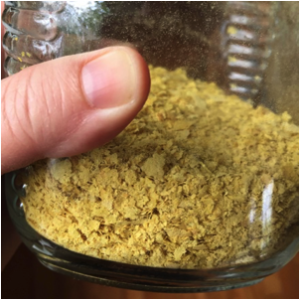
Jar of nutritional yeast
Here it is. Just a jar of yeast, with so many possibilities, as you will see below.
1. Nutritional Yeast

This is a vegan staple, and yet so many people have never even heard of it. First, where to procure?

Any health food store should sell it in bulk, but even a standard grocery store should have a little plastic can of it. It’s rich in B vitamins and is often described with a nutty or cheesy taste. (It’s really a “yeasty” taste but no one wants to say that for obvious reasons.) Online vegans often say to sprinkle it on popcorn, but I find it a little dusty that way. Bloggers always show it on avocado toast, but the avocado doesn’t need it. I use it as a savory seasoning: in soups, in pasta, or even to make a quick vegan mac & cheese. Just get a bag and throw it on or in stuff. It’s good.

Seitan slices
Some curried seitan slices, which I admit I ate after taking this photo.

2. Seitan

I do love a good tofu (I am so serious about tofu), and especially love when I can find local or handmade tofu. But there’s another common plant protein which with you may not be familiar. Seitan is essentially seasoned wheat gluten (or “wheat sausage” if you will), so it’s no good if you avoid gluten or eat gluten-free. Savory and rich, I really think you can’t beat a good homemade seitan. (Despite having more than one young hipster brag to me how much they love “eating Satan.”)

There are all kinds of searchable recipes, and I’d recommend using ones that incorporate lots of rich broth””and beer. (You don’t need the beer; it’s just got a flavor that works really well in seitan.) And if you don’t want to try making it, buy a good brand like Upton’s. It won’t be as juicy from the box, but still hearty and delicious.
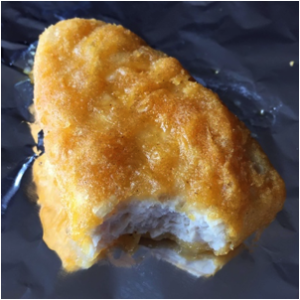
Gardein brand filet with a bite out of it
Fresh out of the toaster oven””and I may have taken a bite.
3. Packaged Plant Protein

I guess I should clarify that I’m a real-deal vegan. Without getting into it, that means I follow a belief system (an ethic) that also influences my diet. Not just a diet. This sometimes creates clashes with various plant-based diets that focus on health or shirk away from processed or commercial products.

No one should eat all packaged products. But if I had to, it might be the Gardein filets! Very likely in your grocer’s freezer too. It’s easy. Bake a couple of filets or tenders, cook a fresh tortilla (I buy ones without lard or non-vegan dough conditioners), and make a wrap with a few greens, some hot sauce, and a swipe of vegan cream cheese or mayo. I’m thinking about it now. Sigh.
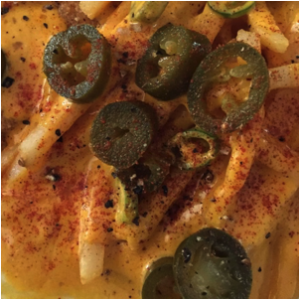
fries with cheese sauce and sliced jalapeños
Don’t tell anyone about this, but I was in a mood one night recently and made this quick cheese sauce by blending cashews; nutritional yeast; boiled potato, carrots, and onion; and salt, pepper, garlic, and paprika. Then I poured it over fries and added sliced jalapeños. It was fast, decadent, and not as high-calorie as it looks.
4. Cashews!

“But I’ve had cashews,” you say. “That’s just nuts.” But vegans use them as an easy source of cream or milk. You do really need a high-quality blender (e.g. Vitamix) to make this work, but if you have one, it’s very simple. It’s recommended to soak the cashews first (we soak a bunch then freeze them), but not required. You can make a quick milk just by blending cashews, water, and your preferred sweetener (or not). I use this for delicious fresh lattes, with a touch of maple syrup.

My favorite use is a quick red sauce (e.g. vodka or masala) by blending a handful of cashews, a can of tomatoes (with green chilies, even better) along with whatever vodka or spices you want. That can be poured over pasta, or used to simmer peas and tofu, or to dip that Gardein you bought, or for whatever!

5. Just grab a plant

Fennel, shallot, and okra
Some stuff I have laying around, ready for my next creation.

No, seriously, I’m not trying to get out of a fifth item here, but once you think more about plants, you’ll remember something you haven’t had for a while. I mean, I can’t just name all the plants. What do I eat? Sometimes a quick stir-fry. Other times a sandwich or freshly mashed guacamole. I can make soup dozens of different ways, all delicious and inexpensive. Stock spices. Stock your favorite grains. Simmer veggies in a rich sauce. Add fennel to pasta. Slice okra. Char corn. Glaze Brussels’ sprouts. Make a slaw. Throw in herbs. Or chop hot peppers. Bake potatoes. Add some Miyoko’s cheese or butter.

I could just go on and on, because quick staples I make for lunch are flashing in front of my eyes. Veggies are great! And maybe, like my fantasy heroes, you’ll be inspired to try one this week. If you do, tag me! I’d love to see what you make.

I hope that was fun””and maybe gave you some ideas for your next meal. I know I’m hungry, and since it’s five o’clock here, I’m off to break into that vegan wine. Want to connect? You can find me and my links at edebell.com. And you can check out my upcoming epic fantasy saga Diamondsong there too!

Author: E.D.E. Bell was born in the year of the fire dragon during a Cleveland blizzard. With an MSE in Electrical Engineering from the University of Michigan, three wonderful children, and nearly two decades in Northern Virginia and Southwest Ohio developing technical intelligence strategy, she now applies her magic to the creation of genre-bending fantasy fiction in Ferndale, Michigan, where she is proud to be part of the Detroit arts community. A passionate vegan and enthusiastic denier of gender rules, she feels strongly about issues related to human equality and animal compassion. She is the author of the Shkode trilogy and the editor of the new anthology, As Told by Things. Her latest book Escape (Diamondsong Book 1) is available for preorder now! You can follow her adventures and social media at edebell.com.

Enjoy this sample of Cat’s writing and want more of it on a weekly basis, along with insights into process, recipes, photos of Taco Cat, chances to ask Cat (or Taco) questions, discounts on and news of new classes, and more? Support her on Patreon.

this writing advice and want more content like it? Check out the classes Cat gives via the Rambo Academy for Wayward Writers, which offers both on-demand and live online writing classes for fantasy and science fiction writers from Cat and other authors, including Ann Leckie, Seanan McGuire, Fran Wilde and other talents! All classes include three free slots.
This was a guest blog post.
Interested in blogging here?

Assembling an itinerary for a blog tour? Promoting a book, game, or other creative effort that’s related to fantasy, horror, or science fiction and want to write a guest post for me?

Alas, I cannot pay, but if that does not dissuade you, here’s the guidelines.

Guest posts are publicized on Twitter, several Facebook pages and groups, my newsletter, and in my weekly link round-ups; you are welcome to link to your site, social media, and other related material.

Send a 2-3 sentence description of the proposed piece along with relevant dates (if, for example, you want to time things with a book release) to cat AT kittywumpus.net. If it sounds good, I’ll let you know.

I prefer essays fall into one of the following areas but I’m open to interesting pitches:

  • Interesting and not much explored areas of writing
  • Writers or other individuals you have been inspired by
  • Your favorite kitchen and a recipe to cook in it
  • A recipe or description of a meal from your upcoming book
  • Women, PoC, LGBT, or otherwise disadvantaged creators in the history of speculative fiction, ranging from very early figures such as Margaret Cavendish and Mary Wollstonecraft up to the present day.
  • Women, PoC, LGBT, or other wise disadvantaged creators in the history of gaming, ranging from very early times up to the present day.
  • F&SF volunteer efforts you work with

Length is 500 words on up, but if you’ve got something stretching beyond 1500 words, you might consider splitting it up into a series.

When submitting the approved piece, please paste the text of the piece into the email. Please include 1-3 images, including a headshot or other representation of you, that can be used with the piece and a 100-150 word bio that includes a pointer to your website and social media presences. (You’re welcome to include other related links.)

Or, if video is more your thing, let me know if you’d like to do a 10-15 minute videochat for my YouTube channel. I’m happy to handle filming and adding subtitles, so if you want a video without that hassle, this is a reasonable way to get one created. ???? Send 2-3 possible topics along with information about what you’re promoting and its timeline.

Show more

Leave a Reply

Your email address will not be published. Required fields are marked *

Get Fiction in Your Mailbox Each Month

Want access to a lively community of writers and readers, free writing classes, co-working sessions, special speakers, weekly writing games, random pictures and MORE for as little as $2? Check out Cat’s Patreon campaign.

Want to get some new fiction? Support my Patreon campaign.


"(On the writing F&SF workshop) Wanted to crow and say thanks: the first story I wrote after taking your class was my very first sale. Coincidence? nah….thanks so much."

~K. Richardson

You may also like...

Guest Post: Score One for Music by B. Morris Allen, "¨Editor, Metaphorosis Books and Metaphorosis Magazine

What if prose were written like music? What if, instead, of a common world, stories in an anthology were steps on a share emotional path? Those are the questions the upcoming anthology Score is attempting to answer.

Emotions are a key part of our experience of art. The books that stick with you are often the ones that made you feel something. Even when we don’t recall the details of a plot (or painting, or movie), we’ll often recall how it made us feel. Even if you don’t recall the details of Watership Down, for example -“” the names of the rabbits, the original warren, etc. “” you probably remember how you felt about the rabbits and what happened to them. You remember how you felt when you closed the book. Even if you mislay every detail of a book, you’ll remember whether it made you laugh or cry or feel wistful.

Score is an attempt to tackle the emotional side of writing head on. A group of almost 20 authors set out not to write about robots or aliens or magic “” though we have all of those “” but to write from emotion.

What does that mean, and how does it work? It means, simply, that each of the authors worked from a coherent emotional score, knowing the emotions in the piece before and after theirs, what emotions they were to emphasize, and … nothing else. They had complete freedom of genre, topic, tone, approach, etc. “” so long as they worked with the emotions they were assigned. The result is a fascinating collection of stories with a distinct emotional progression.

Putting together the score was challenging. As the editor and ‘composer’, I defined fairly early on the emotions we would work with. I knew the direction I wanted to score to take – an overall path of ascending hope that I thought a good fit to the times “” but choosing emotional terminology that would work consistently across many different writers took some work.

In the end, we worked from a palette of six emotional ranges – six emotions with four variants each, two positive, two negative. For example, Hope ranges from Hope at the positive end to Despair at the negative end. These aren’t quite the emotional pairs used by social scientists, and we could have ended up with a wide range of others, but these six emotional ranges allowed ample scope for ups and downs. The emotions are loosely grouped into two sets – the Hope set (Hope, Curiosity, Awe) and the Joy set (Joy, Love, Lust).

Each writer was assigned a specific major and minor emotion, and the score has distinct movements. Using musical terms very approximately, there’s an Overture, a Hope triad, a Joy triad, a Bridge, a Joy triad inversion, a Hope triad inversion, and a Coda. There are high points and low points, but … spoiler alert… it all ends with Hope and Joy.

It’s been a lot of fun putting this together. While I personally often write from an emotional basis, putting together an entire score was an intriguing and challenging exercise. Each writer interpreted the task in their own way, putting their own distinct stamp on it, as artists will. The result is intriguing, and I hope will be as much of an adventure for readers as it was for all of us.

Score: an SFF symphony is out on March 2nd from Metaphorosis Books.

Enjoy this writing advice and want more content like it? Check out the classes Cat gives via the Rambo Academy for Wayward Writers, which offers both on-demand and live online writing classes for fantasy and science fiction writers from Cat and other authors, including Ann Leckie, Seanan McGuire, Fran Wilde and other talents! All classes include three free slots.
If you’re an author or other fantasy and science fiction creative, and want to do a guest blog post, please check out the guest blog post guidelines.

...

Guest Post: Neurodiverse Alien Encounters in The Neurodiversiverse by Anthony Francis

A common science fiction trope is that aliens would think differently from humans. Larry Niven’s carnivorous Kzinti are curious only about things that interest them, C. J. Cherryh’s T’ca are multi-brained aliens that speak in matrices readable in any direction, and Steven Spielberg’s aliens from Close Encounters of the Third Kind communicate with music and gesture.

But, even just on the Earth, every human being thinks differently! This tremendous variation is called neurodiversity, and each individual’s distinctive cognitive style is their neurodivergence. Many kinds of neurodivergence are common, including autism, anxiety, synesthesia, and more – sometimes presenting challenges to individuals if society demands a different thinking style.

But could these different thinking styles actually help us understand aliens? Many autistic folks experience hyperfocus on special interests: could they better empathize with Kzinti? Could someone with dissociative personality disorder better understand the multiple-brained T’ca? And could a person with difficulty verbalizing better harmonize with Spielberg’s aliens?

My co-editor Liza Olmsted and I decided to explore whether neurodiversity would help us understand aliens in The Neurodiversiverse: Alien Encounters, a hopeful, empowering science fiction anthology from Thinking Ink Press exploring neurodivergent folks encountering aliens. Over forty contributors shared with us stories, poems and art exploring this theme.

For example, in “The Space Between Stitches” by Minerva Cerridwen, an autistic person’s hyperfocus helps her effortlessly repair an alien’s broken teleporter. In “Where Monolithic Minds Can’t Travel,” Akis Linardos explores whether aliens with multiple minds would resonate with dissociative disorder, unlocking travel to the stars. And in “Music, Not Words” by Ada Hoffmann, aliens that speak in music find harmony with a young woman who has trouble with words.

Many stories in The Neurodiversiverse are told from an authentic #ownvoices perspective, in which authors write stories about characters who share their own distinctive experiences. For example, I struggle with social anxiety disorder, and in my own “Shadows of Titanium Rain,” give those experiences to the character Djina as she struggles to understand solitary aliens.

Liza and I feel #ownvoices are particularly important because they improve the representation of marginalized voices in stories, which is part of the mission of Thinking Ink Press. Sometimes, it can be hard to imagine achieving something if you’ve never seen someone like yourself doing it – and it can be hard to solve a problem if you have no words to describe it.

We’re bringing The Neurodiversiverse to life no matter what, but because we’re a small press, we’re running a Kickstarter to help defray the costs of producing and promoting the book. In particular, we want to pay our authors the Science Fiction and Fantasy Writer’s Association (SFWA) “professional rate” of 8 cents a word, and the Kickstarter will help us do that.

Creating The Neurodiversiverse has been a voyage of discovery for us. Recently Thinking Ink Press embraced its identity as a publisher focused on marginalized voices – something we had always done, but not precisely noticed that we were doing; but once we noticed that it was our focus, we decided to lean in on that and do it well.

Exploring the topic of neurodiversity inspired me to propose “The Neurodiversiverse Anthology,” which I shared with our team to ensure we handled it sensitively. Liza was enthusiastic, joining as my coeditor and helping craft the anthology’s explicit focus on hopeful, empowering and #ownvoices stories. And work on the book awakened my understanding of my own struggles with neurodivergence, particularly social anxiety disorder and autism.

The Neurodiversiverse has opened doors for us as not just editors but as people with our own struggles with neurodivergence, and we hope it has a similar impact on everyone who reads it. So please back our Kickstarter (accessible during the campaign via neurodiversiverse.com) where you can not only help us pay our authors, you can get a copy of the book and find out the answer to the question, “Would neurodiversity help in an encounter with aliens?”

You can find the Kickstarter here.


About the author: By day, Anthony Francis teaches robots to learn; by night, he writes science fiction and draws comic books. His “Dakota Frost, Skindancer” urban fantasy series begins in the award-winning FROST MOON and continues in BLOOD ROCK and LIQUID FIRE. His latest novel is JEREMIAH WILLSTONE AND THE CLOCKWORK TIME MACHINE. He co-edited the anthology DOORWAYS TO EXTRA TIME and is the co-editor of the forthcoming anthology THE NEURODIVERSIVERSE: ALIEN ENCOUNTERS; for more information check out neurodiversiverse.com . You can read more about Anthony’s words, art and science on his blog “The Library of Dresan” at dresan.com.

If you’re an author or other fantasy and science fiction creative, and want to do a guest blog post, please check out the guest blog post guidelines. Or if you’re looking for community with fellow fantasy, science fiction, and horror writers, sign up for the Rambo Academy for Wayward Writers Critclub!

...

Skip to content