

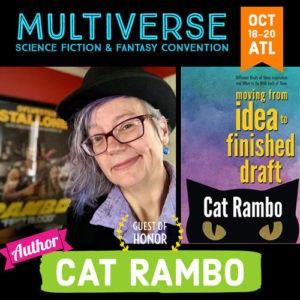
I’m off to Multiverse Con next week – it’s their first year, and I’m there as Industry Guest of Honor along with Seanan McGuire and John Piccacio. Come say hi if you’re there! Two weeks after that I’ll be up in Surrey BC as a presenter at the Surrey International Writers Conference.
In writing stuff, I am working hard this month on EXILES OF TABAT, which should go to beta readers on November 1. THE FIVE OF US, my middle grade space opera, just went off to readers at the beginning of the month. Next up in writing is the sequel to the Tor space opera, which will be my November project. In December, I’m going to focus on short stories and outlining three of my 2020 projects: a horror novel, a novella project, and the third space opera book.
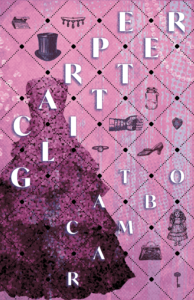
I just got the advance reading copies of CARPE GLITTER, my novelette coming out on the 29th with Meerkat Press. It’s a slim little book, and contains the story of a young woman who finds more than she expected when cleaning out the accumulated belongings of her stage magician grandmother, and asks the question – what do we do with unwanted inheritances when they’re part of our family?
Really enjoyed this family drama cum magic (mostly black) taking place in a late Not-So-Fairy-Grandmother’s house. Trying to find some interesting (and probably sellable) stuff in her deceased granny’s house, Persephone stumbles on stranger and more dangerous things than she had hoped for. A short, enjoyable and beautifully mastered anti-fairy tale novella, which offers more than its glittery surface indicates. Highly recommended for the readers who like true complexity hidden behind apparent simplicity.
This weekend, the Rambo Academy presents two new live online writing classes that I’m excited about. The first, Writing in the Cracks: Finding Time to Write with Diane Morrison, is aimed at people prepping for NaNoWriMo next month, and provides guidance for making and defending writing time. It’s $49 (or $39 for Patreon supporters and former students.) If you can’t make it, don’t despair! Next week the on-demand version will be up as well.
The second class on Sunday is a timely one if you’re thinking about Halloween fiction. Crimson Peaks and Menacing Mansions: How to Write Gothic Horror is a session where Catherine Lundoff will provide lecture and writing exercises designed to help you incorporate gothic horror into your own writing. It’s $99 (or $79 for Patreon supporters and former students.)
Want access to a lively community of writers and readers, free writing classes, co-working sessions, special speakers, weekly writing games, random pictures and MORE for as little as $2? Check out Cat’s Patreon campaign.
Want to get some new fiction? Support my Patreon campaign.
"(On the writing F&SF workshop) Wanted to crow and say thanks: the first story I wrote after taking your class was my very first sale. Coincidence? nah….thanks so much."
~K. Richardson
You may also like...
Nattering Social Justice Cook: Celebrating Rainbow Hair
One place recent culture wars have been being played out has been the virtual space occupied by Twitter and its adjacent social media. Examining a particular hashtag or recurring phrase often provides insight into what the topic of the moment is, as well as what tropes and memes are being deployed.
A common adjective in many of the more conservative, alt-right, and other theater-of-outrage rants I’ve seen in the past couple of years is “rainbow-haired,” never in a positive sense. It’s usually paired with some form of “social justice warrior,” and often accompanied by an emotional catch-phrase or verbiage like “feels” or “drinking the tears.” There’s a lot of interesting stuff built into that particular fixation. So let’s dig around to find what’s contained in the phrase and its use in this pejorative sense.
The rainbow itself has plenty going on, symbology-wise. In many mythologies, it’s the bridge between heaven and earth, used by gods, heroes, and shamans. In the Christian allegory of Noah, it’s the sign of God’s covenant with humanity. Leprechauns hide their gold at the rainbow’s foot, Indra uses it for his bow, and in the Australian Dreaming, it adorns the scales of the Rainbow Serpent who created the world. It’s also got a maxim built into it: something positive that cannot appear without something negative happening first. There are no rainbows without rain, at least a little of which must fall into every life.
In 1978, this metaphor for something containing a multitude of variations became associated with gay pride and diversity, through the efforts of artist/drag queen Gilbert Baker, who said of it: “We needed something beautiful, something from us. The rainbow is so perfect because it really fits our diversity in terms of race, gender, ages, all of those things. Plus, it’s a natural flag””it’s from the sky! And even though the rainbow has been used in other ways in vexilography, this use has now far eclipsed any other use that it had.”
And we should not forget Skittles and the slogan “verb the rainbow.”
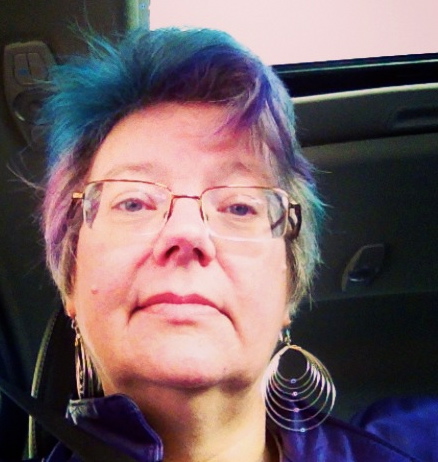
What happens when it becomes hair color that makes it particularly hate-worthy for dour conservatives? It’s something I’m fairly familiar with, since I started dying my hair with streaks of pink in 2006 when I found Loreal’s Color Rays on a Bartell’s shelf. The dye requires no pre-bleaching; it is alarmingly, wonderfully bright when it first goes on, and fades over the course of the next couple of months. While it only comes in three colors rather the multitudes other lines hold. I have yet to find another dye that lasts as long and well. I’ve tried plenty over the years, including Manic Panic, Ion, Arctic Fox, and Vibes. I wrote at length about the (over a decade-long now) experience in The Pink Hair Manifesto so I’ll avoid saying anything other than it’s something I anticipate continuing to do, particularly since it’s become part of my authorial brand.
Let’s ground the recent phenomenon of chemically-colored hair plumage historically, since it happened a few decades earlier than my decision. Fabulous colors required science to make it possible, but the earliest adopters were the punks, particularly Cyndi Lauper. This was considered pretty shocking; I can remember a girl at my high school dying a small patch of hers blue and having her father threaten to kick her out of the house as a result.
Rainbow hair, rooted in a counter-culture movement, revels in individuality and a certain DIY spirit (there is no shame in going to the salon for it, but I find it much more fun to do my own). It celebrates one’s appearance, draws the eye rather than shrinking away from it. It is something beautiful that those who don’t fit inside normal standards of beauty can have. It is playful, joyful, delightful at times.
Very recently it has spread like wildfire, and many of the people adopting it are millennials. This gives the anti-rainbow hair sentiment a double-whammy, providing an “oh these kids nowadays” moment while slamming anyone older for acting overly young. (Which implies that’s a bad thing, which isn’t a notion I agree with).
Here’s something that I think also often makes conservative minds bristle: it confuses gender norms. In traditional thinking, men aren’t supposed to care about or celebrate their appearance in the way women are. But rainbow hair appears all over the gender spectrum. Pull in the strand of meaning associated with gay pride, and the objectionability quotient increases.
There’s a reason alt-right and other manifestations of conservative trollish rhetoric so often focuses on appearance, on fat-shaming or fuckability or even how a new Ken-doll wears their hair. It’s a reversion to the schoolyard insult, the way insecure children will be cruel to others in order to try to build their internal self-worth, a behavior many, but sadly not all, outgrow. Worthy of an essay in itself is the fact that it’s also behavior advantageous to advertisers: anxious consumers who want to fit in are willing to spend money in the effort.
This strategy of playground taunts based on a) something most people have little control over and b) a rigid set of norms is curious when we go back to the associated ideas of emotion and “feels” (I do want to talk about what additional stuff is built into the latter, but let me return to that in a second.) Emotion is traditionally seen as the domain of women and children; men keep a stiff upper lip and a silent heart of winter. Often emotionality is built into the verbs used to describe speech: shrill, shriek, and scream are favorites.
It would be nice if pointing out the gender and other biases BS built into such language defused it entirely, but certainly it’s easier to keep it from affecting you if you’re aware of it. Life for many non-mainstream groups is a constant course of avoiding the particular lumps of low-level radiation scattered throughout our daily landscape. I’m aware I’ve got some shielding from that denied others.
So what’s built into “feels” beyond that? It’s a denigration of the memespeak and emoticons of the millennials, as far as I can tell, a curious mockery of Tumblr and lolcat culture. And there’s a reason that they fear that group, which is better (IMO) at seeing through the clouds of Internet argument than some of the other generations.
Literally four decades ago, when I was a kid, we saw football player Rosey Grier singing that it was all right to feel things:
Which leads me to my conclusion, which is that it seems like an ineffective and overly dour point to hammer on. Overall, I can’t read any of the negatives being packed into rainbow-haired as actual negatives. Celebrate the rainbow connection, I say, and close accordingly with that.
Who said that wishes would be heard and answered when wished on the morning star?
Someone thought of that and someone believed it.
Look what it’s done so far.
What’s so amazing that keeps us stargazing and what do we think we might see?
Someday we’ll find it, the rainbow connection.
The lovers, the dreamers and me.
Looking to the right from our balcony.Day Three here, so I thought I’d describe what it’s like. We’re renting a condo that overlooks the beach, towards the northwest end. The place is great, and there’s a balcony that is literally bigger than our living room back home. We share it with a tiny lizard that is living in the drapes in the living room.
It’s rainy season, so it’s Humid and warm, but there’s usually a nice breeze coming in from the ocean. Rainy season doesn’t mean the same thing that it does in Seattle. Here sometimes it’s nice and sunny and then suddenly OMG THERE ARE BUCKETS OF WATER FALLING FROM THE SKY. I kinda like it, myself. And I’m sure it doesn’t hurt me to be forced inside in order to write. 😉
We’re a little outside the main drag, so we’re within walking distance of grocery store, restaurants, etc, but it’s a bit of a slog in this heat. People are friendly if you address them, but it doesn’t feel as though most of them are interested in interacting. (Not that they should, just that it feels a lot less chatty than back in Seattle.) My Spanish is improving in leaps and bounds, though, so I’m feeling pretty comfortable in terms of being able to communicate. We’ve also found they show Big Bang Theory with Spanish subtitles every evening, which is a nice way to supplement the geekier part of my vocababulary.
The vegetation, the birds, etc, are wonderfully new. Lots and lots of flowers, plenty of lizards (in a wide range of sizes), and birds I don’t know, aside from the pair of macaws we saw on our first evening, which seemed a lovely omen. We believe they were getting very friendly with each other — not sure what that does to the omen’s significance.
We can see the hills and mountains, which usually have clouds slumbering on them, lovely vistas that remind me a little of the Blue Mountain greeting cards we used to sell at Waldenbooks, a ragged line trailing into softer fog, but without all the platitudes written underneath.
Speaking of platitudes, I’ve been following the news back home as well, and watching the sad and horrible events in Ferguson in particular. If, like me, you want to know what you can do besides flail helplessly, here’s a piece, Ten Things White People Can Do About Ferguson Beside Tweet, that I found via N.K. Jemisin that is helpful.
As for the Hugo Awards – many congratulations to all the winners, but in particular Ann Leckie, whose Ancillary Justice kicks butt. It was a weird ballot but hopefully one that raised awareness of the Hugos and will pull in new readers.