We ended up granting a couple of deadline extensions for the novel workshop, and it seemed fairer to me to extend that to everyone. So if you are someone who wanted to apply and just didn’t get their stuff in order, you’re got an extra two weeks if you want to apply.
If you’re interested in the short story workshop, its deadline is the end of this month!
Want access to a lively community of writers and readers, free writing classes, co-working sessions, special speakers, weekly writing games, random pictures and MORE for as little as $2? Check out Cat’s Patreon campaign.
Want to get some new fiction? Support my Patreon campaign.
"(On the writing F&SF workshop) Wanted to crow and say thanks: the first story I wrote after taking your class was my very first sale. Coincidence? nah….thanks so much."
~K. Richardson
You may also like...
Why Podcast? Reasons For Writers
The human associated with this fine dragon is Goldeen Ogawa (http://www.goldeenogawa.com/).This Sunday, Folly Blaine and I are teaching another podcasting class. Here’s the description:
Podcasting Basics
Podcasts, both audio and video, are an increasingly popular way to reach an audience. In this two hour session, learn what you need to know to record and edit your own podcast, how to promote your podcast, and what equipment and software to use. As Folly Blaine, Christy records and acts as Podcast Manager for Every Day Fiction, and has also recorded podcasts for Beneath Ceaseless Skies, Wily Writers, and This Mutant Life; Cat is the former fiction editor of Fantasy Magazine and has recorded podcasts for Clarkesworld, Beneath Ceaseless Skies, and Fantasy Magazine. Limited enrollment ““ reserve a slot now!
Sunday, 9:30-11:30 AM PST, February 9
$99
Why might you be interested in podcasting and learning to do your own? Here’s a few reasons:
It’s a good way to reach a new set of readers. Many of the people who listen to podcasts prefer that to finding your stuff in text form inline. They’ll listen to your story in the car, while exercising, while working, and other places where text isn’t convenient. And they’re always looking for new, good stuff.
It’s a great way to polish your reading aloud skills. As a writer you’ll need to do readings. We’ll give you some tips in the class, but the best way to get better at it? Practice.
It makes you comprehend your work in a new way. I always read aloud stories as a last step in polishing them. Combine that with recording a podcast and you’re examining your work in order to figure out how it sounds.
Last week, my agent told me that authors who record their own books see a significant bump in sales, but that publishing houses don’t like to have them do it, because they’re unsure of the quality. If you can point to previous podcasting experience, you can back up the suggestion that you read your own work and even have samples of what you can do.
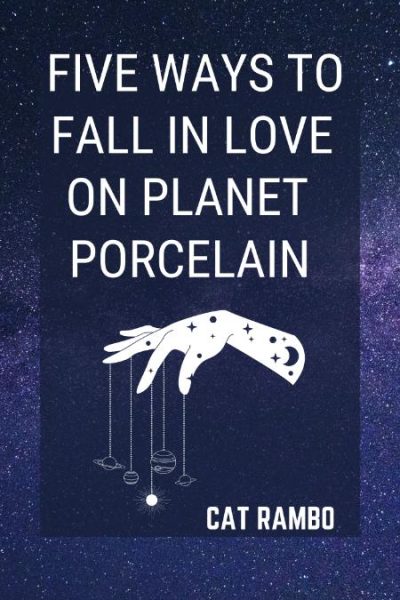
When publicizing “Five Ways to Fall in Love on Planet Porcelain,” I made sure it was available in audio form. Did that help earn it a Nebula nomination? I don’t know, but it certainly didn’t hurt.
Prefer to opt for weekly interaction, advice, opportunities to ask questions, and access to the Chez Rambo Discord community and critique group? Check out Cat’s Patreon. Or sample her writing here.
How to Dunk Your Reader in the Details (Figuratively)
I’m finishing up converting the workshop I did at Surrey International Writers Conference a month or so ago, Dunking Your Readers in the Details, as an on-demand class. That class was in turn based on an hourlong online writing class I did for Greg Wilson’s Twitch channel a few months ago.
The class has been fun to put together. Over the course of being taught multiple times, it’s evolved to a point where it presents a dozen tools for writing more immersive worlds, and includes several exercises to allow you to test out the different techniques and see what works for you.
Curious about it? Here’s the section on prioritizing the senses.
A common tool of “Golden Age science fiction” “” the late 1930s through the 50s, when science fiction was first coming into its own as a genre “” was to invoke all five senses within the first page of a story.
It turns out there’s some science behind that method, in that writing that uses the senses creates more brain activity, setting off mirror neurons. Mirror neurons are neurons that fire under two circumstances: when you are experiencing an event and secondly when you are watching someone else experience it. Writing that invokes the senses makes mirror neurons fire, which makes your reader feel as though they’re experiencing what you are describing.
But beyond that, three of the five senses are more useful to you and should be focused on. Sight and sound will come naturally, and we’re inured to them from watching television and the movies. What you need to push to invoke are smell, taste, and most importantly: touch.
Why is the last the most important? Because touch is more than a question of smooth or rough, velvet versus pebbled. It includes:
â—¦ Temperature like a chilly breeze, the warmth of a sunbeam
â—¦ Bodily sensations such as pain, nausea, exhaustion, fever, itches
â—¦ Motion moments like falling, flying, and floating
When you use these senses in your writing, you are making the reader feel as though they are in the body of the point of view character and experiencing the story world through them. This is a key technique when writing an immersive world.

 We ended up granting a couple of deadline extensions for the novel workshop, and it seemed fairer to me to extend that to everyone. So if you are someone who wanted to apply and just didn’t get their stuff in order, you’re got an extra two weeks if you want to apply.