


 I was on the road for most of September. That photo’s taken in the elevator of the Flatiron Building while I was in NYC, but other places I stayed included Dallas, Texas and Pocatello, Idaho. (More on that to come!) Here’s what I read in September, according to my notes, which always seem to leave out some stuff. Bolded indicates a particularly notable read.
Alex P. Berg. Red Hot Steele.
Jillian Blake. Antisocial.
Ramsey Campbell. The Parasite.
Jessica Cluess A Shadow Bright and Burning.
George Alec Effinger. Heroics.
Justin Evans. The White Devil.
Rumer Godden. Black Narcissus. Interesting because I’d been thinking about omniscient POV, which this book uses.
Joe Hill. The Fireman.
Tami Hoag. Cold Cold Heart,
Aaron James. Assholes* A Theory. Some useful stuff on dealing with bad-faith actors.
Stephen King and Owen King. Gwendy’s Button Box.
Stephen King. End of Watch.
Mur Lafferty. Six Wakes.
Carrie Ann Noble. The Gold Son.
Dan Padavona. Crawlspace.
Sarah Porter. Vassa in the Night.
Susan Kaye Quinn. Third Daughter. Enjoyable steampunk romance with an Indian-flavored milieu.
Ron Ripley. Berkley Street.
Jon Ronson. So You’ve Been Publicly Shamed. Fascinating read about social media and publicity gone awry.
Sherwood Smith. Inda, The Fox, King’s Shield, and Treason’s Shore.
Wendy Corsi Staub. Lullaby and Good Night.
Steven Rasnic Tem. Deadfall Hotel.
I’ve been watching DC’s Legends and am halfway through Season 2 so far.
 Post-Nebulas, I’ve been going through and trying to clear away a lot from my shelves and TBR list, particularly given that I still had a substantial armload from the International Conference of the Fantastic in the Arts and its munificent book tables. Here’s some particular recent favorites.
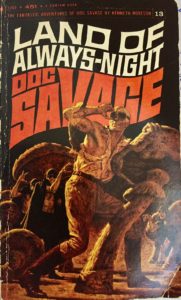 In packing for a trip, I discovered I’d somehow bypassed some of the earlier Doc Savages, so we backtrack now to book 13: Land of Always-Night. On the cover, Doc, wearing torn shirt and steampunk goggles, looks back and away from a grove of giant mushrooms, not noticing the several odd figures vaguely resembling the Monarch from The Venture Brothers menacing him with raised hands.
This one has to be my favorite beginning yet:
It is somewhat ridiculous to say that a human hand can resemble a butterfly. Yet this particular hand did attain that similarity. Probably it was the way it moved, hovered, moved again, with something about it that was remindful of a slow-motion picture being shown on a screen.
The color had something to do with the impression. The hand was white, unnatural; it might have been fashioned of mother of pearl. There was something serpentine, hideous, about the way it strayed and hovered, yet was never still. It made one think of a venomous white moth.
It made Beery Hosmer think of death. Only the expression on Beery Hosmer’s face told that, for he was not saying anything. But he was trying to. His lips shaped word syllables and the muscle strings in his scrawny throat jerked, but no sounds came out.
The horrible white hand floated up toward Beery Hosmer’s face. The side street was gloomy, deserted except for Beery Hosmer and the man with the uncanny hand. The hand stood out in the Merck almost as if it were a thing of white paper with a light inside.
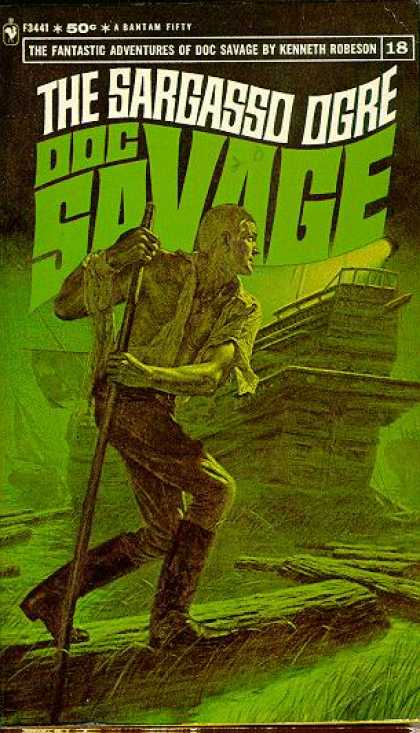 Our cover is mainly green, depicting Doc poling a log in what have to be anti-gravity boots because there is no way he would maintain his balance otherwise, towards an abandoned ship. As always, his shirt is artfully torn and his footwear worthy of a J. Peterman catalog.
In this read, book eighteen of the series, we finally get to see another of Doc’s men, electrical engineer Long Tom. I do want to begin with a caveat that this book starts in Alexandria and initially features an Islamic villain, Pasha Bey; while I will call out some specific instances, this is the first of these where the racism is oozing all over the page and betrays so many things about the American popular conception of the Middle East. I just want to get that out of the way up front, because it is a big ol’ problem in the beginning of this text.
We begin, therefore, with the incredibly problematic Pasha Bey:
An American man of letters once said that, if a man build a better mousetrap, the world would beat a path to his door.
Pasha Bey was like that. His output was not mouse traps, but it was the best of its kind. Being modern, Pasha Bey had become president of a vast organization which specialized in his product. The fame of Pasha Bey was great. From all of Egypt, men beat a path to his door, which was likely to be anywhere in Alexandria. They came to buy this product, of course.
Pasha Bey’s product was murder!

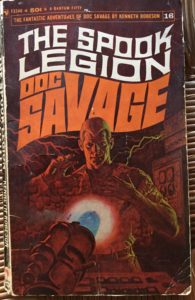 We return to a gentler, more innocent world again with Doc Savage number 16: The Spook Legion. In the intervening time since Quest of Qui, they’ve undergone adventures The Fantastic Island, Land of Always-Night, and Murder Melody. For people interested in undertaking their own reads, here’s an excellent post about which Doc Savage books to start with.
On the red-toned cover, Doc confronts a machine with what seems to be a cabalistic gesture of some sort. Maybe just jazz hands; the cover artist was fond of a particular kind of pose. A closer look shows Doc is in the process of turning invisible; the bricks behind him are starting to show through.
Author Lester Dent tries to pull off some tricky stuff in this book and it sometimes trips him up, unfortunately. How much that actually affects the book is something I’ll leave to you to judge. It’s also a fairly convoluted book, presenting the information as though sliding things into place to give us the final picture. You have to respect Dent’s ability to plot and willingness to just go all the way with the weirdness at times.
Much like Quest of Qui we begin with a certain number of negative assertions, this time about an individual:
Leo Bell was a counter clerk in a Boston telegraph office. Leo was level-headed. He certainly did not believe in spooks. At least, he did not believe in spooks at precisely 10 o’clock at night, as he moved behind the counter straightening the books of message blanks.
At 10:05 Leo’s disbelief and spooks received a rude jarring.
Though he’s alone in the office, he investigates a wastebasket that overturns by itself, and then finds a mysterious message: a telegraph blank filled out as follow:
DOC SAVAGE
NEW YORK CITY
MATTER OF VITAL DANGER TO THOUSANDS MERITS YOUR ATTENTION STOP PLEASE BOARD BOSTON TO NEW YORK PASSENGER PLANE OF EXCELSIOR AIRWAYS AT NOON TO-MORROW STOP GET ABOARD IN BOSTON STOP SUGGEST YOU USE DISGUISE AND BE PREPARED HIDEOUS AND AMAZING EXPERIENCE.
A N ONYMOUS
(1440 Powder Road)
Hideous and amazing! Let us begin. Leo does, of course, send off the telegraph and soon after Doc Savage calls on the phone. He points out certain subtleties we might have missed earlier:
The mysterious circumstances surrounding the appearance of the message then came out. Dr. Savage heard it through without comment then advised, “There is probably no A. N. Onymous listed in your directory.”
Leo Bell looked in the directory.
“No,” he said. “There is not.”
“The name was the result of a trick writing of the word ‘anonymous,'” Doc pointed out. “The dictionary defines an anonymous work as one of unknown authorship, which seems to fit in this case.”
Lemony Snickett has nothing on Lester Dent. Leo and the night manager discuss the mysterious telegram and then vanish from the book, never to be seen again.
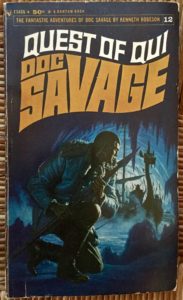 Cassy, in the process of shedding a box of Doc Savage novels, found out I loved them and passed them along. I remember Doc and his men fondly; while at my grandparents for a Kansas summer when I was twelve or thirteen, I found my uncle’s old books, which included a pretty complete run of the Bantam reprints and reveled in them for years to come.
I’m going back and rereading while making notes because I loved and still love these books; my hope is that I’ll start to notice some patterns as I move through the books and that I’ll be able to talk about pulp tropes, gender assumptions, reading fiction aimed at a gender other than your own, and writerly techniques in an entertaining and (maybe) useful way. I’ll go consecutively by issue date of the ones I have; I will go back and fill in earlier ones as I run across the books. I don’t envision doing a post of this kind more than once a week; this one turned out close to six thousand words.
So let us begin.

I love the texture of steampunk and have been enjoying seeing continued riffs on a theme that has a long way to go before it’s played out. Here’s six that I’ve enjoyed in the past couple of years. It is by no means an exhaustive list, but each of these bring in aspects of other genres in a way that showcases how much life such a mixture can produce.
Clockwork Lives by Kevin J. Anderson and Neil Peart The book description had me at “steampunk Canterbury Tales” and it’s got some of that adventure’s flavor as it moves along following the adventures of Marinda Peake as she strives to make her life worthy of her father’s legacy. I picked up the lovely hardcover version of the book, which is very prettily put together, complete with facsimile marbled endpapers, high-grade paper, and nice illustrations.
City of the Saints: A Scientific Romance in Four Parts by D. J. Butler There’s a frenzied genius to Butler’s cast of characters, which includes Richard Burton, Samuel Clemens, and Edgar Allen Poe, all turned into intelligence agents vying with each other and the agents of the Kingdom of Deseret against a background of a Utah transmogrified by the steampunk filter into something rich and tangily textured. This book is fun not just for the quick-paced story but as an alternate history that plays with a number of known characters in ways that only add to their legendary nature.
The Emperor’s Edge by Lindsay Buroker. Buroker is a great example of what indie publishing can be. I came to her Emperor’s Edge series because she’d offered the first one free for the Kindle. Smart strategy on her part, because they’re fun fantasy romps that are addictive as crack, with a cast of characters that are entertaining and engaging, and a slow simmering love story that stretches out over the course of the series.
The Clockwork Dagger by Beth Cato. The Clockwork Dagger is the first of a series; the sequel appeared this June. Another strong romantic subplot, but the focus is the journey of Octavia Leander as she struggles to understand her growing healing powers. It’s an unexpectedly satisfying book, and I’ve got the sequel queued up and in my TBR pile.
Cold Magic by Kate Elliot. The first of a terrific trilogy, this combines epic adventure and steampunk as the orphaned Catherine Barahal travels through a pseudo-Victorian world caught up in the middle of social upheaval. One of the joys of big fat fantasy book series is knowing that you’re in for a good, long ride, and Elliott delivers that in spades. (And if you haven’t read her before, you’re welcome. She’s one of the underestimated fantasy writers, IMO.)
A Thousand Perfect Things by Kay Kenyon. Kenyon writes some of the best social science fiction around, and here she turns that skill to steampunk. The warring countries of Anglica and Bharata meet on a mystical bridge that spans the sea distance between them, and the description of that mode of travel continues to resonate in my head as one of the most interesting landscapes fantasy has to offer.
Crooked by Richard Pett. Imagine Lovecraftian steampunk, with machineries of flesh and rot, and mysterious elixirs of immortality, and you might come close to Crooked. Eerie and wonderful, it’s a marvelous and chilling read that shows how steampunk Cthulhu can becomes.
And here’s a bonus that I ran across while researching links for this post, and found a must-buy: The Diabolical Miss Hyde, by Viola Carr. The description made it irresistible. I love books that pay tribute to classics by reworking them in interesting ways, and Dr. Jekyll and Mr. Hyde is a particular favorite of mine. I’ve saving this read for sometime when I want to curl up and lose myself for a while.
#sfwaauthors #sfwaauthor
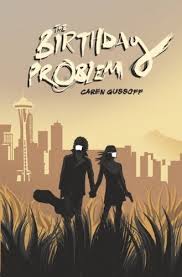
The Birthday Problem of the title is a common mathematical puzzle: find the probability that, in a group of N people, there is at least one pair of people who have the same birthday. (Hint: it’s a much lower number than you think. You can find out more about it on Wikipedia if you want to understand why.) The book is about odd ties and coincidences, set in a crumbling Seattle in a world plagued by nanobots that make people crazy.
Why’s it instructive to take a look at? Because Gussoff confronts two problems that speculative writers often face. The first is a complicated scientific or mathematical concept, like the birthday problem, which the reader needs to understand. Gussoff manages to convey it to the reader with no “As you know, Bob” or overly pedantic moments.
The second is that it’s constructed in a way that is incredibly hard to do: overlapping points of view, and plenty of them. When you switch POVs, you bounce the reader out of the story just a little, and Gussoff does it in a way that swiftly gathers the reader back in.
I like to include a beginning chunk of the book I’m discussing to show you what the author’s prose style as well as what they set. Here’s the first three paragraphs from The Birthday Problem:
Chaaya wasn’t surprised when she woke up and saw lips aimed directly over her face. It was beginning. It’d been just a matter of time.
It begins with one, good solid hallucination.
That was how it had happened to her Nani.This is how it would happen to her.
Gussoff also makes the most of her setting in a way that will delight Seattleites. There’s a joy to imagining Pike Place Market as a post-apocalytic trading post or the SF Museum hosting a cadre led by an aging rock musician.
If you’re interested in more of Gussoff’s work, she’s got a novella appearing this January from Aqueduct Press, Three Songs for Roxy. Its main character is an alien raised by Romany, and Gussoff draws on her own heritage to create a realistic, unromantic, and absolutely appealing narrative.
#sfwapro

The book won both a Lambda and Tiptree Award, and it’s easy to see why. A dynamite protagonist interacting with intriguing and beautifully three-dimensional characters. The world is fabulously drawn, evocative, and both the anthropological and physical science are accurate and carefully thought out.
Ammonite was Griffith’s debut novel. I’d also recommend her most recent, the absolutely amazing Hild, a retelling of the life of historical figure, Saint Hild of Whitby. Come to think of it, nothing I’ve read by her has been shabby, including Slow River, a near-future thriller that is also beautifully told and engaging.
I had the luck to sit in on a class Griffith taught for Clarion West a couple of years ago. She is a consummate, careful wordsmith. The word “luminous” keeps appearing in reviews of her work, and that’s because it’s so beautifully crafted that it seems to glow from within.
The first three paragraphs of a piece set up so much. Here’s the first three of Ammonite, to give you a taste:
Marghe’s suit was still open at neck and wrist, and the helmet rested in the crook of her left arm. An ID flash was sealed to her should” “Marguerite Angelica Taishan, SEC.” The suit was wrinkled and smelled of just-unrolled plastic, and she felt heavy and awkward, even in the two-thirds gravity of orbital station Estrade.
She stood by the airlock at the inside end of A Section. THe door was already open. Waiting. She rested the fingertips of her right hand on the smooth ceramic of the raised hatch frame; it was cool, shocking after two days of the close human heat of A Section.
The sill of the airlock reached her knees; easy enough to step over. No great barrier. The lock chamber itself was two strides across. THe dar door was still closed, sealed to another sill, like this one. Four steps from here to B Section. Four steps. She had recontracted with SEC, endured six months of retraining on Earth, traveled eighteen months aboard the Terragin, and spent the last two days on the Estrade bumping elbows with the three-member crew, all to take those four steps.
#sfwapro
Want access to a lively community of writers and readers, free writing classes, co-working sessions, special speakers, weekly writing games, random pictures and MORE for as little as $2? Check out Cat’s Patreon campaign.