

Five Ways
Subscribe to my newsletter and get a free story!
Share this:

10 Free Science Fiction Classics

1939 Poster from the Karel Capek play, R.U.R.
To write science fiction, it's helpful to know something about its roots.
A major joy of my new Kindle is finding free books. I figured other people might appreciate some of the finds (and might share some of their own – bonus!).

So here’s a slew of classic science fiction novels, available free online on Project Gutenberg. (Kindle users, it’s so so easy to mail files onto your Kindle, although it’s not free when you’re moving books on there, but costs a .15 per MB, with a book running 2-4 MB, depending.)

  1. Flatland by Edwin Abbot. The story of life in two dimensions, written in 1884 by an English schoolmaster, it originally boasted “A Square” as author.
  2. A Princess of Mars by Edgar Rice Burroughs. One of the great pulp writers, Burroughs’ work is well represented on Project Gutenberg, and provides a taste of old school sf at its best. including the Mars, Pellucidar, and Tarzan series.
  3. R.U.R. by Karel Capek. This Czechoslovakian play first was staged in 1921. It deals with the rise of the robots, and their final rebellion against the humans.
  4. Herland by Charlotte Perkins Gilman. Written by one of the early suffrage leaders, Gilman posits a society without men, and in the tradition of such utopian fiction, explains it at length.
  5. Deathworld by Harry Harrison. The first of the Deathworld series, this deals with gambler Jason dinAlt and his visit to the deadliest planet in the universe.
  6. Beyond Lies the Wub by Philip K. Dick. No one can be a science fiction fan without at least a little Philip K. Dick in their reading background (in my opinion). Prolific, full of wild imagination, and talented, he produced novels and short stories that are a major influence on the field. Others to read by Dick: Valis, Ubik), Flow My Tears, the Policeman Said, and (always) Do Androids Dream of Electric Sheep (which inspired the movie Bladerunner). I’m happy to see so many P.K. Dick novels available on the Kindle, but I miss Eye in the Sky and The Man in the High Castle.
  7. Time Traders by Andre Norton. Norton brought countless readers to f&sf through her YA novels. Time Traders is the first of a series and follows sharp-jawed, keen-eyed Ross Murdock in his quest for lost alien technology.
  8. Galaxy Primes by E.E. Smith. Another of the Golden Age writers, Smith does space opera like no one else. Here two men and two men are lost in space and must somehow chart their way back to their home planet, Earth.
  9. Invisible Man by H.G. Wells. There’s a lot of Wells to pick from, but this is one of my favorites, and certainly has inspired plenty of other works, both books and movies. I’ll note that you should read Ralph Ellison’s version first – while not strictly sf, it’s surreal and enlightening and a great take on the idea.

And the tenth? I’m leaving it up to you to supply, dear readers – what would you suggest, what have you found online that delighted or amazed you?

(Coming tomorrow: story prompt!!)


3 Responses

Leave a Reply

Your email address will not be published. Required fields are marked *

Get Fiction in Your Mailbox Each Month

Want access to a lively community of writers and readers, free writing classes, co-working sessions, special speakers, weekly writing games, random pictures and MORE for as little as $2? Check out Cat’s Patreon campaign.

Want to get some new fiction? Support my Patreon campaign.


"(On the writing F&SF workshop) Wanted to crow and say thanks: the first story I wrote after taking your class was my very first sale. Coincidence? nah….thanks so much."

~K. Richardson

You may also like...

Documents of Tabat: Arriving in Tabat
abstract image
What are the documents of Tabat? In an early version of the book, I had a number of interstitial pieces, each a document produced by the city: playbills, advertisements, guide book entries. They had to be cut but I kept them for web-use. I hope you enjoy this installment, but you’ll have to read Beasts of Tabat to get the full significance. -Cat

“Arriving in Tabat: A Visitor’s Guide,” being Pamphlet #12 of the second series of A Visitor’s Guide to Tabat, Spinner Press, author unknown.

No traveler notices the same thing about the city of Tabat when they first see it. For one, it may be the sparkle of sunlight on the harbor and the way the great ship’s shadows glide beside them in the water. For another it may be the lines of the Great Tram and its companions, the vast iron baskets that, suspended from cables, carry passengers up and down the city’s terraces. Or the tiles that adorn most of the roof, a vague gray purple or green in color, made from clay from the marshes to the east of the city.

But how you enter the city will affect your view. You may come by ship, from the Old Continent or the Southern Isles, or even farther aboard, and your first view will be the city’s terraces, sloping down to the harbor’s protected bowl.
If you come from the opposite side, traveling down the Northstretch River and arriving at the river docs, you’ll see the terraces from above, marked with the silver lines of the trams and the green stripe of the Heart Garden cutting across them.

A few come on foot across the marshes on Tabat’s eastern edge, but they are haunted by water-horses and crocodiles, and dangerous for any who do not know the tricks of surviving there.

Of late, experiments with demon-powered dirigibles have provided a new vista to the city, although available only to those who hold the Duke’s favor. Who knows what new sights the city will present from that angle?

But no matter how it looks to you, know that you have come to Tabat, the most wonderful city in the world.

***
Love this world and want to spend longer in it? Check out Hearts of Tabat, the latest Tabat novel! Or get sneak peeks, behind the scenes looks, snippets of work in progres, and more via Cat’s Patreon.

#sfwapro

...

Tracking Story Submissions

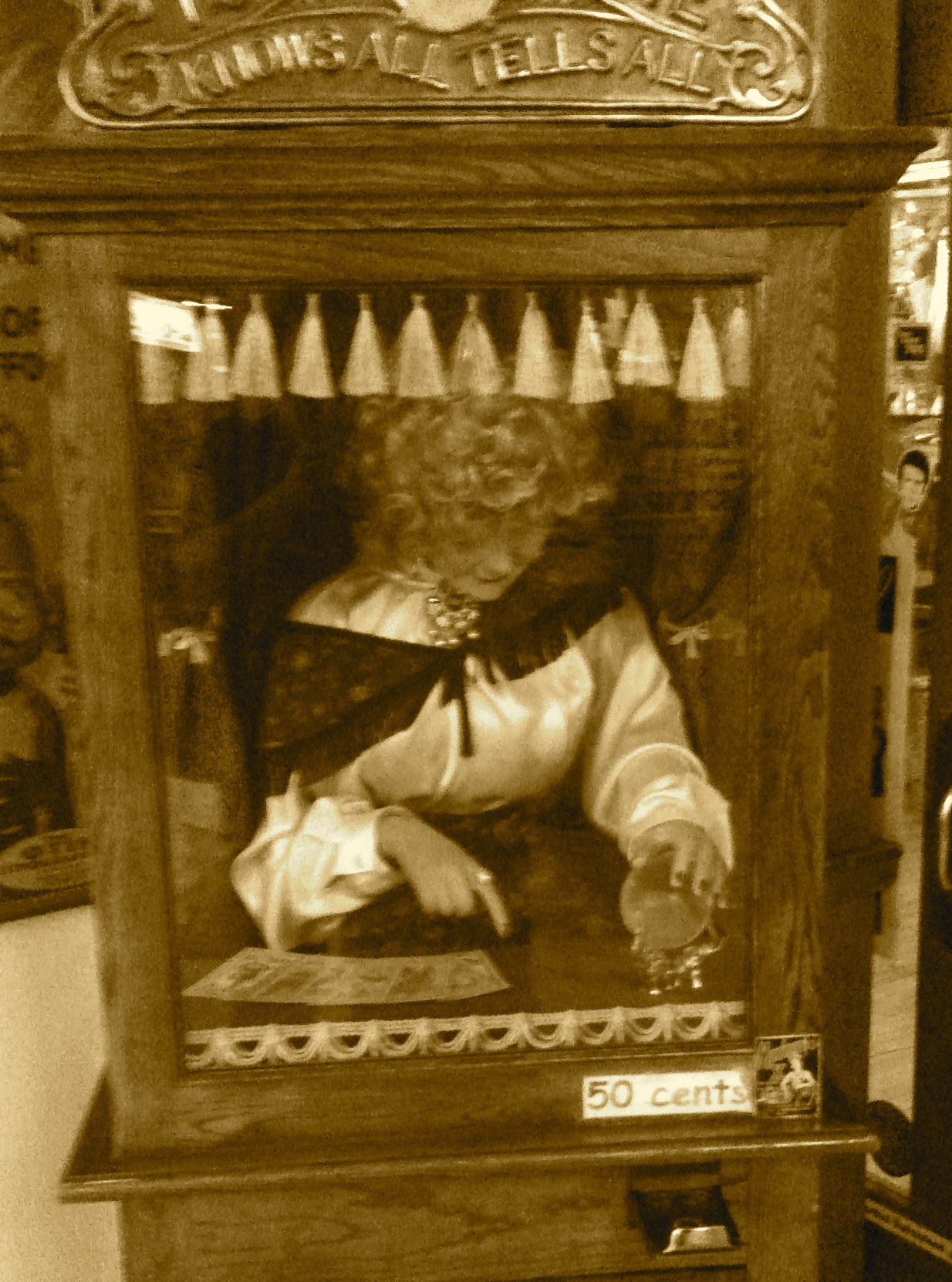
Mechanical Fortune Teller at Pike Place Market
One of the problems with submissions is the guesswork involved - there is no way to predict what market will love a particular story.
Part of today is going to be spent sorting through my spreadsheet of what stories are out where and getting stuff out. That’s one of the really tedious things about being a writer – all the paperwork.

So how do I track submissions and figure out where to send them?

I have an Excel spreadsheet. One page has short stories that are circulating, a second does the same with flash pieces, a third tracks sold stories, a fourth audio reprints, and a fifth foreign reprints. When a rejection comes in, I mark the story on the sheet as freed up and put it in bold red. Once it’s been submitted, I switch the color to blue. That lets me look over the sheet and get an idea of what needs to go out. Right now it’s looking pretty red, so I’ve compiled a list of five flash pieces and ten short stories that need to go out, making a note of the word count.

After that I usually go to a market list, usually Duotrope.com or Ralan.com and look. I have some markets that stories always go through, but once they’ve been through those, it becomes a matter of finding the right place. I’ll look to see what anthologies are open first and see if I’ve got anything that fits into a particular theme.

Another system that can be used to track submissions is the excellent Story

Before I submit anywhere, I read their guidelines and do my best to read an issue or two (if they’re free online fiction, I don’t think there’s any excuse for not doing a little research there.)

Things that up a market’s attractiveness:

  • Good pay – I make my money through writing and editing, so this is a big factor to me.
  • Fast response time – When sending via snail mail, for instance, that adds at least a couple of weeks to the response time. A good resource for checking how fast they’re responding is the Black Hole.
  • Circulation – Do people read the magazine? Is it getting discussed/reviewed? Are many year’s bests coming from its pages?
  • Good editor – A good editor is a joy to work with.

Audio reprints and foreign markets are usually separate passes, since I’m working with different lists there – the best of the stuff that’s been published. I absolutely would be lost in looking at the latter if I didn’t have Douglas Smith’s Foreign Market list. I’ve been bad about audio reprints and need to get more of those circulating, so that will probably come after this pass.

Enjoy this writing advice and want more like it? Check out the classes Cat gives via the Rambo Academy for Wayward Writers, which offers both on-demand and live online writing classes for fantasy and science fiction writers from Cat and other authors, including Ann Leckie, Seanan McGuire, Fran Wilde and other talents! All classes include three free slots.

Perefer to opt for weekly interaction, advice, opportunities to ask questions, and access to the Chez Rambo Discord community and critique group? Check out Cat’s Patreon. Or sample her writing here.

...

Skip to content