I had to go hunt for my proof copy of the book in order to be able to look up the art this time. Tod snagged all my extras in preparation for the reading this Friday, at the University Bookstore in Seattle, at 7 pm. I’ll be reading with three terrific writers: Alma Alexander, Corry L. Lee, and Roz Kaveny.
So! Here’s day three of the giveaway. Comment to win!
(left to right)
Image #1 goes with the story “Therapy Buddha,” which is about how much we project things onto objects and coincidences. It’s near future, another one of the eyed creatures, this one peering down, a little inquisitively, a little confusedly. It looks like part of an organic machine, like so many of Mark’s images.
Image #2 accompanies the story, “Close Your Eyes,” which originally appeared in Apex Digest. This is the one I have as a tattoo, from back before I moved to Seattle, given to me one night in a Durham tattoo parlor. I like it for its ability to be wing and eye and fish, all in one. Vicki used it with the Table of Contents as well.
Image #3 looks like a rocket ship and a Greek amphora at the same time, perhaps bubbling over with some sort of pine and summer scented wine. I selected it to go with “Peaches of Immortality” because it seemed to me it looked a little like the machine at the end of the story.
Image #4 is a detail of the larger image that goes with “The Mermaids Singing, Each to Each.” I’m glad Mark pulled it out like this for the jewelry, since it makes a lovely little piece. His work often has a tribal feel to it, and this looks like an orca to me.
Image #5 goes with “Legends of the Gone”. Sometimes Mark repeats images and this is a variant of one that I always see as a large flightless bird, standing looking at the viewer. (You may not see it. That’s okay.)
Number 5 could be a small whelk. Alas, it has only one eye and one cephalic tentacle–injured? A mutant?
And does anyone else see a row of eyes at the base of 4’s dorsal fin?
Want access to a lively community of writers and readers, free writing classes, co-working sessions, special speakers, weekly writing games, random pictures and MORE for as little as $2? Check out Cat’s Patreon campaign.
Want to get some new fiction? Support my Patreon campaign.
"(On the writing F&SF workshop) Wanted to crow and say thanks: the first story I wrote after taking your class was my very first sale. Coincidence? nah….thanks so much."
~K. Richardson
You may also like...
And So March Begins
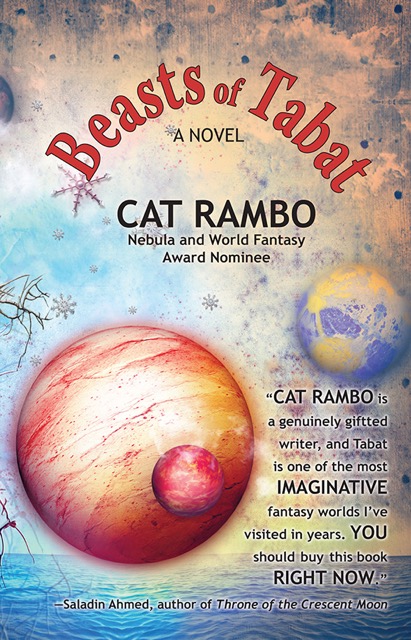
Cover for Beasts of Tabat, first volume in the Tabat Quartet.Things are cranking away as we get ready for the book release. Here’s the cover – the typo that some of you will notice has been addressed. 😉
The book will be available at Emerald City Comicon — find me there at one of my panels, or stop by the Wordfire Press table, which is where I’ll be hanging out when not stalking John Barrowman.
Those panels will be:
Friday, March 27: Fueling Creativity: Sci-Fi and Fantasy Authors on Ideas
Room: Hall B (WSCC 602-603)
Time: 3:30PM – 4:20PM
Moderator: David Hulton
Guest(s): Cat Rambo, Greg Bear, Ramez Naam, Jason M. Hough, Myke Cole
Authors often dread the interview question “where did you get the idea for this book?” because the answer is never simple. There’s rarely a single moment where an entire plot or world comes to mind. This panel is an exploration of why that’s such a difficult question to answer. Our panel of novelists will discuss the many ways they find inspiration for their work. In addition, they’ll talk about the wonderful and often strange ways an idea will find its way into a novel.
Sunday, March 29: Infinite Diversity in Infinite Combinations
Room: Hall B (WSCC 602-603)
Time: 10:30AM – 11:20AM
Moderator: Anna Alexander
Guest(s): Cat Rambo, Garth Reasby
Diversity in entertainment is both vital and challenging. This panel of novelists will cover how to effectively write compelling characters who are different than you and how to deal with critics of who you are versus your work. Panelists include Anna Alexander, Jamie Ford, Cat Rambo, Aaron Duran, J.R. Terrel, Garth Reasby, and Sarah Remy.
I’ll also be appearing at ICFA March 18-22, and will be leading an informational meeting about SFWA there.
Plenty of stuff is lined up for the blog over the next two months, including:
Several giveaways
Lots of guest posts, including experts talking about writing for games and comic books, how to write more than one series at the same time, food and fantasy, writing collaboratively, and more!
Pieces of original fiction related to the book
Essays on the writers that influenced the book
Links to appearances elsewhere
Snippets from the sequel, Hearts of Tabat
I will not be teaching or taking on any new editing projects in March; I will be mailing out soon about April and May classes.
Social Media and Internet Links for November, 2014
Covers the basics of creating and maintaining an online presence for writers. What you need on a website, how to effectively use social media, how to find readers via social media, what free resources are available to writers, whether it's worth it to pay for online advertising, and, most importantly, how to promote yourself online without using all your valuable writing time.Nobody reading your blog? 10 reasons to persist!: Tne more than valid reasons to keep blogging, even when the only person commenting is your mother. 12 Places to Find Fabulous Content: Some good stuff here that’s adaptable to whatever type of blog one might be working with. “Your own bloopers,” for example, is a nice one. How to Use Social Media Listening to Create Better Content for Your Audience: Along the same lines, identify relevant topics to write about on social media as well as identifying influencers and building relationships. How to Get Interviewed by Popular Blogs (Even If You’re Not a Big Shot): If you’re trying to build your authority — as well as links to your website — getting interviewed is a valid strategy. This should help get you started, but be aware it requires a little bit of brazeness. Content Distribution Tools: A variety of additional ways to share content, such as a list on List.ly 13 Experts on How To Promote Content Before Hitting Publish: Some of these steps seem more actionable than others, but some useful stuff to think about when strategizing content production. 7 Practical Ways to Find Content Your Followers Will Love: Primarily about tools rather than different approaches. Covered are Buffer, BuzzSumo, ContentGems, Feedly, HootSuite, Klout, and Swayy.
Community Building a Sustainable Community. As a sometimes moderator of the SFWA boards, and the person the moderators currently report to, I keep an eye out for interesting or useful community building pieces. This is one,although it’s aimed at a community of fans.
Privacy and Security
No one knows where it came from, but there’s new spyware called Regin out there, and it is widespread in crucial industries such as energy, telecom, hospitality, and travel. It’s there and actively monitoring, but experts don’t know why. “Once they [Regin’s operators] gain access, they can remotely control a person’s keyboard, monitor Internet activity, and recover deleted files….O’Murchu said Regin is part of a disquieting trend of government-written and government-enacted malware.”
Social Media What Is Pinterest? A Database of Intentions: An interview with Evan Sharp, one of Pinterest’s co-founders, about the image-centered social network. “What’s cool is that because every object was put there by a person. It’s not the largest inventory in the way that maybe a nerd like me would get excited about. But everything that’s on there, at least one human found interesting, so there is a very good chance that at least one other human is going to find that interesting. So, it’s a good set of objects. It’s the world’s largest set of objects that people care about.”
I put a couple of Twitter-related blog posts out in November. They were Twitter Basics and Best Practices and The One Twitter List You Should Be Keeping: My thoughts on some Twitter best practices.
2014 Social Media Image Size Cheat Sheet: “Understanding why you should use images is the easy part. It’s the mastering of how to actually do it that can be tricky. In addition to finding the right images to post, tweet, pin, and share across your different networks; you also need to figure out the right dimensions for your images, as well.” That’s pretty dead on, which makes this a very useful resource. The 10 Latest and Greatest Social Media Strategies to Boost Your Results and Save You Time: Some useful and interesting stuff here, at least a couple of which I plan to try. Social Sharing Powerhouses: Some places (or strategies) you may not be trying, like Guy Kawasaki’s approach of tweeting a piece of content four times over the course of eight hours. 10 Data-Driven Steps To Dominate LinkedIn Publishing: I still don’t feel like I’ve got a good handle on how to use LinkedIn, but this article may provide a decent starting point. Whats the Best Way to Spend 30 Minutes of Your Time on Social Media Marketing? Unsurprisingly, being able to schedule content plays a part here too. Includes the 12 tasks of a social media manager. 8 Piece-of-Cake Ways to Get More Pinterest Followers: Pinterest remains a social network of interest to me. These are some decent best practices for posting on there.
I follow links like this in order to keep my next edition of Creating an Online Presence up to date. If you want to track my links as they occur, you can follow me on Delicious. If you’re interested in the next online class on it, it’s Sunday morning, February 15th, 2015, 9:30 AM-12:30 PM PST. The cost is $89 for former students; $99 for new students.





6 Responses
Number 5 could be a small whelk. Alas, it has only one eye and one cephalic tentacle–injured? A mutant?
And does anyone else see a row of eyes at the base of 4’s dorsal fin?
OK, probably just me.
I can see why #2 is a tattoo – it has such great motion to it. Beautiful!
I love these images! How many are there, total?
There’s 25 used in the book. Mark’s got a website with some more of his stuff up at http://www.spiderpig.com.
#2 is lovely, but the insectoid helmet appearance of #5 wins it for me. & Sunder, it isn’t just you…guess the eyes had to go somewhere Oo.O
Oooh, those are gorgeous. Number 3 is my favorite, I think.