I really like this flash piece. It’s lovely and sweet. “Beholder” by Sarah Grey on Flash Fiction Online.
Another flash piece, this time from the inimitable Folly Blaine, Scattered.

Want access to a lively community of writers and readers, free writing classes, co-working sessions, special speakers, weekly writing games, random pictures and MORE for as little as $2? Check out Cat’s Patreon campaign.
 One of the very last goals for this month that hasn’t been crossed off the whiteboard yet is “rework Patreon campaign.” It’s a project I’ve been circling for a while, because I’m aware that if I don’t plan carefully, I am quite capable of both overextending myself and making promises I can’t deliver on. I thought I’d show the thought process as I worked through and rearranged, the rationale behind the changes, and some of what I’ve learned from working with Patreon so far.
I started the campaign two years ago because I wanted a place to push some of the stories I was writing. In that regard, it’s been reasonably successful, and looking back, I’ve published two dozen stories that way, ranging in length from flash to novelette. Some have been publicly available, like Aardvark Says Moo, Seven Clockwork Angels, and Web of Blood and Iron, while others were limited to Patreon patrons only.
One of the interesting wrinkles that has developed is the question of stories posted only for patrons. Some magazines regard them as already published; some don’t. To my mind, the smallness of the audience makes that a no, but I clearly have a horse in that race.
I speak there not just as a writer but as SFWA President. Being able to sell that story twice nudges the finances up to the point where making a living off stories might actually be viable, depending on the cost-of-living of wherever the writer resides. And it was possible to make a living off short stories, back in the 20th century, but magazine pay rates have not kept pace with inflation, to the point where (imo) it is no longer a viable option unless you’re willing to live very stringently indeed.
Looking back over the past century, that seems indicative of a trend where increasingly money has been shifted away from the creators and moved to the businesses based on the content they create. For example, at the pay rate of .01 per word that Weird Tales had in 1926; in 2017 that’s 13 cents worth of buying power. The SFWA pro rate started at 3 cents a word; if the rate from the 60s had kept up with inflation, the current pro rate would be 25 cents a word, but it’s currently six cents — and that high only because recently the board has pushed to raise it. (My math is based on this inflation calculator, which seems to back up other calculations I’ve looked at.)
At any rate, since I seem to be rambling in the wrong direction, let me swerve back to Patreon. Putting up stories has been mildly successful, but I haven’t been as good about delivering stuff to patrons as I should have been. Part of the revamp involves a mass letter to current patrons that helps catch up on that, offering the upper level ones e-books to make up for the ones I’d intended to do and send out every six months.
To start the rework, I decide I’ll begin with revamping the reward levels, based on looking at what another successful Patreon creator, M.C.A. Hogarth is doing. Maggie is a friend, and more than that, she’s a smart cookie, who’s even written a book on running successful Kickstarter campaigns. Her rewards are based on a monthly pledge, with $1 level getting some posts, $5 all posts, $10 that plus access to a monthly chat and ongoing chat channel, and one $100 user sponsoring a special piece of content for all patrons, and getting to choose what it is.
I know from experience that looking at what’s working for someone and shamelessly modeling your effort on theirs is not a bad approach, so my next step is thinking about what I can and can’t deliver on a monthly basis and looking to see what parts of Maggie’s framework I can hang those on. Here I need to be both realistic and kind to myself.
So a good place to start is — what am I already doing that I might be drawing on? Can I rearrange some efforts in a more efficient way?
What I do on a daily basis:
What I do on a weekly or monthly basis:
Maggie has a split between the $1 and $5 users, involving extra content. Let’s say I do a post for everyone, comprised of a snippet from recent writing, 2-3 times each week. That gives me a pretty substantial value (IMO) for them, plus I’ll put the two stories in there, rather than making the pledge per story. They’ll also get the coupons for Rambo Academy classes that I send out to my newsletter subscribers, which range from 25-90% off. Hmm. That seems like a good deal for the $1 patrons, so I’ll leave it at that.
Do I want to add $2 supports as well as $5? I actually think I do. How about a writing tip or prompt for each weekday as well? In adding this, I’m thinking about how much prep is involved, but here I think I can pull from my teaching, so the main work is creating the post itself.
What I can add for the $5 supporters? How about a weekly wrap-up each Sunday of what I’ve read that week, along with a recipe? I’m not sure, but let’s give it a try, I decide. One of the nice things about Patreon is that you can tinker with stuff on the fly, so I will make a note on my calendar to look and see how well this is working three months down the line. If I end up doing any of the cooking videos that I’ve been contemplating but haven’t had the time to work on yet, this might be a good place for them. I keep thinking about that one and change my mind, deciding I’ll add a different kind of video, one people have requested, and which won’t be hard to do, me reading a flash piece. I’ll stick to one a month until I know how that’s working and still plan on looking at it in three months.
Okay, $10 peeps. I love the idea of a monthly chat, and my G+ business account lets me invite up to 24 other people. I’ll include that — if it’s immensely popular I may have to scale up to the tech that Maggie’s using, but that question can get kicked down the road for now. I’ve also been using Slack lately, and already have a Rambo Academy channel that I set up but haven’t been using, so I can give folks access to that as well.
Maggie’s next jump is to that $100 level, but I know I’ll be putting out some ebooks this year, so I decide I’ll make a $25 level that lets those patrons get a copy of whatever comes out. This is dangerous, because it’s a deliverable that requires organization — I’ll need to build and maintain a list, and be good about putting e-mailing the books out into the book release campaign. I think about this and decide that since the catchup work I’m doing involves getting existing books out, I’ll be building that list anyhow. This time, I’ll keep it in Evernote, an organizational tool that I’ve been using for SFWA and which I’ve found works well for me, and plan on posting the files on Patreon rather than in e-mail. Maggie sends people physical things; I think about that and decide that it’s not something I should commit to. I know from experience that getting stuff in the mail is not one of my strengths. I decide I’ll add a couple of photos of my art each month at this level; that I know I can deliver.
All right. That leaves me with the $100 level. I decide I’ll commit to the same thing Maggie does. It seems dubious to me that anyone will actually sponsor at that level, but it’s nice to have the option available. For a little while I toy with ideas of levels above that, but it seems like a unrealistic effort that just drains time.
Maggie’s used a cute conceit for the supporters by comparing the levels to areas of a house: the lawn, the lanai, the den. Since I frequently use Chez Rambo mentions on my blog and in social media, I contemplate it. It’s a powerful metaphor, the idea that you’re being invited in, and I know that I want to create the feel of a community. At this point I’m tempted to cut down on the number of levels in order to simplify things, but I resist the urge. After much thought I come up with the following:
I make a note on my follow-up list to check on doing something like getting “Cat Rambo’s Posse” badge ribbons to distribute to patrons at upcoming conventions. That’ll both make them feel appreciated and let them spread the word. I’ve seen other authors distribute badge ribbons at conventions, but I’ve never tried it myself. A quick online search lets me see that I can get them for somewhere in the range of .25-.50 each, depending on how many I order. That’s spendy enough that I decide I do want to save them for patrons rather than giving them out at large.
I’ll want to rewrite the beginning appeal and re-shoot the accompanying video. I put that item aside for when I start the actual work of re-doing the page; right now I’m still in the planning stage and figuring out both my work items and the order in which I should do them.
I look at the reward tiers as part of the revamp. I’ve said if I hit $250 a month I’ll add an extra flash piece. That seems reasonable; I’ll leave it as stands. The $500 level is an additional story recording – if I make it of that flash piece, that works all right, so I leave that alone as well. $1000 is an urban fantasy series. I decide to scrap that for now but then think hard.
What would hitting the $1k a month level on Patreon enable me to do? It’d free up sometime I use for freelancing. What if I took some of that time and did something I’ve wanted to do for a while, a monthly podcast that’s a roundtable focusing on a different topic each time? Okay, that works. I’ll swap that in. The final reward tier is $2500, at which point I’d start a magazine, because people keep asking me about that. I’m not going to hit that reward level anytime soon, but if some fluke occurs, it’ll be a ways down the line, and I’m willing to make good on that promise at that level because it’d let me pay the writers and do a pretty nice little online magazine. Again, I leave that goal alone.
A major part of the change is going to monthly rather than per post; looking at the Patreon docs, I see that I should do this at the beginning of February, since I’ve done two January paid posts. I make another note on my calendar. I also want to get this out the door, so I decide not to wait till I have the video — but also add a note to make sure it goes on this week’s todo list.
Next month I’ll provide some feedback over how successful (or not!) this approach has been.

General Notes and Context:
I was originally invited by the heads of the China World Science Fiction society, Renwei Dong, Haijun Yao, and Wu Yan, to attend the Chinese Nebula Awards ceremony in Beijing, through the kind offices of Ruhan Zhao. Later the invitation was extended by the company Xinhuanet for Wayne and I to then spend a week in Chengdu. It was our first trip to China; getting the visas got complicated and down to the last minute wire but finally everything arrived two days before the actual departure.
Arrival in Beijing and the Chinese Nebulas
We left September 7th and arrived in Beijing on the 8th, where Jingbo Chen and Ruhan picked us up at the airport. We had dinner that night with Mr. Dong, Ms. Song, and other members of the association. The next day, we went to Qinghua University that evening, and I gave a speech on what is new in American SF for the first of several times. This was my first chance to meet our terrific interpreters. They were awesome and just amazing in their ability to listen and speak at the same time. Phenomenal. Plus one had an English accent, was constantly gravely polite even when being thwarted in her duties, and reminded me of a Chinese David Tennant.
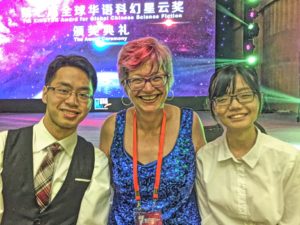
On the 10th, we had numerous panels and discussions at the National Library, along with a terrific banquet that night. We stayed at the National Library Hotel, which had a wonderful bookish modern but still traditional vibe, and had breakfasts most mornings there. This was interesting because it was in the same cafeteria with the government workers and was our first real introduction to the phenomenon of Chinese breakfast. The location was great, however. The ceremonies were held nearby in one of the actual library buildings, and started with a red carpet walk and the signing of a wall. There were several hundred people at the actual ceremonies (I think).
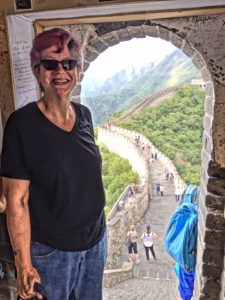
 On the 12th Kelly took us and Crystal Huff, the Finncon co-chair who was also part of the Chinese Nebulas, to a lake reservoir and the Mungtian site of the Great Wall. It was everything I’d hoped and more, and a site that lives up to a writer’s imaginings is a rare one indeed. That evening we had dinner with Crystal, Kelly, Kelly’s boss Richard Lee, and her co-worker Martin at Huo’s restaurant, where we had Peking duck and other amazing foodstuffs. The wonderful floor show included noodle making, dough balloons, tea pouring, and a woah-wait-how-did-they-do-that face changing show. Afterwards we walked around a little bit, then took the subway (where Wayne enchanted a suspicious toddler) to see the Birds Nest and Olympic Park by night. The subway was a quicker way to get around than taxi most of the time and was very easy to use.
We were treated very well. I found that SF is currently very hot in China. Overall, recent wins by Cixin Liu have drawn significant attention to SF in China. In all of this, I am speaking primarily about science fiction, rather than fantasy, since the Chinese see the two genres as very distinct from each other. There has also historically been tension between science writing and science fiction, which is the past has been perceived as being aimed at children, or at least that is something that came up multiple times over the course of the visit.
Nowadays, that’s very different. Numerous groups in China are working on putting together Worldcon bids and I would suspect the question is not so much whether or not we’ll see a Worldcon bid from China in coming years so much as which city will host it: Beijing, Chengdu, or Shanghai. Several people, including the World Science Fiction Society, said that they’d love to see SFWA’s Nebulas hosted over in China if we’re ever interested in doing that. Crystal Huff had been sponsored by the first group as part of their effort to research what would be needed to run a Worldcon.
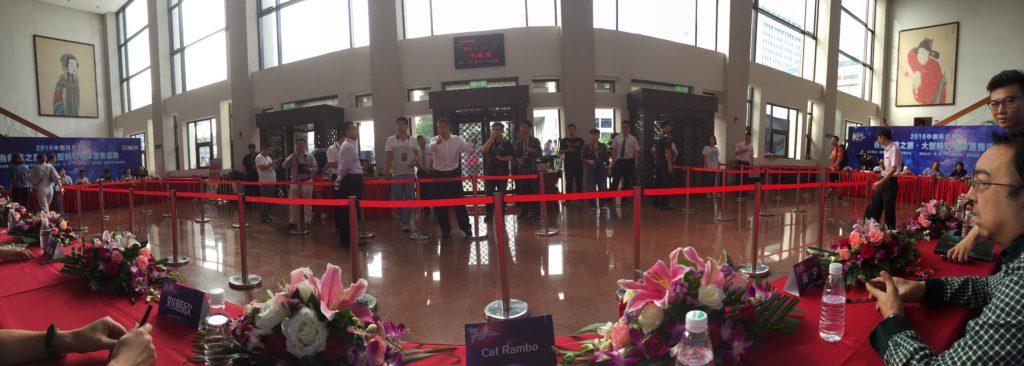
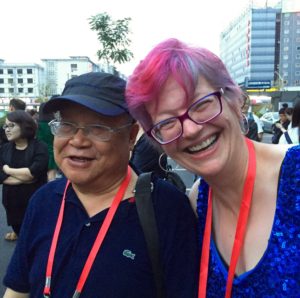
One of the things that I really noticed at the ceremonies and the signing that occurred the next day: the Chinese fans really love science fiction. I sat next to Cixin Liu at the signing and some of his fans were vibrating with the joy of interacting with him to a point that I might have reserved for Paul McCartney when I was a teen-age Cat. They were adorable. They also — and the writers as well — skewed considerably younger than the overall crowds I see at the usual Nebula or other American gatherings. Many of these folks are the future, and I’m pleased to get a chance to interact with so many of them.
The next day Kelly and Martin took Wayne, Crystal, and I in for interviews and to meet with the head of CEPIEC, who went with us for a delicious lunch. Afterwards we went with Martin over to Beiha Park, where we went boating, and then strolled the grounds, viewing the last of the lotus blossoms. We were lucky to be there for the Autumn Festival, so we ate lots of kinds of the traditional moon cakes, and Kelly brought us a big bagful of them when we set off.
Mr. Dong made sure we were well taken care of throughout our visit to Beijing and that we had everything we needed. Sean Gao very kindly postponed his flight back to Chengdu in order to accompany our hapless selves, which was good, because we needed his linguistic intervention a couple of times as we bewildered someone.
Chengdu and Xiuhuanet
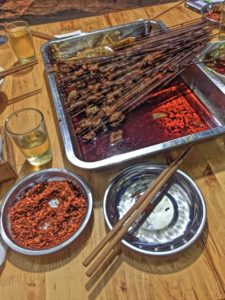
In Chengdu, we were met by Tulip, who was our interpreter, and JingJing of Xinhuanet and her assistant Annie. They took us to the hotel and then out with Sean to what turned out to be the first of AMAZING meals. SO DELICIOUS. SO DELICIOUS.
They planned a lot of stuff for us, which really made this the trip of a lifetime, particularly since often we got behind the scenes level tours (and often a meal). Luckily for me, Tulip furnished a detailed itinerary of our many and varied activities, so I can be extremely precise here:
Wuhou shrine, Jinli street
Jinsha site museum/Huang longXi ancient town
Our very first stop was the Wuhou shrine. Here was my first encounter with Zhuge Liang, an early paragon of wisdom whose shrine this is, although it shares space with the temple of Liu Bei (a Chinese emperor). Very green and serene and historic, and very informative, since Tulip, a well-traveled and experienced guide, turned out to be a font of interesting Chinese history. From there we walked over to the bustle and noise of Jinli street, which featured all sorts of crafts and foods, including displays of silkworm cocoons being unspun and the silk threads being processed to make into comforters. JingJing bought us all spicy peanut candy; next time I’m trying some of the spun sugar candy, like the phoenixes we saw being displayed.
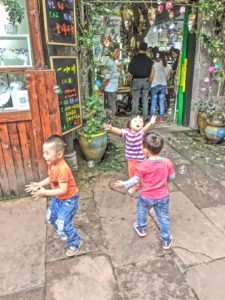
Lunch! And then to the ancient town, which was in a fruit-growing area, with piles of grapes, figs, and kiwis for sale along the road. The town was very cool, and featured more kinds of crafts, this time including some freshwater pearls and nifty masks carved from bamboo root. This was where I picked up a new mask for my collection and took some of my favorite pictures, including the one of children chasing bubbles.
Panda base in Dujiangyan city
Dujiangyan irrigation program
Hexiang mountain villa
Pandas! No cuddling them, alas, but lots of looking and learning about them, all in beautiful surroundings and taken around by a nice guide who answered all sorts of questions. After that, Dujiangyan, which was super cool and much more interesting than the phrase “irrigation program” might imply. For one thing, it was built in 256 BC and still controls water for over 5000 square kilometers of farmland not via a dam system, but by dividing and channeling the water via ingenious means of long wicker baskets filled with stones, called zhulong, which ended up making the Sichauan district the most productive in the country.
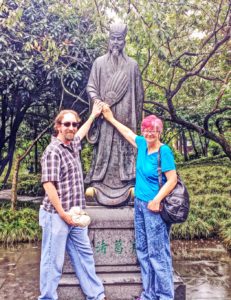
Lots of greenery, in many ways a shrine to water and very beautiful. Here we met Zhuge Liang again, and had our photo taken with him, a tradition meant to evoke his genius in the person touching his hand. After that we headed to a new hotel, the Hexiang mountain villa, a hotel built to evoke an old Chinese palace, which had a lot of beautiful carvings. There was a wedding going on there the same night, with a ton of people; it looked like a gorgeous place for a reception.
September 17
Qingchen Mountain
Afternoon – Taiguli street
Watching Sichuan opera
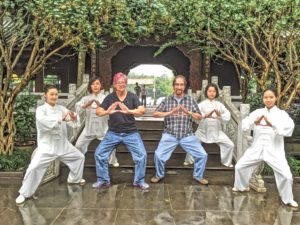
In the morning, we watched a little tai chi being staged in the courtyard then ate breakfast at the hotel before heading to Qingchen Mountain, the birthplace of Taoism, and learned a good bit about both Taoism and Buddhism on our trip up the mountain. Very green and clean, with a beautiful lake halfway up.
Back in Chengdu that evening, we strolled through one of the shopping districts, Taiguli Street, which was full of international goods and high fashion store. After dinner, we headed to watch a show that included plenty of opera along with some other wonderful staged stuff, including a reiteration of amazing mask dancers.
 September 18
Sanxindui site museum
Evening speech at Southwest Jiaotong University
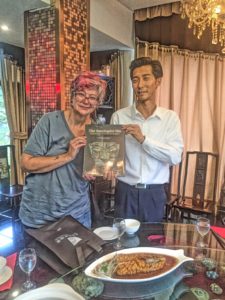
Another amazing trip, this time to see bronzes from 4000 years ago, in a very cool museum. The director was kind enough to have lunch with us after we’d had a guided tour of the museum’s two buildings. The relics are beautiful and when we got back to the hotel later, we realized there was a full-size replica of one of the museum’s “money trees” in its lobby.
That night, after yet another terrific dinner. I made a speech at the local university to a crowd of perhaps 50 or 50 students, who asked all sorts of interesting questions, and who also very sweetly brought me flowers, a beautiful arrangement of lilies that made the hotel room very fragrant. Tulip did a great job coping with all the demands on her vocabulary; she hadn’t encountered much science fiction before and we even had her buying The Three-Body Problem by the end of the trip.
September 19
Wuhou district Sci-fi town
Xinhua.net and interview
Dinner – hot pot!
In the morning we went for a tour of The Wisesoft virtual reality studio, and learned a lot about the Wuhou District, in a meeting that included Jing Gong, Director of the Chengdu Wuhou District Broadcasting Press and Publication Bureau, After that we went to Xinhua.net, where I did a couple of interviews and spent some pleasant time with JingJing’s boss Dawei Hou, and Vice President, Jiangying Shen.
Dinner was Mongolian hot pot! The next morning JingJing brought me a bunch of hot pot makings and then an early morning trip through Chengdu streets followed by tearful farewells at the airport.
Things I Learned about Chinese SF
Some writers I want to point to so I have their names stuck here for future reading. Many of them were there at the Nebulas.
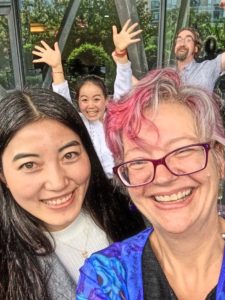
Que A, Shu Bao, Liu Bing, Zhang Cao, Xia Chao, Hongyu Chen, Qiufan Chen, Jingbo Cheng, Bessie Gu, Bo Jiang, Ni Kuang, Xingshi Liu, Yang Lu, Xe Lv, Xiong Mo, Hu Shaoyan, Han Song, Jinkang Wang, He Xi, Xinghan Xiao, Wang Xiaoda, Jian Wu, Huang Yi, Ran Zhang, Wenjing Zhang, Jun Zheng, Zinghzi Zhou
In all of this, I should mention that more than anyone else, Ken Liu has really led the way and shaped SF decades to come by bringing so much attention to Chinese SF. Cixin Liu (who gave me a copy of his third book that I am looking forward to finishing this week) may be Da Liu in China, but surely Ken deserves his own descriptor.
Traveling Tips for Other American SF Writers Visiting China for the First Time
Wifi is everywhere, but the Internet can be frustrating. Facebook and Twitter are censored in China; Wechat is a Chinese version of Facebook that is very popular. I started the trip with just a couple friends on Wechat and now have several dozen. (I am Catrambo on Wechat; feel free to add me.) One implication of the Facebook/Twitter ban is that if you have plug-ins from either social network on your website Chinese readers will have to use a VPN to access your website, which is why I’ve removed the Twitter plugin from my site. It is pretty easy to get a VPN connection through various applications however.
An important note for Americans: water is different there. You cannot drink tap water (I would be careful even using it to rinse after brushing one’s teeth) and sometimes where American restaurants routinely provide water, Chinese establishments will not. For example, I got in the habit of taking a bottle with me to breakfast in Beijing, because the only drink provided there was hot milk, along with a lot of tasty but very dry food.
Along the same practical lines, a friend told me they were worried about the toilets. Well, they are a different mode than we see here in the US, but anyone who’s survived toilets someplace like a concert or a county fair is probably going to be able to navigate the worst of it. I dunno. What one is doing remains much the same worldwide. You should remember to carry a few tissues with you; you’ll need it maybe one in three times.
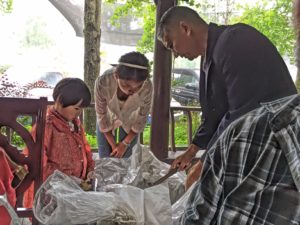
People are super nice overall. Schoolkids in particular want to test out the English they’re learning in school and will Hello how are you and/or ask for a photo with you. While out sightseeing, I noticed people noticing us but it never felt obtrusive or creepy and they would often smile and exchange greetings. This is a point where people’s mileage may vary considerably — I am usually in the midpoint between introvert and extrovert, but have found that the SFWA presidency has nudged me over to extrovert by about 20 points.
 Generally the degree of enthusiasm most American SF writers not familiar with the culture will feel while in China will depend greatly on their ability to operate outside their comfort zone and willingness to be a little flexible, patient, and find misunderstandings funny rather than frustrating. My happiness with the trip is shaped from how much I fell in love with the language and culture as I prepped for the trip, and I know this has been a life-changer in at least a few ways. For one, I’m much more aware of Chinese SF and likely to seek it out. For another, I’m keeping up with my Mandarin study/practice. And finally, I know some of the friendship I made during the trip are ones that will last and deepen in coming years.
Overall, I came away from this trip filled with a great deal of joy and optimism for the future. I was reminded that while there may be all sorts of weird convulsions in the day to day course of things, humanity continues to plod onward and that the motion is generally upward, even when the speed of that trend may not be all we’d hoped. A lot of the casual sexism, racism, and classism I saw as a child or teen is gone, even though sometimes it seems as though it keeps trying to manifest in new shaggy-haired forms. Now China is opening up and with it even more new voices. Fabulous!
Will I go back? Yup. In fact, I’ve already pencilled the Chinese Nebulas in on my 2017 calendar and if I can make it sooner, I may, because I really did enjoy the folks and the sights and everything to the point where I was saddened to leave, plus there are a bunch of things I missed that I want to go back for.
Some resources for additional reading:
An article about SF World, China’s Science Fiction publication
SF fan and news organization Future Affairs Administration associated with Guokr Publishing.
World of Chinese magazine. Article on the history of Chinese SF.
Article on the Three Generals of Chinese SF
Life Week Magazine