


 I was looking at Twitter the other day and reading through mentions of the Nebula Conference Weekend, including celebration of our new Grandmaster C.J. Cherryh, when I hit a tweet saying something along the lines of, “I hope SFWA doesn’t think this excuses the choice of picking (another author) in the past”. The way the sentence struck me got me thinking about the sort of perception that allows that particular construction.
No, SFWA, aka the organization known as The Science Fiction & Fantasy Writers of America doesn’t think that. Because SFWA isn’t a person. It doesn’t think. Sometimes I like to imagine that SFWA. It lives in a basement somewhere and looks much like a pale green gelatinous cube, covered with lint and cat hair, and various unguessable things lurk in its murky depths, like discarded typewriter ribbons, empty Johnny Walker Black Label bottles, and that phone charging cable you lost a few weeks ago.
In actuality, SFWA “” at least in the sense they’re thinking of “” is an entity that changes from year to year, most notably through the leadership, but also through the overall composition of the 200+ volunteers and handful of staff that keep it running. The President makes a lot of choices for the organization; others are made for them. The President gets to pick the next Grandmaster, for example, although every living past President weighs in on the choice, as well as things like the Service to SFWA Award and the recipient of the Kate Wilhelm Solstice Award.
The Board does have to approve those decisions, but there isn’t a giant brain in a bubbling vat marked “SFWA” pondering the decision, and the Board, elected by the nearly 2k members to represent them, does a pretty good job of sorting out what should and shouldn’t be approved. At least, so far they have restrained the majority of my crazier notions, which is as it should be, though I still think a secret SFWA headquarters in the Antarctic guarded by robot unicorns would be a reasonable expense.
Have we had bad Presidents? Sure. A few. Also a whole lot of very good ones. The history of SFWA fascinates me the more I find out about it, and at the heart of many of the best stories are battling egos counterbalanced by a genuine desire to do good on most sides. I’ve been keeping copious notes, and I’ll get at least two books out of my term, a nonfiction one about F&SF fandom in the early 20th century, and a satirical novel that may take a very long time to finish.
Has SFWA made mistakes? Holy smokes, yes. One reason I’m painfully aware of that is that people keep telling me about them. I was standing at last year’s Nebula Awards reception when a woman came up to detail how SFWA had insulted her writing group in a previous decade. And Laurell K. Hamilton was a member of that group, she told me, fixing me with a pointed glare. What could I say, other than, gosh, I believe it would be different nowadays? She swept off, having let me know I could never hope to have Ms. Hamilton in the organization. (But Laurell, if you’re reading this, I’d love to talk about why we’d welcome you.)
Have those mistakes been deliberate? While I’m aware of those egos battling behind the scenes at times, 90% of the problems detailed to me were a result of carelessness and a process that wasn’t paying attention, so communications got lost. The problem is a lot of time silence can feel like an answer — never the one that you want — even when it’s not intended as one. Others are a result of culture clashes where people aren’t thinking about differing perspectives.
Have people tried to tick each other off on occasion? Yes, and sometimes that’s where the organization has gone astray in the past, by letting petty feuds, grudges, or even friendships sway things unduly. When people have set out to upset each other, they have inevitably been successful. Luckily the vast majority of that behavior recently seems to be happening outside the organization, and many of the people truly hip-deep in it seem to have self-selected themselves out.
I can’t do anything about those past grudges and wrongs, other than say SFWA’s doing better on a lot of fronts. Nor do I have much, if any, power over controversies stirred up and continuing to be stirred up primarily because the stirrers have found that a successful strategy for selling books. But I don’t really know that I want (or need) to, because the folks embroiled in all that apparently have plenty of time to fling at it, while I’m trying to snatch what writing moments I can when not working with SFWA efforts aimed at helping writers that have nothing to do with those controversies. For example:
- The Contracts Committee back is back. Have you looked at the model magazine contract that was their first effort? That’s an important document for two reasons. One, it shapes the industry in a positive manner by giving editors what they need to start a magazine that treats writers correctly. This was my main reason for bringing the committee back, actually, because that kept getting requested. Two, it’s actually more than a model. It’s carefully glossed, so a writer can look it over and know what each clause is intended to do, what it should (and shouldn’t) include, and what they should push back on. The Committee just finished a similar contract for writer/agent arrangements and are working on others, including anthology and collaboration contracts.
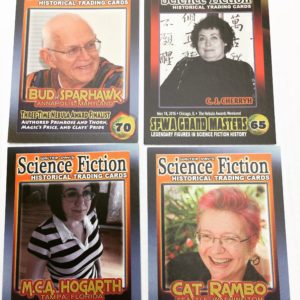
- I recruited M.C.A. Hogarth to run as my Vice President and that was one of the smartest things I could have done, because she is awesome and efficient and knowledgeable. Both of us have corporate experience, which I think has been helpful. Maggie has helped facilitate the entrance of independently published writers into the organization, including driving efforts aimed at helping them. One example of an effort driven by Maggie would be the partnership with Kickstarter, which has grown into multiple things: a curated page on Kickstarter of projects involving SFWA members, the SFWA Star Projects initiative, a Kickstarter rep presenting at the Nebula conference, and that same rep’s offer to assist SFWA members with planning Kickstarter campaigns. Other partnerships that have been established include Amazon, Audible, Bookbub, Draft2Digital, Kobo, and Patreon. Even more are in the works, and we’re also trying to make sure existing ones are used to their best advantage wherever possible. I cannot begin to detail her efforts, but Maggie is indeed, as someone declared her recently, truly metal.
- Beyond that, Maggie is significantly more conservative than I am, and I think having a variety of viewpoints is a very good thing for the SFWA leadership. She balances out some of my wilder tendencies, and I’d like to hope I perform something of the same role for her. F&SF writing/fandom is much more multiplicitous than those pushing the conservative vs. liberal line would have us believe, and SFWA is about working for writers “” all professional F&SF writers. Maggie’s evil agenda is primarily helping our members make more money, and that seems like a pretty good thing. Mine is making things work efficiently and in ways that benefit all members.
- I have worked to facilitate the amazing and hard work that CFO Bud Sparhawk and comptroller Oz Drummond have been doing behind the scenes wherever I can, but I cannot take credit for any of that. Nonetheless, SFWA is moving towards a scrupulously-maintained financial state that can go beyond just sustaining itself, but can allow it to grow at a slow but steady pace. When I came on board we were highly dependent on a revenue source that is rapidly diminishing; I’m pleased to say that we are recovering from that and will not be similarly dependent in the future. I hope to replenish what was taken from the reserves within the next few years.
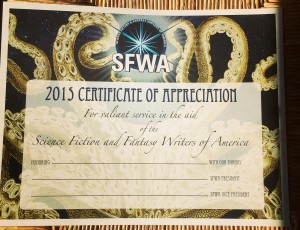
- Via the efforts of volunteer wrangler Derek Künsken, volunteers are finding roles where they can use and expand existing skills, acquire new ones, and know that they are working to benefit SFWA. At the same time that we’re using more volunteers, we’re being much better about acknowledging their efforts. A few weekends ago I was at the volunteer breakfast at the Nebulas, passing out certificates of appreciation (created by Heather MacDougal) for the second year in a row, and we are making that event an integral part of our annual celebration from now on. When I came onboard, the volunteer situation was bad enough that we were losing members because of it “” again, no malice, no intent to hurt people’s feelings or make them feel unvalued, only good desires and intentions that got overwhelmed due to a lack of communication and a team to back up the volunteer coordinator.
- The SFWA Bulletin, that notoriously troubled and erratic entity, is back on schedule and rapidly proving itself capable of representing SFWA’s mission to the world at large. Editor Neil Clarke has been working to create covers and content that reflect the professional nature of the organization and which are useful to working writers. Among other things, we’ve got writers guidelines up for both it and the SFWA blog, and some members have covered their fees via a couple of blog posts or a Bulletin article. Jaym Gates, John Klima, and Tansy Rayner Roberts did the initial work of digging what seemed like a mortally-wounded Bulletin out from under a pile of criticism and ill-feeling, and deserve much praise for performing that rescue. Both Bulletin and the Blog have writers guidelines available online for what I believe is the first time.
- The Speakers Bureau is up, although we need to work now at publicizing it. Nonetheless, I’m very very proud of how it looks and functions. It’s a case of once again facilitating someone else’s work, because Jeremiah Tolbert of Clockpunk Studios did a fabulous job on that, and you’ll see another major effort that he engineered unveiled in the next month or so, a website dedicated to the Nebula Awards.
- The Nebula Conference “” I’ve blogged about it elsewhere “” but this year I had so many people coming up to tell me things not just about how useful the programming was this year, but how welcoming and inclusive the conference felt, from small details like the provision of a gender-neutral bathroom (one in a central location, no less) to much larger ones like the actual panel topics. Sarah Pinsker worked with generous sponsors to make sure that all the nominees that wanted to attend could be at the banquet, and also helped organize the presentation of the Alternate Universe speeches, which were a delightful manifestation of our community’s creativity and solidarity.
- SFWA tries to celebrate the best and most interesting work produced in the genre each year. Towards that end, I made the change of putting the Nebula Recommended Reading List up online. Why? Because it helps people find good stuff to read, stuff that members have enjoyed enough that they thought other people should read it. I spent a good chunk of last year reading for the Nebulas, and I added a good many items to the list while doing so. Along the same lines, this year the Norton jury will produce a short list of recommended reading that will, or so I hope, prove useful to educators, librarians, and booksellers.
- The Membership Retention Committee, which I’m overseeing, is looking at the new member experience and how to help make people aware of the useful things SFWA offers them. Rob Dircks has been working on an infographic of ways SFWA can help a member promote their work “” I know of ten of them, several of which were implemented in the last year, such as the New Release Newsletter.
- I’m putting a group together to try to get people using the discussion forums more. Part of the complication is that their previous incarnation on SFF.net gained a name for being full of flames and other unprofessional behaviors and then got embroiled in a controversy that got confused with the current version. But the forums have been on the upswing lately “” one small sign of that is that lately there’s often people in the chat room attached to the forums during the mornings and some of those discussions are leading to interesting volunteer efforts. Members may have noticed recent issues of the Singularity holding pointers to particularly interesting or useful discussions.
- I’ve got a couple of outreach efforts in the works, including a Storybundle one that will lead to opportunities for members and another to some conventions. I know the first one will be fruitful, and the second just yielded some results in the form of a pipeline to programming at the next Emerald City Comicon.
- Fundraising is something I’m also trying to set up so it happens in an organized way that gets the money to the places in the organization that need it. If you’re one of the fabulous groups that fundraises for the Emergency Medical Fund, please consider shifting that to the Givers Fund, which feeds all of our grant programs, rather than just the EMF, which is currently well-funded. With the reincorporation, we are a 501c nonprofit organization, and your donations are tax deductible and also eligible to be matched if your employer matches charitable contributions.
When someone says to me, “SFWA should do X,” more often than not I agree, but also know it’s not feasible. So I write it down, because at some point, when the organization is purring along like the well-oiled machine it can and should become, we may be able to do it. Two years ago when I came on as Vice President, there were problems getting in the way of that mission: no one was tracking what anyone was doing, and results included moribund processes, erratic efforts, a Bulletin still mired in chaos, and a lot of members who were unhappy about the state of things (although unable to agree what the state was, in most cases). The only thing saving us were the valiant efforts of the SFWA staff, most notably Operations Director Kate Baker, hallowed be her name. A few years later, a lot of those loose ends have been taken care of and there’s a plan and process in place for taking care of more.
SFWA exists for professional F&SF writers. We can talk about the mission to inform, defend, advocate for and all of that, but it boils down to this: if you are a professional genre writer, you should be able to join the organization and know that you are getting your money’s worth. Recently while researching, I counted ten ways SFWA can help a member promote their work; half of those were created in the past two years.
Right now, membership’s worth the price (according to my personal meter; I acknowledge mileage may vary), but the people who are getting substantially more than their money’s worth are the ones actively engaging with the organization: participating in the discussion forums in order to share resources, tips, and sometimes just vacation or pet pictures; reading the electronic newsletter, The Singularity, to find out about activities and opportunities; using some of the promotional tools we’ve been assembling; and, more than anything else, volunteering in a way that yields satisfaction, entertainment, and sometimes even knowledge. That’s why I keep volunteering, and have been for the decade I’ve been a member.
I’ve got another year to go as SFWA President and while I don’t know if I’ll run again, I do have a timeline of stuff I want to see SFWA do in the next few years. Right now those manifestations of “SFWA should do X” probably get slotted in as something to think about in 2017 or even possibly 2018, depending on other efforts. Or they may just get written down in the shared Evernote notebook we have labeled “Pie in the Sky.” But they’re getting recorded in an organized way that they never have been before and that makes me think we can refrain from the continual reinvention of the wheel (this time with eight spokes instead of six!) that’s plagued SFWA in the past.
Will there be more controversies? Yup. But I think the vast majority will be at the same level, which is in the 1-3 range on the scale of 1-10, with smooth sailing being 0, and a controversy involving massive amounts of illegal substances, border-crossings, and the violation of animal heads being a 10. That is the nature of humanity, that no matter what choice is made, people feel the need to weigh in on it.
In the past I’ve avoided those controversies as a rule because, in the words of the immortal John Bigboote, they were “not my goddamn planet.” But sometimes as SFWA President, those problems are in fact happening on the soil of my planet or happening close enough that we’re catching some fall-out. So I spend a certain amount of time trying to put myself into other people’s shoes, figuring out which parts of my reactions to things are informed versus those that are knee-jerk, and generally thinking about where I’d like to see SFWA in, say, ten years and whether or not they’ll affect that. So far the answer has been “no” consistently enough that I continue not to worry about the occasional rocky patch. They just give me more traction overall.
Why am I writing all this? That’s a good question. Mainly it was that tweet, which made me think about a lot of other tweets. I’ve got a bad habit of taking criticism of SFWA a little personally, at least while I’m in a leadership role, and I know that the vast majority of the criticism isn’t intended that way. And partially to explain why when, at the SFWA meeting last week when a woman demanded to know why I wasn’t “doing something about the Hugos,” I just smiled at her and explained that’s not a circus ring I have any right to step into.
By the way, since the season is starting where I have to point this out on a daily basis – SFWA still has nothing to do with the Hugos. We administer the Nebulas. If you’re curious about those, here’s the website and here’s the 2016 Recommended Reading List so far. I’m using it to track my favorite reading this year; one advantage of that is that it’ll give it all to me in a nice little list at year’s end that I can use when doing my 2016 recommendations blog post.
I’ve meandered on a while and said what I wanted to say, and avoided working on a couple stories and an essay in the process. I wanted to let folks know what we’re doing and throw out a few facts to counteract some of the weirder assertions I’ve seen over the past year or so. Mostly I was procrastinating, though, and WordPress tells me I have now gone over the length of much of my fiction.
So if you’ll excuse me now, I need to go feed the thing in the basement and then write a few stories.
* I had no idea how much time this role was capable of eating, but I should have. It’s not my first volunteer rodeo. It is, though, the most entertaining so far.


 Swinging the Doors Open to Independent Writers
36 Responses
SFWA is Many Things, But Not a Gelatinous Cube: https://t.co/HW4cbjPJ06
RT @Catrambo: SFWA is Many Things, But Not a Gelatinous Cube: https://t.co/HW4cbjPJ06
RT @Catrambo: SFWA is Many Things, But Not a Gelatinous Cube: https://t.co/HW4cbjPJ06
RT @Catrambo: SFWA is Many Things, But Not a Gelatinous Cube: https://t.co/HW4cbjPJ06
RT @Catrambo: SFWA is Many Things, But Not a Gelatinous Cube: https://t.co/HW4cbjPJ06
RT @Catrambo: SFWA is Many Things, But Not a Gelatinous Cube: https://t.co/HW4cbjPJ06
Nope, definitely not a gelatinous cube. Or a black pudding or an ooze.
Selfishly, I would like to see you run again because I think you’re doing much good.
RT @Catrambo: SFWA is Many Things, But Not a Gelatinous Cube: https://t.co/HW4cbjPJ06
RT @Catrambo: SFWA is Many Things, But Not a Gelatinous Cube: https://t.co/HW4cbjPJ06
SFWA is Many Things, But Not a Gelatinous Cube https://t.co/IzqhVze36J
RT @Catrambo: SFWA is Many Things, But Not a Gelatinous Cube: https://t.co/HW4cbjPJ06
FYI US SF writers, not a gelatinous cube – https://t.co/TyRxkRu8M1
Ah, the problems of ‘this volunteer non-profit should do X’. I’m familiar with that one from being a board member of such an organization. Typically, our response is along the lines of ‘You’re right. Put together a proposal to make it happen, and we’ll look at it.’
It amazing how frequently that’s the end of the conversation.
If you really want Ms. Hamilton as a member, you might want to correct the spelling of her first name. It is “Laurell”, with 3 L’s.
Ack! I’ve fixed that. I am a fan of both the Anita Blake and Merry Gentry books and should have known better.
SFWA is Many Things, But Not a Gelatinous Cube says @Catrambo
https://t.co/LCpUaMcsov
RT @PrinceJvstin: SFWA is Many Things, But Not a Gelatinous Cube says @Catrambo
https://t.co/LCpUaMcsov
On SFWA’s true nature, or the many things it is not. https://t.co/PfAuIQeByS
RT @Catrambo: On SFWA’s true nature, or the many things it is not. https://t.co/PfAuIQeByS
RT @Catrambo: On SFWA’s true nature, or the many things it is not. https://t.co/PfAuIQeByS
RT @Catrambo: On SFWA’s true nature, or the many things it is not. https://t.co/PfAuIQeByS
RT @Catrambo: On SFWA’s true nature, or the many things it is not. https://t.co/PfAuIQeByS
RT @Catrambo: On SFWA’s true nature, or the many things it is not. https://t.co/PfAuIQeByS
RT @Catrambo: On SFWA’s true nature, or the many things it is not. https://t.co/PfAuIQeByS
RT @Catrambo: On SFWA’s true nature, or the many things it is not. https://t.co/PfAuIQeByS
RT @Catrambo: On SFWA’s true nature, or the many things it is not. https://t.co/PfAuIQeByS
SFWA president Cat Rambo gives an update on various SFWA projects and talks about non-monolithicness. https://t.co/nOnpds8I5R
In a volunteer organization, the most appropriate answer to “You should do X” is usually, “Good idea, would you like to do it?”
RT @Catrambo: On SFWA’s true nature, or the many things it is not. https://t.co/PfAuIQeByS
Hiya! This was a good read. Struggling with my first book-baby and reminders that there is so much work being put into the community of writers is buoying.
I was curious about the reading list. The link doesn’t go anywhere though, was it taken down?
It’s out of date – here’s this year’s: https://www.sfwa.org/forum/reading/