

Five Ways
Subscribe to my newsletter and get a free story!
Share this:

WIP: Written in Cinnamon Foam (working title)

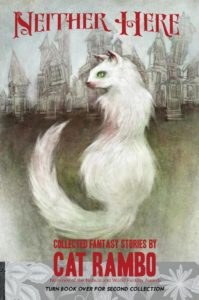
nhntfrontHere’s something from the current piece. For fellow West Seattleites, the coffee shop in question is indeed the Admiral Bird. This is a sequel to “The Wizards of West Seattle,” which is available in Neither Here Nor There, just out this week!

“You need to stop holding a grudge about it,” Penny said.

Albert snorted. “You tried to kill me!”

“I’m a demon. That’s my nature. And it was one of the old lady’s tests. You don’t need to worry about me any more.”

Albert didn’t say anything, but he was unconvinced. In the months since he’d become apprentice to May Huang, one of the wizards of West Seattle, he’d faced several tests, but none as harrowing as that long chase down Alaska Way towards Alki with a long-faced and eager Penny on his heels. Only his encounter and subsequent alliance with Mr. Gray had put a stop to that, and Albert was still unsure what the consequences of that would be.

Penny mocked him. She manifested as a bright-eyed woman of indeterminate age, her face sharp-featured. “Oh, Penny, you’re so scary, oh Penny I can never unsee what I have seen, oh Penny please don’t eat my soul.”

“I’m unclear why don’t eat my soul is an unreasonable demand.”

“I’m just saying, you don’t need to worry about it. Anyhow, Huang wants me to teach you about oracles.”

They were walking down California Ave, passing the Admiral Theater. They both saluted the Little Free Library there, Penny with a graceful curtsey, Albert’s bow slightly more awkward, as they passed.

“I know how oracles work,” Albert said smugly. “That’s how I knew you were something other than human. I found the Oracle, left a crayon in his path.”

“He’s powerful because of the limitations on his magic,” Penny said. “Being able to use only found objects is pretty severe. But there are other routes.” She pointed. “We’re headed to the Bird. I need coffee.”

“Isn’t that a flower shop?”

“And here you have a principle of oracles. Anywhere boundaries blur, they can manifest.”

He’d passed the store a hundred times on walks and seen the flower shop sign, but closer inspection proved the front was a coffee shop, shifting into flowers in the back as seamlessly as two interior shots Photoshopped together.

At the counter Penny ordered coffee but Albert shook his head when she glanced at him. She shrugged. He looked around: dinette tables and chairs, an old truck serving as coffee table, pictures on the wall, the frames the size of his hand, enclosing stamp-sized pictures. He went closer to look.

Each was a scene from West Seattle: the shore at Lincoln Park, the overlook near Huang’s house, the playground at Hiawatha, drawn in fine-nibbed pen and colored in jewel-colored inks that made each one, a summer’s day, come alive. They were as bright and lovely as the day outside, and he craved one of them instantly.

A little label by the cluster said, “Enquire at the register about the price.” He went back to where Penny was counting out her bills.

He waited till she was done and asked the woman at the counter, “Excuse me, how much are the pictures?”

She tilted her head, considering him. He was suddenly conscious of the smear of yogurt from this morning’s breakfast on the knee of his jeans, the fact that he hadn’t bothered to shave, and his “Uncle Ike’s Pot Shop” t-shirt.

Let me know what you think! Patreon supporters, you get to be the first ones to see the finished version. 😉

Enjoy this sample of Cat’s writing and want more of it on a weekly basis, along with insights into process, recipes, photos of Taco Cat, chances to ask Cat (or Taco) questions, discounts on and news of new classes, and more? Support her on Patreon..
Leave a Reply

Your email address will not be published. Required fields are marked *

Get Fiction in Your Mailbox Each Month

Want access to a lively community of writers and readers, free writing classes, co-working sessions, special speakers, weekly writing games, random pictures and MORE for as little as $2? Check out Cat’s Patreon campaign.

Want to get some new fiction? Support my Patreon campaign.


"(On the writing F&SF workshop) Wanted to crow and say thanks: the first story I wrote after taking your class was my very first sale. Coincidence? nah….thanks so much."

~K. Richardson

You may also like...

Let's Retain ALL the Rights!

Picture of a handwritten pageOne of the questions being raised repeatedly on a discussion board I participate on is the question of electronic rights. Should a magazine be able to buy a story and display it on their website in perpetuity without additional payment? Does it make a different whether or not it’s behind a paywall? If there’s no additional payment, when should rights revert? What happens with something like an anthology that is in electronic form and hence won’t go out of print the way a hard-copy edition does?

I’m presuming that most people reading this know that normally when you “sell” a story to a publication, what they’re actually buying is the right to publish it in a particular form. You, the author, retain any rights not spelled out in the contract. You can (and I encourage you to) sell the story again as a reprint, and you may want to look at forms like audio or in another language.

This is something that’s still very new, and it’s not something that’s been factored in when lists like SFWA-qualifying markets were put together. It’s not mentioned on sites like Ralan.com or the Submission Grinder. As a writer, though, you need to be aware of what you’re selling.

Take some time to skim through the contract and find out what the publication is buying. What’s the “exclusive period,” the period where they are the only ones that can print it? What forms are they planning to release your work in? Here’s a Columbia Law School resource that may be helpful in trying to decipher legalese.

If you’re publishing, how do you feel about perpetual rights? Is the horse already well out of the barn as far as that goes, or can writers push back on the practice of acquiring perpetual rights without payment?

Enjoy this writing advice and want more content like it? Check out the classes Cat gives via the Rambo Academy for Wayward Writers, which offers both on-demand and live online writing classes for fantasy and science fiction writers from Cat and other authors, including Ann Leckie, Seanan McGuire, Fran Wilde and other talents! All classes include three free slots.

Prefer to opt for weekly interaction, advice, opportunities to ask questions, and access to the Chez Rambo Discord community and critique group? Check out Cat’s Patreon. Or sample her writing here.

...

Storybundling the Write Stuff

Listing of Storybundle Write Stuff offerings.I have several maxims that I have developed over the course of my writing career. One of them is, “If Kris Rusch invites you into a project, you say yes.” Because Kris is one of the people who understands independent publishing and its possibilities, and she is a savvy, savvy marketer.

When Kris came and asked about including my book Creating an Online Presence in a Storybundle, I was thrilled and also a little panicked, because I knew it had to be updated before it went in there. Too much had happened on the Internet in the two and a half years since I’d first put it up. I was also flattered that she thought the book was worth including, because I value her opinion.

And the truth is, if you’re a writer, you do need to at least think about this stuff enough to make an informed decision. If you’re being traditionally published, your publisher will probably expect you to be helping out with the marketing in the form of social media or other Internet efforts. Every book launch, for example, seems to involve a slew of guest blog posts and similar promotions.

If you’re small press published, again the publisher will probably expect you to be helping out with the marketing and I would regard a lack of such expectations as a possible danger sign.

And if you’re going indie, there’s no way around it. You’re going to have to think about this stuff, and the more you do, the more it will pay off — IF you are writing good stuff and making that the focus, not the marketing.

The world is changing rapidly in many aspects; publishing is definitely part of that change. Writers must stay informed of that if they want to make a living at it. Look at this Storybundle. E-bundles are easy to do and even easier to download. Storybundle and Humblebundle have both been making big strides in this area. Kobo lets you bundle your books, I found out in talking to Mark Lefebvre from Kobo last weekend at the Nebulas.

Here’s what you get beside the brand new version of Creating an Online Presence:

  • The Rational Writer, Nuts and Bolts by Mindy Klasky
  • Weinberg on Writing – The Fieldstone Method by Gerald M. Weinberg
  • How to Make a Living With Your Writing by Joanna Penn
  • Heinlein’s Rules – Five Simple Business Rules For Writing by Dean Wesley Smith
  • How to Negotiate Anything – Freelancer’s Survivor Guide by Kristine Kathryn Rusch
  • Stages of a Fiction Writer by Dean Wesley Smith
  • Writing the Novel from Plot to Print to Pixel by Lawrence Block
  • Business For Breakfast Vol 2.: The Beginning Professional Publisher by Leah Cutter
  • The Writer’s Business Plan: A Plain English Guidebook by Tonya D. Price, MBA

Part of the success of such bundles is using online marketing like this very blog post. So please — help me out by spreading the word of this excellent bundle (which might make a great graduation gift for a new writer) and its contents.

#sfwapro

...

Skip to content