One of the nice things about having a lot of pots bubbling away, particularly when other people are supervising some of them, is knowing what’s coming up on the menu. So here, in no particular order, is a deeper look at three pet projects that are manifesting.
SFWA Ed will be online education via the web: an array of classes aimed at a range of writers, from new to professional. We’ve got a lot of members who teach, and I know our coordinator has been reaching out to as many as he can. That’s been rolling along splendidly thanks to the undauntable and indefatigable Jonathan Brazee. I believe it will be a mix of paid and free classes; we’re still figuring out all the details.
First Chapters is my attempt to answer the question: how can I know what to vote for in award season without reading every single book? That’s the biggest complaint I hear about any of the awards. Or one of them, now that I think about it. At any rate, this compendium will have a first chapter from eligible books, with the info you need to figure out what category or categories it fits in for awards like the Nebulas, Hugos, Norton, the Dragon Awards, etc. Using it should help someone find the books they want to read in their entirety. If you’re interested in making sure you’re contacted when we start taking chapters, please drop me a line. (If you have been asked not to contact me, please mail your interest to office@sfwa.org.) This project is rolling along thanks to the efforts of Dan Potter and the Publishing Committee.
The Preserve Your Legacy Campaign. So to talk about this one, I have to talk about a SFWA volunteer, Bud Webster, who was frickin’ tireless in working with the SFWA Estates Project, which works to connect authors’ estate with publishers, editors, scholars, etc. Bud was smart and funny and above all, kind. One of the good-hearted people that help keep the world running. This campaign is aimed at helping writers learn how to preserve their literary estate and archive their works. This one’s being driven by the excellent Lawrence Schoen.
Want access to a lively community of writers and readers, free writing classes, co-working sessions, special speakers, weekly writing games, random pictures and MORE for as little as $2? Check out Cat’s Patreon campaign.
Want to get some new fiction? Support my Patreon campaign.
"(On the writing F&SF workshop) Wanted to crow and say thanks: the first story I wrote after taking your class was my very first sale. Coincidence? nah….thanks so much."
~K. Richardson
You may also like...
Addendum to Night Shade
I blogged about Nightshade last week, and since then there’s been a number of developments, including modification of the contracts that were so crappy. Authors should be feeling a little happier, at least.
But, I wanted to point to another group that’s involved in this and which is getting worse treatment than the authors, which is the production crew.
Marty Halpern says:
…all the focus online this past week has been the deal that Skyhorse and Start are offering the Night Shade authors. Authors. Authors.
There has been absolutely no mention, nor commitment made, to all the artists, designers, editors (including myself), and others who are owed tens of thousands of dollars — and seem to have been forgotten in all this “discussion” over the authors’ deal.
And now that NS is essentially closed and in “escrow” for this potential sale, the money that is owed to me (for invoices dating back to October of last year) — and all the other production people — may never get paid.
There would be no books to speak of if there weren’t editors, artists, and designers willing to work continuously for Night Shade for just the promise of pay. We are a dedicated lot and deserve to have our story told — and responded to — as well.
I’m afraid that when all is said and done, and the authors make their decisions — some will join S/S, others will not — those of us production people who helped put Night Shade books on the shelves and in ereaders, may be left holding a lot of empty invoices and bills.
Better than nothing, sure. And Start and Skyhorse have been both communicative and willing to listen to authors, despite the deluge of “shame on you” comments on their Facebook wall. Still, finding this out is disappointing, particularly since production crew aren’t usually particularly well paid in the first place.
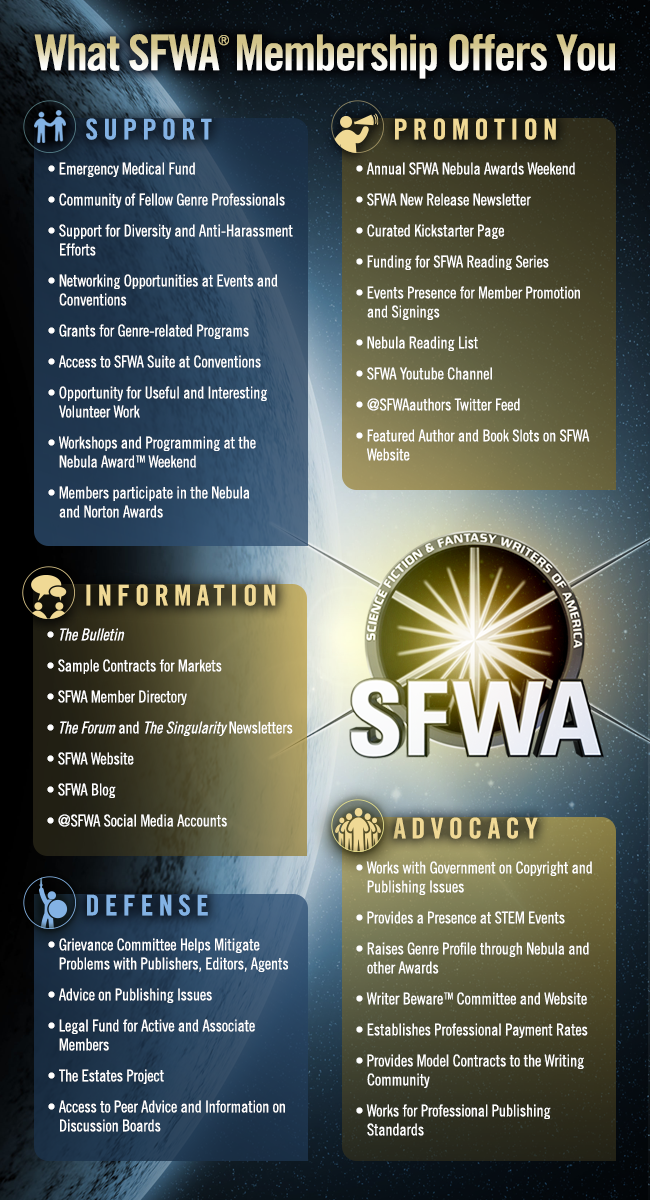
The SFWA statement is the result of a lot of work behind the scenes on the part of SFWA’s Grievance Committee, and I’d like to use this opportunity to both thank that committee and explain why it’s one of the answers to “why should I join SFWA?” (There are, in my opinion, a number of others.)
When I first became aware of what Galaktika had done, at first I had difficulty comprehending the scale of it. Surely it had to be a few stories rather than just one or two…but no, it was, literally, dozens. Then three figures worth of stories. Holy criminently.
The excuses that were sent to me as well as others over the course of the investigation chronicled here were manifest and sometimes a bit whiney. I was told that one author’s had been told their book had cost the company money and that therefore they owed it to the company to allow their work to be reprinted as advertisement for the other work.
In all of this, my hands were tied. What, realistically, could SFWA do, given legal and travel costs?
The answer was, actually, a decent amount in terms of keeping those affected informed and negotiating on their behalf, mainly because of the ninjas of Griefcom. Griefcom is the informal name for SFWA’s Grievance Committee, a small group of volunteers led by John E. Johnston III. I love John, whose politics are diametrically opposed to mine and with whom I share amiable political bickering and frequent recipes, and who feels as fiercely as I do that writers deserve both pay and control over their own work.
Griefcom’s members handle different areas: Ian Watson was the point person for the Galaktika issues and drafted the report on which I based SFWA’s formal statement about the magazine after much discussion with Johnston, Watson, and the SFWA board. Other members include Michael Armstrong (Novels), John Barnes (Work Made For Hire/Bookseller Relations), Michael Capobianco (Special Projects), Elizabeth Anne Leonard (Mediator), Lee Martindale (Senior Mediator), Ron Montana (TV and Film), and Eric James Stone (Short Fiction). Right now we are looking for someone experienced with game issues; drop volunteer@sfwa.org a line if you’re a member interested in volunteering.
Griefcom’s main weapon is the fact that it operates behind the scenes, and goes public only when necessary, which is why they came and asked me to make a statement about the situation. From my vantage point, I get a better picture than most people of what Griefcom does, and it’s a lot. Want to protect yourself so you won’t need their intervention? Read your contracts and never sign anything you don’t understand. Griefcom has been negotiating with Galaktika on behalf of several writers for months; they finally decided it was time to say something publicly.
Will Galaktika shape up? It remains to be seen. I hope so, and SFWA will revisit the matter in three months to follow-up and let folks know what Galaktika has done in the interim.
Is this actually a matter that SFWA should concern itself with? Absolutely. Recently it’s been underscored for me that people perceive SFWA as an American entity, but the truth is that we have a substantial international contingent. Worldcon in Finland poses a chance to spread that message, and so here’s a few things that I’m doing.
SFWA members scanning the most recent copy of the Singularity, SFWA’s bi-monthly e-newsletter for members, to find volunteer opportunities, will have noticed that I have a call out for translators. My plan is to get the SFWA membership requirements and questionnaire translated into as many languages as possible; I have commitments for Chinese, Filipino, Finnish, French, Klingon, Portuguese, Russian, and Spanish versions and am pursuing others. If you’re interested in helping with that effort, please let me know.
At the suggestion of Crystal Huff, I’m thinking about programming that might spread the message, such as a panel on the internationalization of SFWA. Such a panel would work for many conventions, I would think, but debuting it in Finland seems like a great idea (although we might sneak peek it at the Nebulas next May in Pittsburgh.)
I’m mulling over what form something connecting translators and F&SF writers might look like. Translating fiction requires not just ability with the language, but a writerly sensibility, an understanding of how to make the sentences fluid and compelling and three dimensional. So maybe something where potential translators could submit a listing of translation credits along with sample of their own work, translated into the languages they’re adept in, backed up with the ability for SFWA members to post testimonials. This seems like something the field needs; if anyone’s aware of existing efforts along these lines, please let me know?
Maybe it’s time for a new version of The SFWA European Hall of Fame, this time The SFWA International Hall of Fame. That seems like something for me to discuss with our Kickstarter contact. She and I have been discussing a 2018 project, reviving the Architects of Wonders anthology, but this might make a good interim effort. (Speaking of Kickstarter, SFWA partners with over three dozen institutions and companies, including Amazon, Kickstarter, and Kobo to make sure member concerns and suggestions are passed along as well as new opportunities created. If you’d like to be on the Partnership committee handling these monthly check-ins, drop our volunteer wrangler Derek a line at volunteer@sfwa.org.)
I’m actively soliciting feedback and suggestions for other ways to help spread the world that SFWA isn’t just for Americans. Let me know what you think.
(And, gah, I know I need to poke the gamewriting stuff along. I thought the Board was getting it done in my absence. I apologize, gamewriters. We ARE working on it. So many plates, all spinning so busily.)






 If you’re not familiar with SFWA’s official statement on Galaktika,