

Five Ways
Subscribe to my newsletter and get a free story!
Share this:

Upcoming Workshops

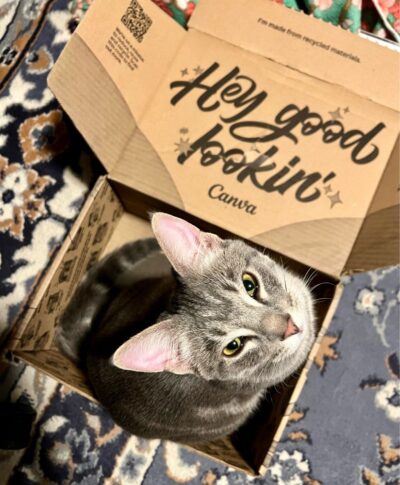
Picture of a grey cat looking upward from a box. The inside lid reads "Hey good looking". The cat's name is Clark.
The message approved by the Rambo Academy for Wayward Writers marketing department.
I’ve been rearranging the school somewhat, and part of that is a plan to continue doing multi-session classes, rather than a mixed bag of single session ones. Most of these will be on Saturday morning/afternoons, but I will try to mix things up a bit here and there so people in different time zones don’t have to get up at 3 AM.

Right now, I’m teaching my Extended Novel Workshop, aimed at people who have a novel in mind and want to work on preplanning and creating a schedule in which to execute it. We’re on week four of that right now, and today’s session will focus on worldbuilding. I’m really enjoying this workshop, and it’s such a great group of talented people. I can’t wait to read some of these books. So I definitely want to keep giving this each year.

I also want to do my Writing F&SF Stories workshop, and I’ll offer that in the Jan/Feb 2025 timeframe. That will feature six sessions on writing short stories, including writing and critiquing stories.

I’ve switched to a two months on, two months off model, which gives me more time to focus on writing and also helps me replenish my internal extroversion fuel. So I’ll offer one other extended workshop in the May/June period but I’m still figuring out what I want to do with that. Possibilities include:

  • an advanced Writing F&SF Stories workshop
  • a survey class on 20th century F&SF stories that would be reading & discussing multiple stories from a specific era each session
  • a multi-session workshop on increasing emotional depth and complexity in your work
  • a multi-session workshop focusing on literary techniques

I’d also like to do something on teaching writing sometime, but I don’t know if that would be one session or several.

Please tell me what you think. Are these appealing? Is there something you’d like to see me teach? As always, Patreon subscribers will get first chance to sign up for and a discount on these classes.

Leave a Reply

Your email address will not be published. Required fields are marked *

Get Fiction in Your Mailbox Each Month

Want access to a lively community of writers and readers, free writing classes, co-working sessions, special speakers, weekly writing games, random pictures and MORE for as little as $2? Check out Cat’s Patreon campaign.

Want to get some new fiction? Support my Patreon campaign.


"(On the writing F&SF workshop) Wanted to crow and say thanks: the first story I wrote after taking your class was my very first sale. Coincidence? nah….thanks so much."

~K. Richardson

You may also like...

How to Dunk Your Reader in the Details (Figuratively)

I’m finishing up converting the workshop I did at Surrey International Writers Conference a month or so ago, Dunking Your Readers in the Details, as an on-demand class. That class was in turn based on an hourlong online writing class I did for Greg Wilson’s Twitch channel a few months ago.

The class has been fun to put together. Over the course of being taught multiple times, it’s evolved to a point where it presents a dozen tools for writing more immersive worlds, and includes several exercises to allow you to test out the different techniques and see what works for you.

Curious about it? Here’s the section on prioritizing the senses.

A common tool of “Golden Age science fiction” “” the late 1930s through the 50s, when science fiction was first coming into its own as a genre “” was to invoke all five senses within the first page of a story.

It turns out there’s some science behind that method, in that writing that uses the senses creates more brain activity, setting off mirror neurons. Mirror neurons are neurons that fire under two circumstances: when you are experiencing an event and secondly when you are watching someone else experience it. Writing that invokes the senses makes mirror neurons fire, which makes your reader feel as though they’re experiencing what you are describing.

But beyond that, three of the five senses are more useful to you and should be focused on. Sight and sound will come naturally, and we’re inured to them from watching television and the movies. What you need to push to invoke are smell, taste, and most importantly: touch.

Why is the last the most important? Because touch is more than a question of smooth or rough, velvet versus pebbled. It includes:

â—¦ Temperature like a chilly breeze, the warmth of a sunbeam

â—¦ Bodily sensations such as pain, nausea, exhaustion, fever, itches

â—¦ Motion moments like falling, flying, and floating

When you use these senses in your writing, you are making the reader feel as though they are in the body of the point of view character and experiencing the story world through them. This is a key technique when writing an immersive world.

Update: the class is now available here!

...

Nattering Social Justice Cook: Supporting The Next Generation

Ancient village with modern kids and bubbles.
If you don’t know about DonorsChoose, it’s a great program that lets you support individual classroom projects. I sponsored one in honor of my aunt Nona. Here’s the lovely thank you note I just got.

Dear Cat Rambo,

Thank you so much for your donation to my classroom. Having copies of Persepolis: The Story Of A Childhood has had a dramatic impact on my students as they finish their eighth grade year.

When the students received copies of a book that they were actually interested in, they felt like they were the ones in charge of their learning experience. The decision to design a unit around Persepolis was student driven. Earlier this year I noticed that students were coming to class regularly asking questions about the Middle East and Islam. In student interest surveys, the class overwhelmingly expressed a desire to learn more about these topics. So when students got copies of Persepolis, they felt as if their voices were being heard. When I started the unit, I noticed a big increase in student engagement. “I felt lucky!” Eighth grader De’jean Williams said when the class received the books. “Adults hardly ever listen to us- it’s nice when they finally do.”

The Persepolis books have provided students with a window into life in the Middle East. Students are beginning to understand the complexity of the forces shaping the region. They are deeply engaging with questions about the role of government, culture and religion influencing a society. Middle school is the time when students are first beginning to shape their world-view. Reading Persepolis is helping students in this process. As the United States gets more and more involved in the region, I am so glad that my students understanding of the region is growing.

Thanks again for your generous donation! You are truly making a difference in the lives of young people!!

With gratitude,
Ms. Founds

Want to see students reading diverse, interesting, informative reading that features protagonists like them? Find programs doing just that and help them.

...

Skip to content