

Five Ways
Subscribe to my newsletter and get a free story!
Share this:

From the Fathomless Abyss novella in progress

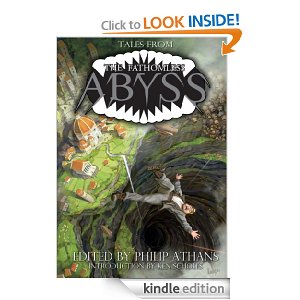
Cover for Tales From The Fathomless Abyss, stories by Mike Resnick & Brad R. Torgersen, Jay Lake, Mel Odom, J.M. McDermott, Cat Rambo, and Philip Athans.
I’m working on a novella set in the world of The Fathomless Abyss, a shared universe project with authors Mike Resnick, Brad R. Torgersen, Jay Lake, Mel Odom, J.M. McDermott, Philip Athans, and myself. We’ve all done stories set in it, and each of us will be producing novellas set there over the course of this year.

If you’re interested in finding more about the oddities of the Fathomless Abyss world, check out the From the Fathomless Abyss anthology, which contains a story of mine that I like very much called “A Querulous Flute of Bone,” a somewhat odd retelling of O. Henry’s short story, “The Pimaloosa Pancakes.”

This project, which will appear as a stand-alone, is a mash-up of William S. Burrough’s Junky and H.P. Lovecraft’s “Dreams in The Witch House,” a story which terrified me as a child. Here’s how it begins:

His earliest memory was fearing the nightmares. He never slept well, all his life, even in that first moment, so long ago he remembered remembering it more than actually remembering it.

Knowing that if he slept, they’d come crawling out from underneath his cot, or spawn in the cavern shadows outside their hut only to come creeping in.

He didn’t remember what the nightmares were. Were they what they would be later, that room, over and over again? Or were they more childish ones, a ghost chasing him around a table, its breath rot-damp, or a fiery lizard curled in the stove’s belly?
The second earliest memory was the couple. Or rather, first the light on his face. They were going Outside, out to the walls of the world and he could see the light ahead of them.

Then, in the shadows, movement, squirming like a worm in a mushroom box, but much larger. Flesh twined with flesh, limbs sliding together slick and naked against the weed-choked rock.

What was that in the woman’s stringy blonde hair? A tiny rat of shadow. Its face was human, pugnacious jaw slung forward, brow pronounced. It looked at him and he nearly pissed himself.

His mother yanking his hand along so he stumbled, nearly fell. He tried to stop her, tried to ask, but she wouldn’t meet his eyes or acknowledge his tugging hand. Her face red in the light as they went onward towards the market Outside.

Later, she said to his father, when she thought him out of earshot, “Shameful junkers! Rutting there beside the path with their dreams frolicking on them where any passerby could see!”

“There ought to be a law,” his father said in a mechanical tone.

Or was that his mind interpreting the memory, ascribing the tone his father always used, the tenor his mother, a thwarted councilwoman, habitually took?

It was the first time he’d seen a junker.

Not even close to the last.

Leave a Reply

Your email address will not be published. Required fields are marked *

Get Fiction in Your Mailbox Each Month

Want access to a lively community of writers and readers, free writing classes, co-working sessions, special speakers, weekly writing games, random pictures and MORE for as little as $2? Check out Cat’s Patreon campaign.

Want to get some new fiction? Support my Patreon campaign.


"(On the writing F&SF workshop) Wanted to crow and say thanks: the first story I wrote after taking your class was my very first sale. Coincidence? nah….thanks so much."

~K. Richardson

You may also like...

Patreon Post: California Ghosts

Picture of two peopleThis post marks a change-up in my Patreon campaign – I will post content publicly. If you’re enjoying it and want to make sure it continues, please consider supporting my ongoing attempts with this publishing model! There are several levels of possible support, but you can do it for as little as a dollar a month.

I’m enjoying on retreat in California right now, which will explain what provoked this piece.

California Ghosts

When you walk in the hills in southern California, through stands of pine and tall grass, up shaly mountains where the sides fall away steeply and the rock splinters rather than crumbles, you can hear the sound of the wind in the treetops, making them sway, making them creak. Stand still and you will hear the little noises, the sound of a deer’s delicate steps, far away a Stellar’s jay scolding some interloper, the click and tap of falling rocks.

There are ghosts out there in the hills, walking the ridges, slipping among the trees, but they are mostly animal ghosts, the memories of deer and mountain lions, a flicker of rattlesnake among the grass stalks, an eagle’s shadow floating over the earth.

If you find a human ghost alone out there while walking, approach it with caution. Groups of ghosts are left behind by villages and tribes, and many of them died peacefully, among those they loved. Solo ghosts are usually ghosts who came to a violent end, blade or bullet or even bared teeth, and they do not want to be disturbed.

If such a ghost blocks your path, stand still enough to hear the protests of the pines, the slide of dust downhill. Do not look them in the eye, but at a point past their shoulder. At first they will know this for a ruse, but give it time and they will falter. Finally they will turn away and vanish, because you can never see the back of a ghost, and you will be free to move further.

There are other dangers in the hills, but you know if you keep walking towards the sunset, eventually you will find the ocean ““ perhaps cliffs dropping down, perhaps sand and rock sloping. There are more ghosts in the ocean than anywhere else, but that is because it is so very large, and most of them are fish and gulls, whose ghosts pay no attention to humans. Sit on the shore and listen again. You’ll hear it say, Why go on walking? and Who knows why the wind blows?

And when you realize that the only sounds you cannot hear are your breath, your heart, your body, you will know you are a ghost yourself, ready to go down to the sea, and swim there in the water, in the waves alive with noise.

...

First Editing Class: Notes and Observations

Photo of a black cat named Raven
The cats remain fascinated by the classes. They can't figure out who I'm talking to.
The Editing class is split into three sections. In this first session, we focused on developmental, or “big picture,” editing.

Some people are taking the class in order to edit their own stuff, others to edit for other folks, a couple for a combination of that. We talked about what a developmental edit is intended to do, and how it’s different from a copy-edit. In fact, you want to avoid copy-editing (other than a couple of cases which I’ll get to in a minute) because often that sentence you’re tinkering with will end up discarded or substantially revised in the final version.

Honing your editing ability to where you can trust it is one way to free yourself up when writing. Instead of listening to the internal editor telling you that sentence isn’t perfect or that you need to check that name on Wikipedia before using it, you can assure that editor it will get its chance during the revision process and go on writing.


Developing a process also helps you know when to stop rewriting. I work from the big picture stuff in, moving to small sentence level details in a second or third draft. Usually my process goes like this:

  1. Bang out a first draft. It may have parenthetical directions like (expand on this) or (transition here) or (describe), but it is a complete story.
  2. (Optional but encouraged) Let it sit for a week or two. This is where procrastination can really bite you in the ass.
  3. Print out the draft and write all over it. This is my developmental edit, in which structures may get changes, sections moved (or eliminated), point of view or tense changed, etc. It’s also where all those parenthetical directions get fulfilled.
  4. Entering these changes onto the computer may involve some more tinkering as I do so, but generally I’m working towards another draft that I can print out.
  5. That draft gets printed out and edited again. This stage is where I read aloud and tinker at the sentence and paragraph level. I may changes names at this point, and I’ll do things like look for adverbs (as discussed in The 10% Solution).
  6. I will probably do another read aloud pass after that’s entered into the computer, depending on how hard a deadline is pressing.

More on developmental editing, what it is, how I do it, and how one needs to adapt editing to genres such as hard SF, dark fantasy, horror, etc, in another post.

...

Skip to content