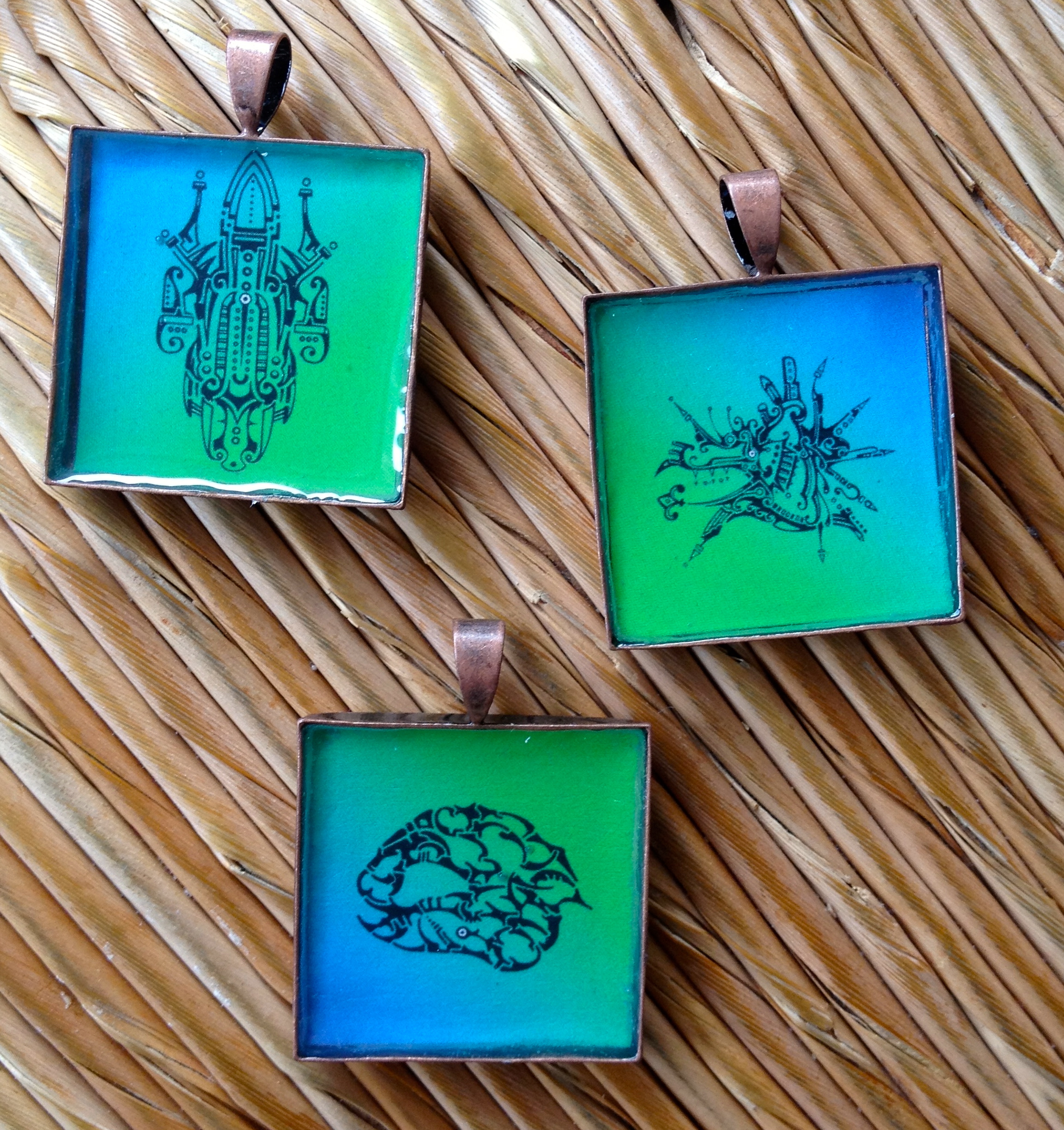
Last day of the giveaway! Remember that you can comment five times (one per giveaway post) in order to be entered five times in the jewelry giveaway. Here’s another shot of that jewelry, just because it’s so pretty. 🙂Near + Far jewelry, based on interior art by Mark W. Tripp.
The book launch has been going well. If you’re one of the people who’ve finished the book already, Amazon reviews are most welcome if you feel so inclined. (Yeah, I know that’s shameless, but I’d really like this book to do well because I love it so much.) Lots of people have signed up for the Goodreads give-away and 165 people have added it on there.
Some of the interviews, reviews, and guest blog posts:
So here’s the last five of our images, left to right.
Image #1 accompanies the story “Angry Rose’s Lament.” It’s another of the images that remind me of a submarine, if you had one carved by Aztecs.
Image #2 was chosen to go with the story, “Long Enough and Just So Long.” I like this image to the point where I’m considering another tattoo, featuring this. I don’t know why it appeals to me so much.
Image #3 was chosen for its swordlike aspect to illustrate the superhero story, “Ms. Liberty Gets A Haircut.”
Image #4 is set with the story “Seeking Nothing.” This one’s half submarine, half brass musical instrument.
Image #5 illustrates the story “Surrogates,” because it often looks to me like a laughing jester’s face, of the sort that perfectly illustrates that story.
One reminds me a bit of a dragon, too. Maybe because my toddler pointed to the submarine in the Willamette River outside of OMSI and called it a dragon not long ago.
You don’t have to go far to travel to strange places. They are at your fingers times.
I’ve read many of Cat’s stories. They tend to be lead by a character whom she manages to bring to life, even in short story whole worlds abound. There are touches of humor, heart and sometimes sorrow. Her stories have a sense of intelligence without being cerebral. But the two most important things that seem to connect much of the work are the joy and the wonder of the world.
These stories are something that will always be near your heart.
I see a lion swallowing a fish, and a whole world swimming through words. Beautiful stuff, Cat. I’m so super impressed and so happy it’s doing so well.
Want access to a lively community of writers and readers, free writing classes, co-working sessions, special speakers, weekly writing games, random pictures and MORE for as little as $2? Check out Cat’s Patreon campaign.
Want to get some new fiction? Support my Patreon campaign.
"(On the writing F&SF workshop) Wanted to crow and say thanks: the first story I wrote after taking your class was my very first sale. Coincidence? nah….thanks so much."
~K. Richardson
You may also like...
Book Launch!
Hydra House cover for Near by Cat Rambo. Art by Stephen Counley; cover deisgn by Tod McCoy.Today’s the official day that Near + Far is launched upon the world. Huzzah! If you’re wondering how to buy or spread the word about the book, here’s some details.
Some of you have received the mail I sent out talking about what you could do to spread word of the book. Here’s some of the pertinent details from that for those as wants such.As you know, publishing is changing and increasingly authors are part of the promotion process. I’m asking — if you should feel so inclined — for your help if getting the buzz out.
So what can you do?
Well, sure, buy the book is top of the list. But we don’t all have the budget. Here’s some other ways that you can assist in getting the word out about Near + Far:
1. Request it through your library. Most will even let you do this online.
2. Request it at your local bookstore. It’s available through Ingram, a major book distributor, so they should be able to get it.
3. Write an Amazon review or tag the book on Amazon. Amazon reviews are great! But if you don’t have the time to write one up, you can still help. One way that often gets overlooked is tagging. Scroll to the bottom of the Amazon page for the book until you see “Tags Customers Associate with This Product.” Add tags that you think might help someone find the book, if you notice anything missing, or just go through and check the boxes next to the tags you think are relevant (which is hopefully all of them.)
4. Review it or add it to your to-read list on book sites. Reviews on Barnes & Noble, Goodreads, LibraryThing (http://www.librarything.com/work/13024203/book/89765198), and Shelfari are great!
5. Blog about the book. Any mention of the book, particularly one that explains why you liked it, is awesome. There’s actually some cool little things about the book:
The tête-bêche format, also known as the Ace Double. Flip the Near side of the book over, and you’ll find Far on the other side.
The interior artwork is by long-time friend Mark W. Tripp.
If you’re one of the people who’s already received a necklace, take a picture of it with yourself to send me for the Near + Far page. Or alternately, the necklace with someone/something/draped across a rotting log/in a bookstore/whatever?
Stories range from very early to very recent, spanning markets from Asimov’s and Lightspeed to small and somewhat obscure anthologies. I’ve included some of my favorite stories, such as “The Mermaids Singing Each to Each,” “Surrogates,” and “Bus Ride to Mars.”
6. Share news of it on social networks. Sharing links on Facebook and other social networks is great. I’ll be posting links to blog entries about the book on the main networks I use: Facebook, Google +, and Twitter. Just favoriting, plusing or liking posts helps give them a little Google juice. Even going to the Facebook page at https://www.facebook.com/nearplusfar and clicking “Like” helps.
7. Share news of it on mailing lists and other groups. Pass the news along to your fellows on writing or SF-related discussion boards, BBSes, mailing lists, and other forums.
8. Share links on bookmarking sites. If you use bookmarking sites like Delicious, Reddit, or Stumbleupon, please think about bookmarking pages about the book. Here’s some pages that might be worth bookmarking:
Today I am letting myself slack a little, feeling caught up from the weekend’s excesses and so I can game tonight.
Today’s wordcount: 2592
Current Hearts of Tabat wordcount: 119954
Total word count for the week so far (day 3): 13568
Total word count for this retreat: 60229
Worked on Hearts of Tabat, “Moderator,” untitled piece
Works finished on this retreat: “California Ghosts,” “My Name is Scrooge,” “Blue Train Blues.”
Time spent on SFWA email, discussion boards, other stuff: 45 minutes
From the untitled piece:
The magician gestured, and out of the pool came musicians, the very first thing the tip of a flute, sounding, so it was as though the music pulled the musician forth, accompanied by others: grave-eyed singers and merry drummers; guitarists and mandolinists with great dark eyes in which all the secrets of the moon were written; one great brassy instrument made of others interlocked, so it took six to play it, all puffing away at their appointed mouthpiece, and all of them bowed down to the priestess who stood watching, her sand-colored eyes impersonal and face stone-smooth.
“Very pretty,” she said, and yawned with a feline grace, perhaps even accentuating the similarity in a knowing way with a tilt of her head.
The magician smiled, just as catlike, just as calm. “You can do better, I am sure,” he said.
She shrugged, her manner diffident, but rather than reply, she pursed her lips and whistled. Birds formed, swooping down, and wherever they swooped, they erased a swathe of the musicians, left great arcs of nothingness hanging as the seemingly oblivious players continued, their music slowly diminishing as they vanished, the instruments going one by one, and the last thing to hang, trembling in the air, was an unaccompanied hand, holding up a triangle that emitted not a sound.
Landing, the birds began to sing, and though the music was not particularly sweet, there was a naturalness about it that somehow rebuked the mechanical precision of the song theirs succeeded. As they sang, more and more birds appeared, and the music swelled, washing over the pair where they stood, like a river.
The priestess patted the air with the flat of her hand and the birds winked out of existence, leaving the two of them in a great white room, the antechamber of her temple.
“Will you go further in, then?” she said, and her voice was still casual.
The magician’s eyes were green as new grass and the black beard on his chin, which grew to a double point, was oiled and smelled of attar-of-roses. He considered her as though this was the smallest of debates, and finally stepped forward.





10 Responses
One reminds me a bit of a dragon, too. Maybe because my toddler pointed to the submarine in the Willamette River outside of OMSI and called it a dragon not long ago.
I want a charm.
Something new for my to-read list!
Very Pretty! I’ve only read two of the stories so far. . .
They’re quite lovely, Cat. Evocative and strangely visceral.
They’re stunning!
These pieces are amazing! I can’t wait to read the book ^_^
You don’t have to go far to travel to strange places. They are at your fingers times.
I’ve read many of Cat’s stories. They tend to be lead by a character whom she manages to bring to life, even in short story whole worlds abound. There are touches of humor, heart and sometimes sorrow. Her stories have a sense of intelligence without being cerebral. But the two most important things that seem to connect much of the work are the joy and the wonder of the world.
These stories are something that will always be near your heart.
I see a lion swallowing a fish, and a whole world swimming through words. Beautiful stuff, Cat. I’m so super impressed and so happy it’s doing so well.
I can’t. Wait to read the book. If my cousin says its a good read then I def listen to her….