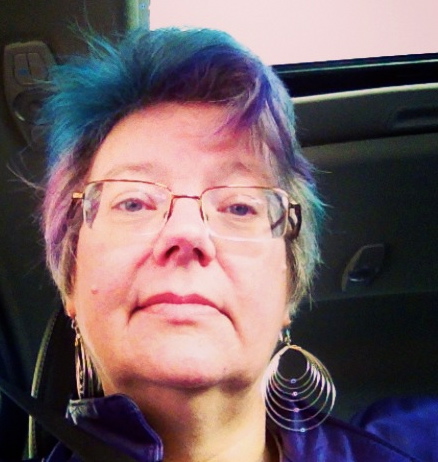
On August 16, 2013, at 8 p.m., Seattle’s Wayward Coffeehouse (6417 N. Roosevelt WAY NE, #104, Seattle, WA) will host a reading of four of the area’s notable speculative fiction writers. Ted Kosmatka, J.M. Sidorova, Django Wexler, and Cat Rambo will read from new and forthcoming work.
The four readers share something beyond a love of speculative fiction — they are all represented by the same agent, Seth Fishman of the Gernert Company. After meeting during the Locus Awards recently hosted in Seattle, the four joined forces for a joint reading at the Wayward Coffeehouse. Their work ranges from epic fantasy to hard SF.
About the readers:
Ted Kosmatka‘s work has been reprinted in nine Year’s Best anthologies, translated into a dozen languages, and performed on stage in Indiana and New Work. He’s been nominated for both the Nebula Award and the Theodore Sturgeon Memorial Award and is co-winner of the 2010 Asimov’s Readers’ Choice Award. His novel The Games was nominated for a Locus Award for Best First Novel. He grew up in Chesterton, Indiana and now works as a video game writer.
Cat Rambo lives, writes, and teaches by the shores of an eagle-haunted lake in Redmond, Washington. Her 200+ fiction publications include stories in Asimov’s, Clarkesworld Magazine, and Tor.com. Her short story, “Five Ways to Fall in Love on Planet Porcelain,” from her story collection Near + Far (Hydra House Books), was a 2012 Nebula nominee. Her editorship of Fantasy Magazine earned her a World Fantasy Award nomination in 2012.
J.M. Sidorova is a fiction writer and a biomedical scientist at the University of Washington. She is a graduate of the Clarion West workshop for writers of speculative fiction. Her science fiction and fantasy short stories appeared in Clarkesworld, Asimov’s, and other venues. Her debut novel The Age of Ice (Scribner/Simon & Schuster) has just arrived at bookstores.
Django Wexler graduated from Carnegie Mellon University in Pittsburgh with degrees in creative writing and computer science, and worked for the University and artificial intelligence. Eventually he migrated to Microsoft in Seattle, where he now lives with two cats and a teetering mountain of books. His latest book is the first of an epic fantasy quintet, The Thousand Names.
Want access to a lively community of writers and readers, free writing classes, co-working sessions, special speakers, weekly writing games, random pictures and MORE for as little as $2? Check out Cat’s Patreon campaign.
Want to get some new fiction? Support my Patreon campaign.
"(On the writing F&SF workshop) Wanted to crow and say thanks: the first story I wrote after taking your class was my very first sale. Coincidence? nah….thanks so much."
~K. Richardson
You may also like...
On Clarion and Privilege and the Internets
Neil Gaiman has been catching a lot of flack for this tweet.
People are, understandably, saying that the equation clarion + student = pro writer is not the only way you can reach that particular sum, and they are absolutely correct, although the drama is — as is often the case on the Internet — a bit hyperbolic.
This is the fact of F&SF (and any other genre) writing — there are writers disadvantaged by gender, or race, or sexuality or other physical circumstances. But there’s also a big group — which contains a disproportionate number of those differing physically — affected by economic issues.
Here are two simple facts:
If you have the economic means to attend a workshop like Clarion West, Clarion, Kevin J. Anderson’s Superstars, the workshops given by Kris Rusch and Dean Wesley Smith, etc, it can give you a career advantage, primarily in terms of forming a support network of peers, although there are a number of other plusses. The degree of advantage depends on both luck and how willing you are to make the most of the time at the workshop.
If you have the economics means to attend a convention, it can give you a career advantage, primarily in terms of industry contacts. The degree of advantage depends on both luck and how willing you are to make the most of the time at the convention.
But there is nothing being taught at a workshop that you cannot pick up by yourself, given time, though it is true that workshop teaching can often be inspirational, effective, and sometimes entirely life-changing.
Being able to attend a convention or workshop is not just a matter of being able to pay the substantial fee. It’s being able to travel and most importantly — it’s being able to take time away from both work and family. That’s an incredible privilege.
I came through Clarion West in 2005. My instructors were (in chronological order) Octavia Butler, Andy Duncan, L. Timmel DuChamp, Connie Willis, Gordon Van Gelder, and Michael Swanwick. I am a pretty convivial person, and remain close friends with the majority of my instructors. I also was part of a talented class that included E.C. Myers (winner of the Andre Norton Award for his book Fair Coin), Rachel Swirsky (frequent nominee and winner of things) and goddamn Ann Leckie, whose Ancillary series has set the bar for success so high the rest of us are just going, “Yeah right.”
I was able to do this because I had a partner willing to let me quit my job and try writing for a while. A decade later, I have yet to make half of what my Microsoft salary was through writing; I continue to persevere. If I had a family to support, it would have been incredibly difficult to do it — perhaps simply impossible. It gave me an advantage, and it also kicked me in the ass to be productive, because I was intensely aware of just how lucky I was.
Neil is — obviously — not saying you can’t be a writer without such a workshop. Note that Gaiman himself did not go to such a workshop, as far as I know. He is, though, enthused about the workshop (as befits a former instructor) and aware of what a big advantage it can prove.
But it also depends on what you make of it. In any class there will be those who persevere and those who fall by the wayside. Of the people in my writing workshop from decades ago at Hopkins, only a handful are still writing. Ten years later, a few members of my Clarion West class seem to have dropped off the face of the planet.
You have to want it hard enough to work for it, no matter what. You have to be willing to make time for writing words down and thinking about the order and what happens when you rearrange them. You have to have a hide hard enough to survive the day when there’s three rejections plus a nice fan letter whose writer is confused and thinks you’re someone else with a similar name. You have to be willing to trim away some bullshit activities and substitute stuff that lets you work at your craft, like reading or taking online classes or whatever. That’s the part you need.
A while back, I read someone saying that we all have someone who gives us permission to call ourselves a writer. For me, it was John Barth: sitting in his sunlit Hopkins office, a bookcase framing his smiling, balding head talking about my stories and a fellowship he wanted me to apply for is something I will always remember. But that is less important than giving yourself permission to call yourself a writer. It’s harder — it requires a certain amount of adamant ego and determination — but that permission can — and must — come from inside as well as externally. That’s the most important component, and you can do it with or without the aid of a workshop.
TL;DR version? Ain’t nothing going to substitute for hard work. Why aren’t you writing?
Later addendum: Most of the workshops do offer some scholarships; if there’s one you’re interested in, I do suggest asking about what financial aid is available.
Links from the Blogging 101 Class - Google Analytics Resources
There’s a number of tools for evaluating how a blog’s doing traffic-wise, but I’m not sure why anyone doesn’t just use Google Analytics, which will tell you how many visitors, where they’re coming from, what pages they’re looking at, and much more. Much like SEO, this is something that could take up its own workshop, and we didn’t get much to explore it in class. Hopefully these links will prove an alternate entrance.



 On August 16, 2013, at 8 p.m., Seattle’s Wayward Coffeehouse (6417 N. Roosevelt WAY NE, #104, Seattle, WA) will host a reading of four of the area’s notable speculative fiction writers. Ted Kosmatka, J.M. Sidorova, Django Wexler, and Cat Rambo will read from new and forthcoming work.