

Five Ways
Subscribe to my newsletter and get a free story!
Share this:

Reading List: Superhero Fiction

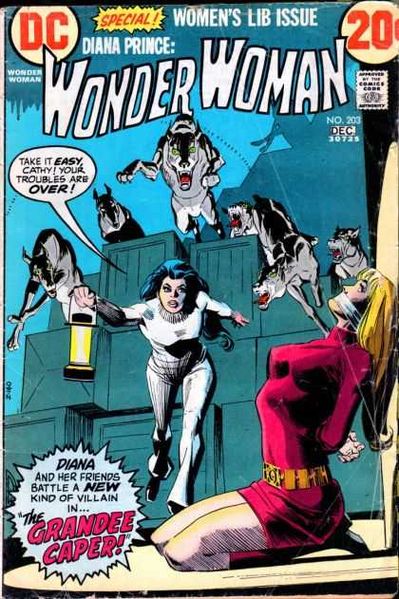
Wonder Woman Issue 203I recently posted in a Reddit thread about superhero novels and thought that the list I put together there might form an interesting blog post.

Superhero novels are near and dear to my heart for several reasons.

  • One, I grew up reading comic books and loved some of them dearly. The only fanfic I have ever written involved the uncanny X-Men and the super villain Arcade, along with a thinly veiled version of myself. It has, luckily, been lost and not recorded for posterity.
  • Two, I loved playing superhero RPG’s like Villains and Vigilantes and Champions. Superhero 2044 came out around the same time, but it wasn’t as interesting to my gaming group, which tended to stick with Champions.
  • This led in fact to three, which is that I once wrote a novel involving superheroes. I wrote it while in the Masters program in writing at Johns Hopkins. At the time, watchmen had just come out, and the possibilities of superhero literature had not, perhaps we shall say, been realized as effectively as it is today. In fact, I took the book to Tom Disch, who was teaching in the office next to me, and who read a chapter, fixed me with a gimlet eye, and asked, “but why bother?” Several publishing houses looked at the novel and felt it was well written but not commercial. Some time later, tragically, the manuscript was lost in the course of moves. Its heroes can be found in a short story which appeared in Strange Horizons, Ms. Liberty Gets a Haircut, which can also be found in story collection Near + Far. Other superhero stories by me appear in Corrupts Absolutely and Eyes Like Sky and Coal and Moonlight

So here’s some of my favorites:

From the Notebooks of Dr. Brain by Minister Faust is awesome superhero fiction. It’s told by the therapist of a superhero team that closely resembles the Avengers. Faust also has The Coyote Kings of the Space-Age Bachelor Pad.

Count Geiger’s Blues by Michael Bishop is amazing. Along the same lines is Bishop’s Brittle Innings, the story of a baseball playing monster.

The Wild Cards series edited by George R.R. Martin (of GoT fame) is tons and tons of fun and there are a LOT of them for those of us who like to read at a fast and furious clip.

In Hero Years I’m Dead by Michael Stackpole is terrific along with Once a Hero. I wish Stackpole would write more in this world.

Carrie Vaughn After the Golden Age is told from the point of view of the unpowered daughter of a pair of superheroes, Captain Olympus and Spark.

Playing for Keeps by Mur Lafferty.

Austin Grossman’s Soon I Will Be Invincible is told from alternating experienced villain and novice hero viewpoints.

Michael Chabon’s The Amazing Adventures of Kavalier & Clay is a classic.

The Sugar Frosted Nutsack by Mark Leyner is, like all of Leyner’s books, hysterical, but this time with superheroes.

Those Who Walk in Darkness by John Ridley is the beginning of a series that I found reminiscent of joint online project Shadow Unit, created by Elizabeth Bear, Holly Black, Leah Bobet, Emma Bull, Sarah Monette, and Will Shetterly.

Nobody Gets the Girl by James Maxey. Series.

Evil Genius by Catherine Jinks is YA superhero fantasy.

Karma Girl by Jennifer Estep is frothy and funny and sweeps you along in a nicely satisfying story. First of a series.

Along the same lines is Black and White, the story of a superhero and a supervillain friendship by Jackie Kessler and Caitlin Kittredge. First in a series.

Santa Olivia by Jacqueline Carey (also known for her Kushiel adult epic fantasy series) is the story of a group genetically engineered for superpowers. First of a series.

If you want something that goes back to some of F&SF’s roots, try Doc Savage or A Feast Unknown by Philip Jose Farmer.

4 Responses

  1. I love super hero novels! I just read Ian Tregillis’ Bitter Seeds, the first part of his “Milkweed Triptych,” — British warlocks battling Nazi Ubermenschen. What’s not to love? 🙂

  2. The Wild Cards series is the only reason I knew who GRR Martin was when Game of Thrones became popular. I’ve got the first 3 on my shelf.

  3. Excellent taste. But let me direct your attention to Jim Munroe’s _Flyboy Action Figure Comes with Gasmask_, which is either the best one or really close.

Leave a Reply

Your email address will not be published. Required fields are marked *

Get Fiction in Your Mailbox Each Month

Want access to a lively community of writers and readers, free writing classes, co-working sessions, special speakers, weekly writing games, random pictures and MORE for as little as $2? Check out Cat’s Patreon campaign.

Want to get some new fiction? Support my Patreon campaign.


"(On the writing F&SF workshop) Wanted to crow and say thanks: the first story I wrote after taking your class was my very first sale. Coincidence? nah….thanks so much."

~K. Richardson

You may also like...

Teaser: Another Excerpt from A New Board is Elected at Villa Encantada

Picture of a stone lantern.Here’s another chunk from “A New Board is Elected at Villa Encantada,” (working title) a darkly humorous story about a very odd condo complex that I’ve written several stories about already. It’s been fun filling out the complex’s roster a little in this story, and I’m going back to revise one of the unpublished ones with some of these details. Like the talking cacti.

Even the cacti garden was talking about the assessment. I usually don’t visit down there, in the little rock garden near the lake. For one thing all of the cacti like to talk at once. They ramble and they repeat and they are altogether too fond of puns. Not for the first time, I wondered what exactly the magician who had created them had had in mind. Had it really been a dozen cranky plants, whose extreme longevity led them to be highly opinionated about everything?

There are twelve cacti altogether, eleven in pots and one who has chosen to plant itself and grow. The eleven in pots have opted for mobility over size. They were fond of making Rumpelstiltskin wheel them about the complex in order to enjoy the sun and fresh air.

Each was distinctive, both in personality and appearance. They had names, which usually mattered only to each other. I had mentally bestowed nicknames on them: Bombast, Furor, Humblepie, Obscuro, Smarmy, Weasel, Johnny Nonsense, Earnest, Hairyfoot, Splainer, and the unpotted Old Dignity, a massive saguaro towering a good fifteen feet over its much shorter, hideously root bound, compatriots.

Bombast said, “It’s a cabal! They’ve been waiting to seize power for years now, and rob our reserves, turn us over to some real estate agent so the complex can be demolished for a high rise.”

Furor said, “Don’t be ridiculous. They’re not organized enough to be a cabal. And this place isn’t zoned for high-rises.” It added, its tone dark, “No, what they have in store for us is much, much worse.”

“How can they hope to understand the history of the complex?” demanded Hairyfoot. “Most of them haven’t even been here a decade.”

I considered them. The complex was odd at the best of times. It was a refuge, a complex that didn’t mind people who were outside the ordinary. That led to a population that was more mixed than most, including the denizens of this garden.

Earnest said to me, “Did you give your proxy to someone to vote?”

I shook my head and fled.

Rumpelstiltskin was by the dumpster, sorting out recyclables. He looked wretched and smudgy as an old sheet of newsprint. As I passed, he looked up, and said, hopefully, “What’s my name?”

“Not today,” I said. “You won’t escape today.”

I felt guilty at the look on his face, and the situation made me itch, but it’s been so hard to find a maintenance man here that I could understand why they had done it. Sometimes when you find good help, you have to rely on the laws of magic to keep them from leaving. Unscrupulous? Yes, undoubtedly. But the needs of the many outweigh those of the few. Or the one, in his case.

If you want to read the rest of the story, you can get it, along with at least six other stories, at the end of July by signing up to sponsor me in the Clarion West Write-a-thon. Even a small donation entitles you to the stories, so please do sign up!

...

On Clarion and Privilege and the Internets

Neil Gaiman has been catching a lot of flack for this tweet.

a tweet by Nail Gaiman

People are, understandably, saying that the equation clarion + student = pro writer is not the only way you can reach that particular sum, and they are absolutely correct, although the drama is — as is often the case on the Internet — a bit hyperbolic.

This is the fact of F&SF (and any other genre) writing — there are writers disadvantaged by gender, or race, or sexuality or other physical circumstances. But there’s also a big group — which contains a disproportionate number of those differing physically — affected by economic issues.

Here are two simple facts:

  • If you have the economic means to attend a workshop like Clarion West, Clarion, Kevin J. Anderson’s Superstars, the workshops given by Kris Rusch and Dean Wesley Smith, etc, it can give you a career advantage, primarily in terms of forming a support network of peers, although there are a number of other plusses. The degree of advantage depends on both luck and how willing you are to make the most of the time at the workshop.
  • If you have the economics means to attend a convention, it can give you a career advantage, primarily in terms of industry contacts. The degree of advantage depends on both luck and how willing you are to make the most of the time at the convention.

But there is nothing being taught at a workshop that you cannot pick up by yourself, given time, though it is true that workshop teaching can often be inspirational, effective, and sometimes entirely life-changing.

Being able to attend a convention or workshop is not just a matter of being able to pay the substantial fee. It’s being able to travel and most importantly — it’s being able to take time away from both work and family. That’s an incredible privilege.

I came through Clarion West in 2005. My instructors were (in chronological order) Octavia Butler, Andy Duncan, L. Timmel DuChamp, Connie Willis, Gordon Van Gelder, and Michael Swanwick. I am a pretty convivial person, and remain close friends with the majority of my instructors. I also was part of a talented class that included E.C. Myers (winner of the Andre Norton Award for his book Fair Coin), Rachel Swirsky (frequent nominee and winner of things) and goddamn Ann Leckie, whose Ancillary series has set the bar for success so high the rest of us are just going, “Yeah right.”

I was able to do this because I had a partner willing to let me quit my job and try writing for a while. A decade later, I have yet to make half of what my Microsoft salary was through writing; I continue to persevere. If I had a family to support, it would have been incredibly difficult to do it — perhaps simply impossible. It gave me an advantage, and it also kicked me in the ass to be productive, because I was intensely aware of just how lucky I was.

Neil is — obviously — not saying you can’t be a writer without such a workshop. Note that Gaiman himself did not go to such a workshop, as far as I know. He is, though, enthused about the workshop (as befits a former instructor) and aware of what a big advantage it can prove.

But it also depends on what you make of it. In any class there will be those who persevere and those who fall by the wayside. Of the people in my writing workshop from decades ago at Hopkins, only a handful are still writing. Ten years later, a few members of my Clarion West class seem to have dropped off the face of the planet.

You have to want it hard enough to work for it, no matter what. You have to be willing to make time for writing words down and thinking about the order and what happens when you rearrange them. You have to have a hide hard enough to survive the day when there’s three rejections plus a nice fan letter whose writer is confused and thinks you’re someone else with a similar name. You have to be willing to trim away some bullshit activities and substitute stuff that lets you work at your craft, like reading or taking online classes or whatever. That’s the part you need.

A while back, I read someone saying that we all have someone who gives us permission to call ourselves a writer. For me, it was John Barth: sitting in his sunlit Hopkins office, a bookcase framing his smiling, balding head talking about my stories and a fellowship he wanted me to apply for is something I will always remember. But that is less important than giving yourself permission to call yourself a writer. It’s harder — it requires a certain amount of adamant ego and determination — but that permission can — and must — come from inside as well as externally. That’s the most important component, and you can do it with or without the aid of a workshop.

TL;DR version? Ain’t nothing going to substitute for hard work. Why aren’t you writing?

Later addendum: Most of the workshops do offer some scholarships; if there’s one you’re interested in, I do suggest asking about what financial aid is available.

...

Skip to content