Here's some of the books, stacked in the hallway and waiting to be sorted through. It's a fairly representative sampling. Redlaw was picked up at a con; it's a good thriller reminiscent of Paul Cornell's London Calling. Nicola Griffith's Slow River is a book I hate to part with and I know there's a good chance I might reread it at some point but for now...out it goes. There's some issues of the Magazine of F&SF, and Lawrence Durrell's Clea, which was part of "I will improve myself as a writer" reading.One of the things 2014 is bringing is all sorts of interesting and awesome changes, but part of that is a need to trim down drastically. So I’ve been going through my books getting ready to sell a lot of them. Many are from teen years, college, or grad school. Others are gathered at cons, sometimes with stories attached. Some sparked stories, or were gifts from, or were written by people I respect and admire and sometimes love. Some are signed. Some have notes jotted in them. Some are books that changed my life.
So far I’ve winnowed 700 or 800 books from the collection and there’s still a lot left. Not to mention there’s a storage locker holding at least another 1000. Argh.
But rather than dump them all at Value Village, I’m taking these last days to sort through them. Because some of these books are old, old friends. So I’m checking them on Amazon (and finding a few worth unexpectedly more, which is nice) and listing all the ones for sale in a spreadsheet, with a few notes and a price. A few I’m putting aside to give to specific people. There’s two boxes laid aside already for my godchildren.
My plan with the ones for sale is to give my two best friends, my brother, and my mom first crack to see if there’s any they want. (Or any that are actually already theirs, in mom’s case, since the boundary between my mom’s books and mine has been pretty fluid from time to time.)
After that, time to see if I can get a little filthy lucre for them. I’ll offer to share the spreadsheet with my writing group, students, other friends, and anyone else interested. (Drop a line here if you are.) Lots of fiction, particularly short stories, a lot of Women’s Studies texts, assorted odd bits and interesting historical stuff. The usual round of books about writing.
I’ll be blogging about some of the books as I hit them. After this comes a similar pass at all the knick-knackery I have accumulated. Not looking forward to that too much, but there’s also a good feeling, a wind-through-one’s-soul feeling that comes with shedding stuff.
Want access to a lively community of writers and readers, free writing classes, co-working sessions, special speakers, weekly writing games, random pictures and MORE for as little as $2? Check out Cat’s Patreon campaign.
Want to get some new fiction? Support my Patreon campaign.
"(On the writing F&SF workshop) Wanted to crow and say thanks: the first story I wrote after taking your class was my very first sale. Coincidence? nah….thanks so much."
~K. Richardson
You may also like...
Nattering Social Justice Cook: DIY Cooking Kits
Shared food can be a social experience that creates friendships.
Within the last few years, an industry has sprung up aimed at people who don’t know how to cook but yearn to do so. The basic model of such companies is that they deliver kits for making a homemade meal: the ingredients, with any pre-work like peeling or trimming already done, and a set of instructions that includes step by step photographs pretty enough to be in a food magazine.
I tried one of these services a year or two ago, lured by a good coupon deal, and did get some value out of it, but cancelled the subscription before they could start hitting me with the non-coupon costs. For someone utterly foreign to the idea of cooking, these might be useful to show how easy it is to create a tasty meal, or for someone scared of failure, they might build confidence. But the amount of wasteful packaging was striking, and that seems a bad thing to me. I don’t like creating garbage, because among other things, it means I must expend effort taking it out, but also because it’s bad for the planet.
The average American generates 4.3 pounds of garbage per day. That’s over a pound and a half over what the figure was in 1960. So we’ve gotten, overall, less efficient rather than more, while at the same time depending on resources that are diminishing.
Every one of the kits came in cardboard packaging around a styrofoam box with two large ice packs. I stuck a few of those ice packs away for re-use but there are only so many ice packs any household can use and they’re not recyclable because they’re filled with some sort of chemical solution. Every ingredient was packaged separately, down to tiny plastic bottles holding approximately a teaspoon of soy sauce. If I had weighed the garbage against the end result, I would have found the garbage far in excess of the end result.
I think people should know how to cook, because it’s a skill that helps them make their life better in a number of ways. I freely acknowledge that people with few resources will have a harder time cooking, yet be in a position where the practice would benefit them tremendously. Some low-cost appliances can be of much use here, like a rice cooker, hot plate, or toaster oven, but using those efficiently takes skill and knowledge. These kits aren’t going to teach people some important basics, such as how to shop economically/efficiently, how to store ingredients, or how to prepare food.
My grade school taught home economics in 6th grade, in a time benighted enough that girls weren’t allowed to take shop class, because that teacher claimed he was too worried about long hair getting caught in machinery. It was useful stuff: how to plan and cook a meal and how to sew things, mainly. We did have a few boys in there, mainly ones who were there for eating part of cooking practice.
Most of what I learned about the kitchen, though, I learned at home, from my mother, who was and continues to be a skilled and adventurous cook, my maternal grandmother, who provided farmhand meals for decades and was a master cake decorator, and my paternal grandmother, who had only a few dishes down, but made them well.
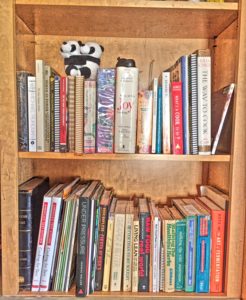
It wasn’t until graduate school, though, that I realized that I really loved to cook and was pretty good at it, particularly after two years of catering to a household that included two vegetarians, a lactose-intolerant, someone testing for food allergies, and a follower of the Pritikin no-fat whatsoever diet. I hosted dinners and potlucks, fed a houseful of boarders, and created a backyard garden that supplied fresh ingredients. I learned to love tiny ethnic grocery stores as well as how to make some of my own staples, began to bake bread on a regular basis, and began to accumulate what’s currently two shelves of cookbooks (and books about cooking), despite frequent culling.
Some of these books have survived several decades of purges and moves.
Why do I think the skill is so important? Here’s what it has brought to my life over the years.
Economic advantages: I can live significantly more cheaply than someone who eats out or buys pre-prepared food. I could feed my household for significantly less than I would otherwise if I’m willing to put a little time into planning my meal schedule and shopping. Among the things I can and often do make at home that are cheaper: yogurt, bread, pasta, salsa, mayonnaise, hummus, cookies, soup stock, kombucha, burritos, ricotta cheese, cold-brewed coffee, instant oatmeal, flavored butter, ice cream — and that’s just the foodstuffs. I can stretch meals – buy something that serves for multiple meals, like a pork shoulder that goes into pulled pork, stir-fry, and then soup. Learning how to cook well can be the single biggest budget-changer skill a person learns.
Nutritional advantages: I know what’s going into my food and can accommodate my partner’s sensitivity to corn, for one. Looking at the list of ingredients of something like Hamburger Helper, I see a bewildering array of chemicals. Some are everyday things dressed up in scientific names, but a lot are chemicals designed to keep the food lasting longer on a store shelf or to make it pretty. I can incorporate foods that I know are good for us or cut down on things like sugar, sodium, and fat.
Educational advantages: Learning how to cook means learning how to plan and prepare. When I give a dinner party, I’ve got a schedule laid out ahead of time: this dish goes into the oven at time x, then I prep onions for the next dish while the water’s boiling for yet another. It means a bit of math if you want to play around with servings and substitutions. It can mean even more education: learning the cuisine of a particularly country often involves learning something about its history and culture. You also learn how a small addition can have a major impact, how to taste as you go, and other useful stratagems.
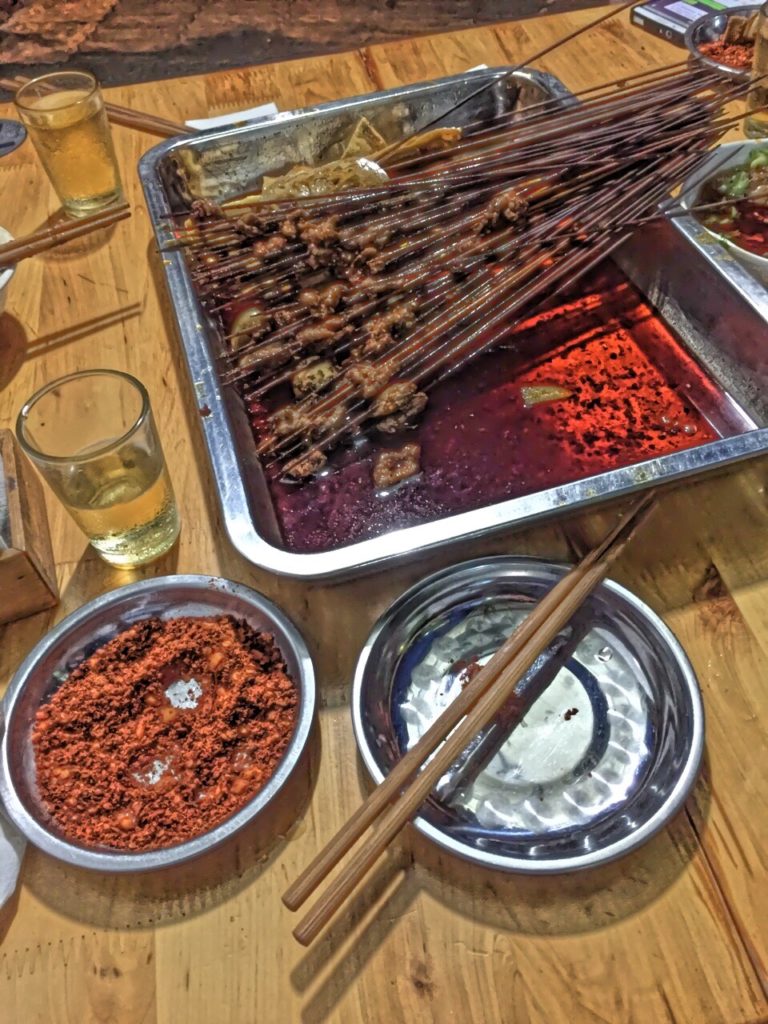
Social advantages: In grad school I hosted countless potlucks, which were a cheap way for impoverished grad students to come together for a meal, as well as various cook-offs, including a chili competition that featured, if I’m remembering correctly, eight different kinds. Yesterday I hosted my D&D group, feeding them an epic lunch of Mongolian hotpot before we started gaming. I can also throw a party much more cheaply than the cost of hiring someone to cater it. Moreover, through judicious application of delicious food and drink, I can delight my friends and enjoy their company and conversation for a period of time. When I was dating, I showed off my cooking skills more than once in order to woo someone. There’s something about having someone prepare food to you that is deeply romantic. Not to mention the seductive shazam of an intimate meal shared in the right setting. Even now, I can demonstrate affection for my spouse by fixing him breakfast in bed or his favorite snack when he’s feeling beleaguered by the world.
Aesthetic advantages: Food is one of life’s great pleasures. Celebrating its flavors and complexities is an aesthetic pursuit, and learning to appreciate new foods is an opening up to new things that helps make life more enjoyable. If you understand food and some of its complexities, you can appreciate that elaborate dessert or delicately flavored cheese even better. And a writer can rarely go wrong by exploring the sensory, in my opinion.
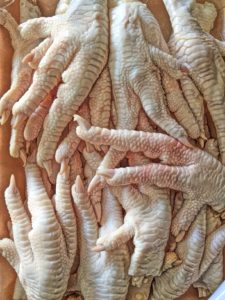
Ecological advantages: Learn how to cook and you eliminate a lot of waste. Plus you learn how to use up some of what would be otherwise thrown away. Vegetable and meat trimmings can be saved to make awesome soup stock; those excess bananas so quickly turning brown can become an ice cream substitute. I made soup stock from chicken feet yesterday; the result was a healthy broth for my sick spouse that cheered him up, but also reminded me that living creatures went into our meal. Eating meatless (which has its economic pluses as well) is much easier if you know how to cook things like lentils, beans, and grains. Learning how to ferment foods has made me more aware of how much we depend on the microbial world in cooking.
How does one acquire the skill? DIY kitchen kits are not the way to go. Pick a simple dish: scrambled eggs, a grilled cheese sandwich, a basic soup. Start smaller if you’re totally new and learn how to hard-boil an egg. That’s a useful skill, because not only have you learned how to make pre-packaged protein-rich snacks that you can take with you to work, but you’ve learned a basic ingredient for recipes ranging from egg salad to eggs Vindaloo.
Or pick a basic appliance and start experimenting. A rice cooker is one of the mostversatilethings you can own; throw a handful of lentils and some spices in with your rice and you’ve got a cheap, one-pot meal, for example. A toaster oven performs a multitude of tasks, and a slow cooker has many of the uses a rice cooker does.
One of the great things about the Internet is that it throws up so much of this stuff online. When I started making my own tamales, I went to Youtube to watch techniques and learned by seeing the demonstration in a way I would have never absorbed from a textual recipe. It was a bit of a challenge, which learning new things should be (IMO) in order for them to really sink in. Opening a package and putting preassembled bits together doesn’t give you the knowledge you need in order to assemble those things on your own.
Like so many things in life. Right now we’re at a time when plenty of people are ready to provide you with pre-assembled mindsets, lists of talking points, ingredients measured and tailored so they can be assembled only into a single recipe. Question your mental ingredients, know where they come from, and taste as you go.
And remember the universe loves you (along with everybody else).
Taken during World Fantasy in San Diego, 2011, by On Focus Photography.Since 2006, I’ve dyed at least part of my hair pink, usually a few locks near my face. The dye comes in a kit from L’oreal and doesn’t require bleaching beforehand ““ brush it on, wait thirty minutes, and wash it off. Voila, cartoon-bright streaks among the (once-prematurely) graying strands.
The first time I dyed it, I was about to head off to my first Wiscon ““ a large feminist science fiction convention held yearly in Madison, Wisconsin. As I’ve found the case at sf conventions since then, I wasn’t the only person there with an odd hair color; I glimpsed rainbows of pink, blue, and green. And I realized it was becoming. Complete strangers would lean over and whisper, “I like your hair,” including two flight attendants on the way home.
After the con the color faded, softer and softer, until finally, when I went to get a haircut, the hairdresser was cutting away dusty rose tips. I looked in the mirror and saw a middle-aged woman with a short, practical cut.
I bought a new kit on the way home and re-pinked my hair that afternoon.
Since then it’s become a ritual following each haircut. I go in and see it trimmed away until only the faintest hint of color remains. Sometimes I take advantage of this time to do my shopping in sedater department stores like Macy’s or Nordstroms, excursions that I think of as “passing for surburban.” Then I go home and re-dye my hair. I’m always a little self-conscious those first few days of screaming fuchsia, when I have to sleep with a towel over the pillow to keep the pink from leaving traces on the pillowcase. I try to time these days to coincide with a science fiction convention or some similar event.
I use that as an excuse when people ask me why I dye it. “I’m a sci-fi writer and it helps fans identify me at cons,” I say. That’s the partial truth. It’s part of my brand. But it’s also more than that.
Sometimes people interpret it for me. When my mother was recovering from surgery for colon cancer one year, I visited the hospital every day and used the valet parking they provided. “I know why your hair’s pink,” the elderly valet confided to me one day as he took the keys from me. “Are you a survivor or is it a relative?” I realized that he thought I was part of the flood of pink that month against cancer. I couldn’t bear to disillusion him, so I said something to him about my mother, and he went on to tell me about the women in his life who had struggled with cancer.
That’s another reason why I dye it pink. People talk to me. There’s something about the color that draws them to ask about it or say that they like it. The only person I’ve ever found who disapproved outright was a relative’s girlfriend. She didn’t last. My hair color has.
But more than that, the pink forces me to talk to people as well. I’ve habitually toed the line between introvert and extrovert, depending on which Meyer Briggs results you look at, and I like the fact that the pink pushes me outside myself, makes me be socially brave in a way I’ve sometimes retreated from.
The pink’s a favorite with people. I tried purple one year, a vibrant, almost fluorescent purple that required bleaching the hair beforehand, a painful process I will never repeat. Some nuance of the purple made it seem more confrontational, less welcoming than the pink. Fewer people came up to say something about it, although I was startled at one point when a man behind me began stroking it. “I couldn’t resist the color,” he said.
I have been advised to avoid blue. “It ages one,” a friend said, although I’ve admired the turquoise shading of Camille Alexa, a fellow speculative fiction writer, at several cons.
I worry that L’oreal will stop making this particular brand. I’ve got five boxes of it stockpiled under my sink. I figure I’ll commit to the color until the year or two that the boxes represent are past. After all, who knows what advances in hair color may have been made by then?
It took a while for my mother to get used to it. Finally one day, when we were coming out of a store, she chuckled. “Did you see that man?” she said. “He smiled at your hair. I guess anything that makes people smile is okay.”
And I agree. If I’m making people smile, I’m doing something right.
I’m lucky to live in Seattle, where hair is often not its natural shade. I’ve found when I visit the East Coast, particularly in the southern areas, people are not quite as welcoming of the color. They’re more likely to surreptitiously (or so they think) point it out to each other. I haven’t traveled abroad with it yet.
And I’m lucky to work at home as a writer, with no boss to object to the pink. More than once someone has wistfully said, “They would never let me do that at work.” That seems a shame to me, much like seeing the trainers at my gym wearing work-mandated band-aids over tattoos lest they shock the sensibilities of the patrons.
The hair color also lets people spot me in a society where being a middle-aged woman is often a cloak of invisibility. Sometimes that’s unwelcome. I’d rather fade into the crowd, which is much harder to do when pink-topped. That’s why I love sf conventions so much, why they feel like coming home to my spiritual tribe. At Penguicon I rubbed elbows with a woman whose wheelchair was tricked out like a Victorian mechanical contraption, complete with sporadic puffs of steam, a strapping young gentleman costumed as Thor, and a woman whose baby was dressed up as a miniature robot, complete with blinking lights. Indeed, at Norwescon, a local convention that’s particularly costume heavy, I look positively sedate.
It’s strange that I engage in this particular cosmetic practice. I’ve always resisted make-up. I put it on and, despite the best teachings of my mother the former Mary Kay representative, I see a clown-faced stranger in the mirror. The pink hair allows me to feel like I’ve managed some effort to dress up. Combine it with the right shirt, and people assume I’ve carefully color-coordinated outfit and hair.
But I cringe, just a faint recoil, when I look at those shirts in my closet: the crisp peppermint striped or hibiscus and butterfly printed shirts gleaned from the local Talbots outlet. Because here’s a secret: I’m not particularly fond of pink. I was never a Barbie girl. I like deep purples, turquoise, and emeralds.
In fact, I resent the way pink’s been mandated for little girls. I worry that I’m doing this to make myself less threatening to men, that I’m saying, “Look! I’m a feminist, but a fluffy pink harmless one.”
But I tell myself to stop over-thinking it. It’s a color, not a lifestyle. I embrace my pink and claim it. Which adds another dimension to it for me: it’s ironic statement as well as fashion one. It says I don’t give a damn about what other people consider age-appropriate. “This is me,” my hair says. And I look damn good in pink, or so I think.
Or maybe that’s just ego talking, an overly healthy one bolstered by all those strangers telling me they like my hair.