

Five Ways
Subscribe to my newsletter and get a free story!
Share this:

Chez Rambo Reading, January 2019

I’m tracking my reading on a monthly basis again as part of 2019’s effort to be more methodical about record keeping. So here’s what i read, along with some notes on it, as i start building up in order to be doing more regular lengthy reviews again.

  • I have been binge-reading Robert J. Crane’s Out of the Box series and finished up Badder, Nemesis, Apex, Time, Remember, Hero, and Flashback. These are highly satisfying superhero novels and I’m really looking forward to the next installment, which is book #24.
  • I also tried to add more nonfiction to my reading list in 2019. The first of these was Seth Godin’s This is Marketing: You Can’t Be Seen Until You Learn to See, which I found myself taking a lot of notes on. I’ve been reading a number of works on marketing and pricing for the Rambo Academy and it’s been handy but right now I feel like I have been slogging through the same grad-level text on pricing for a kerjillion years.
  • Because I work with some clients as a writing coach, I found The Coaching Habit: Say Less, Ask More, and Change the Way You Lead Forever by Michael Bungay Stamer useful, particularly the listen more, talk less part.
  • William Gibson’s The Peripheral was a terrific read and I’m working on an essay that is an appreciation of Gibson and his work. He’s our latest SFWA Grand master and I’m looking forward to meeting him at the Nebulas.
  • I read Diane Morrison’s Once Upon a Time in The Wyrd West in order to blurb it. Here’s the blurb I sent: Saskatchewan gunslinger elves in a world vividly real and detailed. Morrison shows us a rarely explored Weird West landscape. Really a fun book for Weird Western lovers.
  • A space romp that I really enjoyed, I read Elizabeth McCoy’s Queen of Roses at the suggestion of M.C.A. Hogarth to think about for an upcoming Storybundle. Pleased to say I’m including it, because it’s a really fun read with a great AI protagonist, Sarafina.
  • The book Astounding: John W. Campbell, Isaac Asimov, Robet A. Heinlein, L. Ron Hubbard, and the Golden Age of Science Fiction by Alec Nevala-Lee was an interesting read, particularly since Nevala-Lee’s take on a few figures differed from ones I’d been presented with in the past, particularly Randall Garrett. An acquaintance (now passed) used to insist that Garrett’s habit of walking up to women at parties and saying “I’m Randall Garrett, let’s fuck” was an example of someone unbound by stifling social norms and that no one ever took offense at it, while Nevala-Lee describes Garrett as “a bearded Texan who was known within the science fiction community as a drunk and a sexual predator” (p. 321) following up with a description of Garrett’s actions when engaged to Campbell’s daughter Jane that makes him seem like a pretty awful guy. Anyhow, if you are into SF history, this has a goodly amount, plus a nicely thorough bibliography for further reading.
  • I’m very fond of Kindle Unlimited, given how many books I consume on a weekly basis. There’s a lot of quality titles on it, and this is one of them. Currently by Sarah Mensinga features a fascinating world and a resourceful refugee heroine.
  • Bird Box by Josh Malerman was in many ways similar to the movie, although the ending is slightly different. Dunno that one has to both read the book and see the movie, unless you really dig understanding the differences between the two forms, in which case it might greatly interest you.
  • Lies Sleeping by Ben Aaronovitch finished up the terrific Rivers of London urban fantasy police procedural series and I am amore thant a little sad to say goodbye to its fabulous characters, particularly Peter Grant and Leslie.
  • Niall Slater’s The Second Death of Daedalus Mole is not findable in e-form on the Amazon store, but I read it on my e-reader and no longer remember how I came across it. However, it’s another fun space romp, and recommended.
  • Charlie Holmberg’s The Plastic Magician is part of the Paper Magician series and is a worthy addition, although it didn’t charm me the way the earlier books did.
  • While on the road, I binged on some K.J. Charles, which are M/M Regency romances, and read through An Unseen Attraction, An Unnatural Vice, An Unsuitable Heir (I love Pen!), A Gentleman’s Position, A Fashionable Indulgence, and A Seditious Affair.
  • The Last to See Me by M. Dresser was a subtle and lovely read, one of those books that’s thoroughly speculative yet emphasizing its literary qualities. Some beautiful description, and a slowly unfolding mystery about a modern day ghost resisting the exorcist who’s been summoned to clear her away from the house she haunts.
  • Queen of the Dark Things by C. Robert Cargill is the sequel to a book I haven’t read but now have to go pick up. The setting is both Austin, Texas and Australia in a nicely done modern fantasy that would have been called horror twenty years ago.
  • Another nonfiction read, The Myth of Capitalism: Monopolies and the Death of Competition by Jonathan Tepper and Denise Hearn is a sobering read with a lot of relevance to today’s politics and the rule of the kleptocracy. Well written and clearly laid out.
  • The Wild Dead by Carrie Vaughn is also a sequel where I need to go find the first book. This lovely, understated read reminded me of Kim Stanbley Robinson crossed with Ursula K. Le Guin. Beautifully done.
  • Baking Powder Wars: The Cutthroat Food Fight that Revolutionized Cooking, by Linda Critello is food history and fascinating, particularly if you ever wondered about the difference between cream of tartar and baking powder.
  • Superhero Syndrome by Caryn Larringa is the promising start to another superhero series available on Kindle Unlimited, but it’s the only one available still, although it originally appeared in 2017.
  • Molly Tanzer’s Creatures of Want and Ruin is a solid read, and a follow-up to her Creatures of Will and Temper, though it’s set in Prohibition America while its predecessor was Victorian England. Enjoyable and engaging, it was a great read to finish out the month with.

Leave a Reply

Your email address will not be published. Required fields are marked *

Get Fiction in Your Mailbox Each Month

Want access to a lively community of writers and readers, free writing classes, co-working sessions, special speakers, weekly writing games, random pictures and MORE for as little as $2? Check out Cat’s Patreon campaign.

Want to get some new fiction? Support my Patreon campaign.


"(On the writing F&SF workshop) Wanted to crow and say thanks: the first story I wrote after taking your class was my very first sale. Coincidence? nah….thanks so much."

~K. Richardson

You may also like...

Opinion: On Baen Books, Moderating Discussion Boards, & Political Expression

A few days ago writer Jason Sanford published an investigative report into what was happening on the discussion boards known as “Baen’s Bar,” run by the fantasy and science fiction publisher Baen Books, specifically in its Politics group, where people were posting in support of the Jan 6 coup attempt and suggesting ways it could be better organized and executed. Baen, as well as some authors, replied. Others replied to them. Now I’m weighing in too.

To put this in context, let me say: I have decades of experience with online moderation. I have been a moderator on three lively BBSes, a game discussion board, and was for a good time the head moderator of the Science Fiction and Fantasy Writers of America‘s private discussion forums, including during the period the organization’s board ejected Vox Day. I may have spent more words discussing moderation policy with Jerry Pournelle than any other human being (I understand some ARPANET administrators might also be in the running.) In trying to navigate all that, I’ve done a lot of reading about online culture, communication, and how text works. My friends tell me I have good people skills.

In the interest of full disclosure, I’m technically a Baen author. I have a story in a couple of Baen anthologies and another in an upcoming one. I also was the main decider in the choice to give Toni Weisskopf a Kate Wilhelm Solstice award in 2016 in acknowledgment of how much she has shaped the field. I have never been on their discussion boards, as far as I can remember.

As such, I have a Lot of Opinions, and a few observations.

1) Boards have to have moderators and rules, and superloose ones like “no hitting” are dangerous. One person’s affectionate verbal love tap of greeting may be someone else’s roundhouse swing. This is why moderation is exhausting, usually thankless, and involves a lot of arguing with people about why their posts needed to be amended or removed. I salute anyone who tries to run one, let alone successfully. One thing that makes the SFWA ones work nowadays is patient moderation plus a willingness of the overall administration to back the moderators up.

SFWA does this because such moderation is important for an organization. If you want a board to be useful to all of your users, you keep it a place where if someone posts a question, they get an answer, rather than a series of insults and a Tubgirl shot. Otherwise, why are you putting money into maintaining those boards? For a company like Baen, they are an extension of the business and should represent it in a way that serves all, rather than a small vocal portion, of your customer base.

2) Those moderators create and sustain the culture of a discussion board. I read Eric Flint’s essay up to the point where he said “a never-heard-of-him who uses the monicker of Theoryman”. And then I started thinking maybe he’d read a different piece, because while I respect Eric and his opinion, the difference between Theoryman being some rando and the fact that Theoryman is actually a board moderator is such a big one that it feels like Eric went into Sanford’s piece already angry and determined what he would find, to the point where he skimmed for stuff to corroborate that and skipped everything else. [Later edit: I corrected this passage to note that I did, in fact, read the entirety of Flint’s essay and also learned that the moderator was a longtime member but had only two months earlier become a moderator.]

There is a pattern where authors defending these posts all take the stance of “oh, they were so awful I personally stopped reading them but I am still sure they couldn’t have held anything harmful.” My first reaction to the observation, “I stopped visiting “Politics” about”¦ oh, I dunno. Twenty-three years ago?” is that perhaps what he says about it 23 years ago will be somewhat more informed than “here’s what’s happening 23 years later as people with a certain amount invested in this argument have described it to me.” (And it seems contradictory doing that when also maintaining Mercedes Lackey/Larry Dixon’s experience of getting driven off the boards 23 years ago was so long ago that it’s meaningless.)

3) Talking about politics has always been fraught. Nowadays even more so. In 2020, I tried adding a politics channel to my Discord server, and shattered one of my most valued friendships in the process. We no longer have that channel. And it cannot be ignored that this year’s attempt to take our country by force was organized on electronic message boards and coordinated in the same way.

There are plenty of places online where people can talk politics. So many of them, in such a variety of flavors. Saying “this can’t happen here” is very different than “This can’t happen everywhere.” Take that cigarette outside and smoke it, but you can’t do it here in the bar. I would be heartily surprised if multiple alternative places for the regular posters to talk about the best way to take down American cities haven’t already sprung up, and of course the meta-discussion of all of this “cancel culture” is freely taking place online.

4) Free speech is a great ideal, up to the point where it’s being used to promote killing people. Popper’s Paradox applies.

Speech can also hurt people. The effect on a person’s physical — not to mention mental — health from verbal abuse has been documented over and over again. And, as we have seen, speech can incite riots that kill people. Want more? Search on “online trolls drove to suicide” but prepare yourself. For some, it’s their victory condition. Or was that just a joke, hee hee, they say, denying their own words in the middle of saying them.

5) What “if you can’t stand the heat, get out of the kitchen,” aka “people who are too weak should avoid this discourse” says is “only certain people get to speak here.” And that’s shitty, no matter how many noble words you try to dress it up with. As an analogy, we make things wheelchair accessible so those folks can enjoy them, rather than declaring everything off-limits to them.

Or maybe that’s just a stance some folks are simply incapable of comprehending. The reaction to the idea of a character in a wheelchair in D&D 5E was overall positive, but it got heartily derided by some people who didn’t take a minute to think about how much that might matter to another player.

I am so tired of this argument, which so often gets used by people who have, indeed, fought the good fight but somewhere along the line also acquired the idea that only people who’ve gotten punched in the face for speaking get to talk. That’s what underlies someone talking about “swooning” or “pearl-clutching” and don’t even get me started on some of the gender stuff that gets draped onto that rhetoric like a six year old putting tinsel on a Christmas tree.

But I also want to point out that some people are getting pretty hot under the collar about an attack on the publisher, when it’s an article that talks specifically about the message boards and the behavior happening on them. Info about the publisher hosting those boards is provided for context. It does seem possible for a publisher to be both publishing left-wing and right-wing stuff at the same time, so maybe we can abandon that question and look at what Sanford’s actually talking about: not what’s happening on the publication list, but on the message boards.

If that discussion is so upsetting for them that they can’t undertake it without saying things like “you should be thrown from a plane for saying this,” then perhaps that portion of the audience might could wanna take their own advice regarding the temperature in this particular kitchen, because at this party there’s a bunch of people talking in there already without threatening to defenestrate anyone.

6) Online harassment is used by a number of folks to silence other people and it includes tactics like SWATting, contacting one’s employer, doxxing, and worse. Jason Sanford is experiencing some of this right now, to the point where he’s had to take his Twitter and Patreon private, but he’s not the first, nor will he be the last. It is shitty and invasive, and it’s something that can constantly ambush you.

Moreover, stochastic terrorism is a thing, and it’s one that some of the “my wishing you were dead wasn’t really a death threat because I didn’t say I’d do it personally” yahoos are hoping for. That hope that someone will be hurt as a result of their rhetoric flickers dimly in the depths of their creepy little souls, even when they claim otherwise, because here in America, it’s a possibility every time they stir up an audience to think of their opponents as NPCs rather than people. And it’s something that is particularly hard on the vulnerable. If you’re a white male experiencing harassment, know that if you were a woman of color, you’d be getting it a hundred times worse, whether you acknowledge that or not.

So… I don’t know what will happen with Baen’s discussion boards. I hope that they’ll do what sometimes happens as a result of these challenges: emerge as something better and more useful, something that creates more community ties than eroding them. Because it’s a time and place when we need more kind, brave words and less hateful, thoughtless rhetoric, and I feel any efforts to establish that is where true heroism lies. Thank you for issuing the challenge, Jason. I hope people rise to meet it.

March 18 addendum: An organized campaign to smear and harass Sanford, including threats against people at his workplace and doxxing people associated with him, is still ongoing a month later and shows no sign of ceasing.

...

Nattering Social Justice Cook: Celebrating Rainbow Hair

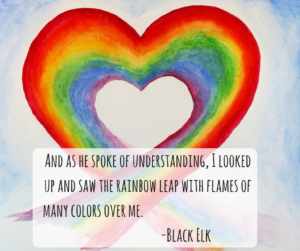
And as he spoke of understanding, I looked up and saw the rainbow leap with flames of many colors over me. -Black Elk

One place recent culture wars have been being played out has been the virtual space occupied by Twitter and its adjacent social media. Examining a particular hashtag or recurring phrase often provides insight into what the topic of the moment is, as well as what tropes and memes are being deployed.

A common adjective in many of the more conservative, alt-right, and other theater-of-outrage rants I’ve seen in the past couple of years is “rainbow-haired,” never in a positive sense. It’s usually paired with some form of “social justice warrior,” and often accompanied by an emotional catch-phrase or verbiage like “feels” or “drinking the tears.” There’s a lot of interesting stuff built into that particular fixation. So let’s dig around to find what’s contained in the phrase and its use in this pejorative sense.

The rainbow itself has plenty going on, symbology-wise. In many mythologies, it’s the bridge between heaven and earth, used by gods, heroes, and shamans. In the Christian allegory of Noah, it’s the sign of God’s covenant with humanity. Leprechauns hide their gold at the rainbow’s foot, Indra uses it for his bow, and in the Australian Dreaming, it adorns the scales of the Rainbow Serpent who created the world. It’s also got a maxim built into it: something positive that cannot appear without something negative happening first. There are no rainbows without rain, at least a little of which must fall into every life.

In 1978, this metaphor for something containing a multitude of variations became associated with gay pride and diversity, through the efforts of artist/drag queen Gilbert Baker, who said of it: “We needed something beautiful, something from us. The rainbow is so perfect because it really fits our diversity in terms of race, gender, ages, all of those things. Plus, it’s a natural flag””it’s from the sky! And even though the rainbow has been used in other ways in vexilography, this use has now far eclipsed any other use that it had.”

And we should not forget Skittles and the slogan “verb the rainbow.”

What happens when it becomes hair color that makes it particularly hate-worthy for dour conservatives? It’s something I’m fairly familiar with, since I started dying my hair with streaks of pink in 2006 when I found Loreal’s Color Rays on a Bartell’s shelf. The dye requires no pre-bleaching; it is alarmingly, wonderfully bright when it first goes on, and fades over the course of the next couple of months. While it only comes in three colors rather the multitudes other lines hold. I have yet to find another dye that lasts as long and well. I’ve tried plenty over the years, including Manic Panic, Ion, Arctic Fox, and Vibes. I wrote at length about the (over a decade-long now) experience in The Pink Hair Manifesto so I’ll avoid saying anything other than it’s something I anticipate continuing to do, particularly since it’s become part of my authorial brand.

Let’s ground the recent phenomenon of chemically-colored hair plumage historically, since it happened a few decades earlier than my decision. Fabulous colors required science to make it possible, but the earliest adopters were the punks, particularly Cyndi Lauper. This was considered pretty shocking; I can remember a girl at my high school dying a small patch of hers blue and having her father threaten to kick her out of the house as a result.

Rainbow hair, rooted in a counter-culture movement, revels in individuality and a certain DIY spirit (there is no shame in going to the salon for it, but I find it much more fun to do my own). It celebrates one’s appearance, draws the eye rather than shrinking away from it. It is something beautiful that those who don’t fit inside normal standards of beauty can have. It is playful, joyful, delightful at times.

Very recently it has spread like wildfire, and many of the people adopting it are millennials. This gives the anti-rainbow hair sentiment a double-whammy, providing an “oh these kids nowadays” moment while slamming anyone older for acting overly young. (Which implies that’s a bad thing, which isn’t a notion I agree with).

Screen Shot 2017-06-26 at 10.19.06 AMHere’s something that I think also often makes conservative minds bristle: it confuses gender norms. In traditional thinking, men aren’t supposed to care about or celebrate their appearance in the way women are. But rainbow hair appears all over the gender spectrum. Pull in the strand of meaning associated with gay pride, and the objectionability quotient increases.

There’s a reason alt-right and other manifestations of conservative trollish rhetoric so often focuses on appearance, on fat-shaming or fuckability or even how a new Ken-doll wears their hair. It’s a reversion to the schoolyard insult, the way insecure children will be cruel to others in order to try to build their internal self-worth, a behavior many, but sadly not all, outgrow. Worthy of an essay in itself is the fact that it’s also behavior advantageous to advertisers: anxious consumers who want to fit in are willing to spend money in the effort.

This strategy of playground taunts based on a) something most people have little control over and b) a rigid set of norms is curious when we go back to the associated ideas of emotion and “feels” (I do want to talk about what additional stuff is built into the latter, but let me return to that in a second.) Emotion is traditionally seen as the domain of women and children; men keep a stiff upper lip and a silent heart of winter. Often emotionality is built into the verbs used to describe speech: shrill, shriek, and scream are favorites.

Big boys don’t cry. Women and other non-males do, and there is a Smeagol or Renfield-level insistence on the deliciousness of such tears, as with so much of the writing, which depends on mockery of other people’s passions or even what’s portrayed as their rude insistence on co-existing in this world.

It would be nice if pointing out the gender and other biases BS built into such language defused it entirely, but certainly it’s easier to keep it from affecting you if you’re aware of it. Life for many non-mainstream groups is a constant course of avoiding the particular lumps of low-level radiation scattered throughout our daily landscape. I’m aware I’ve got some shielding from that denied others.

So what’s built into “feels” beyond that? It’s a denigration of the memespeak and emoticons of the millennials, as far as I can tell, a curious mockery of Tumblr and lolcat culture. And there’s a reason that they fear that group, which is better (IMO) at seeing through the clouds of Internet argument than some of the other generations.

Literally four decades ago, when I was a kid, we saw football player Rosey Grier singing that it was all right to feel things:

I’m bemused that the people in the world I inhabit remain so wedded to a norm that seems harmful to men and makes them less capable of understanding the world. Maybe the feelz aren’t such a bad thing after all.

Which leads me to my conclusion, which is that it seems like an ineffective and overly dour point to hammer on. Overall, I can’t read any of the negatives being packed into rainbow-haired as actual negatives. Celebrate the rainbow connection, I say, and close accordingly with that.

Who said that wishes would be heard and answered when wished on the morning star?
Someone thought of that and someone believed it.
Look what it’s done so far.
What’s so amazing that keeps us stargazing and what do we think we might see?
Someday we’ll find it, the rainbow connection.
The lovers, the dreamers and me.

...

Skip to content