I’m very pleased to announce that Tor has acquired my recent space fantasy (maybe?), as part of a three book deal, and I’ll be working with Christopher Morgan there. While I’ve had a lot of short stories published traditionally, this is the first novel to go through that, and I’m looking forward to seeing what the process is like. What is the book about? Well, I’m actually not sure of the genre but have been describing it as a banter-driven space military fantasy in which a group of ex-military turned restauranteurs get an unexpected package, just as things start exploding. I’m 40k words into the sequel.
I’m so pleased by this and blissed out to the point where I’ve been grinning all week. The book was written last October/November as part of a change in my writing routine, and if that routine pays off this well, you better believe I’m going to stick to it. So — up at 5:30 AM and off to the gym, then only writing through 11 AM. I love these characters, who are a lot of fun, and they’ve informed me they’ve got plenty of story to tell.
This does change a few things: I will not be taking new coaching clients, and the only editing projects I will be doing are ones where I really want to be doing the edit. I will still be delighted to write stories for anthologies as well as sending stuff out — I’ve been finishing up a couple of stories this week. I’m also going to be stricter about no internet till 11 AM and will be a lot more hardass about not scheduling calls or other stuff during that time.
I will still be teaching and running the Rambo Academy for Wayward Writers — I get so much inspiration from those classes that I would be sad not to do them and I do want to eventually have on-demand versions of all of my classes up there. After 2019 is over, though, I may start claiming a few more weekends for my own.
For those worried about the plight of Bella, Teo, Adelina, Sebastiano and the other Tabatians, I remain committed to being a hybrid author and I do intend to finish up the Tabat Quartet. =) If you want Tabat snippets and other creative pieces, please consider supporting my Patreon. Or encourage small press efforts by picking up one of my collections (Altered America (steampunk), Near + Far (SF), or Neither Here Nor There (fantasy)) or the Tabat novels from Wordfire Press! Otherwise, you might like to try the recent anthology that I edited, If This Goes On, from Parvus Press. Curious about how all this writing happened? Pick up my nonfiction book, Moving From Idea to Finished Draft.
I’m done with the SFWA presidency as of July 1. Those of you who remember back before that time will recall how alarmingly productive I could be when I set my mind to it. You have no idea how much is coming. =)
Want access to a lively community of writers and readers, free writing classes, co-working sessions, special speakers, weekly writing games, random pictures and MORE for as little as $2? Check out Cat’s Patreon campaign.
Want to get some new fiction? Support my Patreon campaign.
"(On the writing F&SF workshop) Wanted to crow and say thanks: the first story I wrote after taking your class was my very first sale. Coincidence? nah….thanks so much."
~K. Richardson
You may also like...
Transitions and Shifting POV in Fiction
Think of transitions as links in the narrative chain, holding scenes together and allowing for a natural progression from one to the next.So the title of this looks like I’m going to talk about something useful, but actually, I’m pretty much going to gush about Joe Abercrombie’s writing. I hadn’t read anything by him, but was at Confusion last January and had enough people recommend his writing (and watched a writer I admire go total fanboy when confronted with Joe) that I picked up THE HEROES to try it out and was immediately blown away.
So now I’ve worked my way through BEST SERVED COLD and am on the third volume of the First Law trilogy, which starts with THE BLADE ITSELF (and I can tell I’m going back to read both of the first two, in order to see better how they fit with the First Law trilogy). I’ve got to say, gee whiz, when Delany is talking about how you can only write stuff as good as the best stuff you’re reading, this is the sort of thing he’s talking about, because I know I’ve learned a good bit about the subject matter mentioned in the title from looking to see how Abercrombie does it.
The books have multiple POVs. A frighteningly large number of them, and I say that as someone who’s worked with them in a novel and seen how complicated and yucky and full of snarls that particular brand of yarn can be. In THE HEROES, the POVs aren’t restricted to main characters – sometimes the writing does things like dip briefly but deeply into the mind of a secondary character who’s about to get killed on the next page.
Where those POVs overlap, their collision creates additional meaning. For example, there’s a lengthy section in the head of Logen, a Northman, about how unnatural he finds the privies in the southern castle he’s visiting. A bit later, while in the POV of another character, we see him look upset at the possibility that an assassin might have crawled up through one of them, and because of that earlier section, that look takes on a deeper meaning, to the point where another character sees him still looking at the latrine door suspiciously, the effect is wonderfully funny.
Often the same encounter is seen through multiple eyes, letting us see where people go wrong. It’s a very powerful strategy, perhaps because it invokes a certain frustration on the part of the reader without getting TOO frustrating to the moment where you end up with a moment where you just want to scream at the characters, “WHAT are you thinking?” And characters thinking about each other and their relationship, particularly a relationship that keeps changing, works so beautifully, so wonderfully, for developing character and relationship and even plotline, that I’m in awe.
I’ve got to say that one of my favorite moments is in BEST SERVED COLD, and you should stop right now if you haven’t read it, because I really don’t want to spoil this for you. There’s a section where the POV is shifting rapidly back and forth between two characters, and we think they’re in the same place only to find at the end of the passage that everything the reader thought was, in fact, wrong. It’s gorgeous. If I were the jealous sort of writer, I think it would make me want to hit Joe and then go weep with despair.
Fortunately (probably for both of us), I’m not. Instead I’m looking to see how he does all this so I can steal freely. In fact, in the latest story I finished, I noticed a transition where one character is starting a thought and another is finishing it, that I’m pretty sure came from this reading.
So for those reading this trying to create their own transitions – here’s one strategy that Abercrombie seems to use often. Is there something – an object, a phrase, a circumstance of weather – in one scene’s ending that can be used in the next scene’s beginning? Some examples:
First scene ends with an observation about the snow; the following begins with an expansion on that.
First scene contains mention of a particular character; the following is from that character’s POV.
First scene someone wonders what a particular character is doing and imagines their circumstances; following scene is from that character’s POV and shows how wrong the imagining was.
Movies do this a lot. We close with a shot of one object; a similar shot begins the next scene. Someone says something to close a scene; in the next it’s repeated or answered. We close on a landscape at a particular time and open with it transformed by a different setting in time. These transitions give a feeling of completeness. Rather than separate pieces jammed together like a mosaic, they’re woven together, threads from one leading into and changing another. Transitions lead the reader along, let her/him swing from vine to vine like Tarzan, each one a new handhold on their journey through the narrative.
Prefer to opt for weekly interaction, advice, opportunities to ask questions, and access to the Chez Rambo Discord community and critique group? Check out Cat’s Patreon. Or sample her writing here.
Think of the opening and ending of the story as the reader passing through the same door.Someone mentioned that they’d like to see a post on endings. Endings are hard. You have to go back and look for all the loose ends. It’s like weaving a basket – all those spiky little sticks poking out need to be woven together into a coherent shape. Here’s three things I think about when working on an ending.
1. Circularity is a big help. It provides a sense that the reader has returned to the beginning, but now everything is changed. Here’s a cheat – take something that appears in your first three paragraphs and invoke it in your last three as well. It can be changed – the rose that initially trembled, dew-covered, as our heroine picked it is now lying withered and flat in the road. Or it is a new rose, being picked by another woman who is the replacement for the first?
For an example of this, I’m actually going to be obnoxious and point to my own story, Magnificent Pigs. Technically I cheat, because the object I used doesn’t appear until the fourth paragraph, the brass bed which creaks in protest as Aaron sits down. At the end it’s become the object of Jilly’s salvation, the vehicle that carries her away into the sky. There’s other reappearing things: pigs are mentioned right off the bat (in the title, even) and they’re crucial to the end. And the story begins and ends with the idea of death and (hopefully) changes your perception of it.
Here’s another example, taken from Joe Hill’s wonderful “Pop Art” in 20th Century Ghosts (Kindle edition) It begins with a paragraph that sets up the rules of the story gracefully and efficiently:
My best friend when I was twelve was inflatable. His name was Arthur Roth, which also made him an inflatable Hebrew, although in our now-and-then talks about the afterlife, I don’t remember that he took an especially Jewish perspective. Talk was mostly what we did — in his condition rough-house was out of the question — and the subject of death, and what might follow it, came up more than once. I think Arthur knew he would be lucky to survive high school. When I met him, he had already almost been killed a dozen times, once for every year he had been alive. The afterlife was always on his mind; also the possible lack of one.
We know that the story is about the narrator and his best friend, but the focus will be the friend. We know it will have funny moments, and many of those come from Arthur’s mouth, so we like him even more. We know that in this story, the surreal is fair game. We know that there can be fairy-tale resonances. And we know, immediately, that the story will be about Arthur’s death.
That death returns at the end of the story, which I will not include, because you should read the story without that particular spoiler. But I feel comfortable in revealing that Arthur’s death reappears at the end in the shape of two people talking about it. It’s a lovely, well-constructed story with a lot of clever structure to it.
2. Give the reader space in which to appreciate your ending, a sentence or two of standing back and letting the story tumble into meaning in their head. That’s what “Pop Art” does – doesn’t end with the actual death, but ends with a discussion of it, which provides a chance to extract additional meaning from the story.
Here’s the end to Carol Emshwiller’s equally lovely “Grandma,” from the collection, Report to the Men’s Club (Kindle edition). The story, told by an superhero’s grandchild, begins with a litany of actions that the grandmother has performed in her role as superhero, and ends with the decision to take up that role (although somewhat modified), given physical form:
I’m wearing Grandma’s costume most of the time now. I sleep in it. It makes me feel safe. I’m doing my own little rescues as usual. (The vegetable garden is full of happy weeds. I keep the bird feeder going. I leave scraps out for the skunk.) Those count — almost as much as Grandma’s rescues did. Anyway, I know the weeds think so.
3. Let the reader hear the door of the story click shut. John Barth said this in a workshop one time and it’s always stuck with me. This is related to number 2, but even more, it’s the idea of providing a line that says “The End” or the equivalent, and lets the reader know the story is over. Have you ever heard someone read and not been sure when to clap? Those readers need to close the door a little harder.
Here, for example, is the end of Pat Cadigan’s “Vengeance is Yours” from her collection Patterns.
That’s the funny thing about vengeance. Half the time people hire me, they’re getting back at the wrong persons for all the wrong reasons. I should know. I’m an authority.
But then again, the vengeance isn’t mine.
BOOM the door is shut and the story is over.
Like beginnings, endings are important, and worth spending some extra time on. They’re the last handshake on your reader/guest’s way out the door, the smile or clever goodbye that makes them sigh in satisfaction, sitting in their homeward bound taxicab: “Oh, that was such a good party!” A good ending lets the reader close the book then sit back and savor its perfection, reconciling them to the fact that the dream you spun is over.
Writing exercise: Grab a story whose ending doesn’t satisfy. Using your first three paragraphs, write an ending that returns to that scene and lets us know exactly what has and hasn’t changed.
#mc_embed_signup{background:#fff; clear:left; font:14px Helvetica,Arial,sans-serif; }
/* Add your own MailChimp form style overrides in your site stylesheet or in this style block.
We recommend moving this block and the preceding CSS link to the HEAD of your HTML file. */

 I’m very pleased to announce that Tor has acquired my recent space fantasy (maybe?), as part of a three book deal, and I’ll be working with Christopher Morgan there. While I’ve had a lot of short stories published traditionally, this is the first novel to go through that, and I’m looking forward to seeing what the process is like. What is the book about? Well, I’m actually not sure of the genre but have been describing it as a banter-driven space military fantasy in which a group of ex-military turned restauranteurs get an unexpected package, just as things start exploding. I’m 40k words into the sequel.
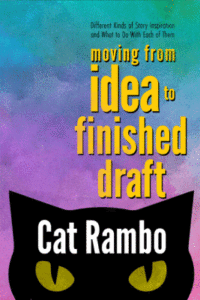 For those worried about the plight of Bella, Teo, Adelina, Sebastiano and the other Tabatians, I remain committed to being a hybrid author and I do intend to finish up the Tabat Quartet. =) If you want Tabat snippets and other creative pieces, please consider supporting my Patreon. Or encourage small press efforts by picking up one of my collections (Altered America (steampunk), Near + Far (SF), or Neither Here Nor There (fantasy)) or the Tabat novels from Wordfire Press! Otherwise, you might like to try the recent anthology that I edited, If This Goes On, from Parvus Press. Curious about how all this writing happened? Pick up my nonfiction book, Moving From Idea to Finished Draft.


One Response