

Five Ways
Subscribe to my newsletter and get a free story!
Share this:

Treating Myself

Things keep moving along well and I thought I’d check in. My reward for winning a Nebula is that I’m using part of teaching plus Storybundle money to upgrade my workspace. I just put in the order for a fancy standing desk and stool, and am going to retire my faithful IKEA hack deck that I’ve been using the last six years or so.

This will be a much wider workspace, so it also means I can pick up a second monitor and have a lot more real estate when teaching/writing. I had that with my former set-up and it really made a difference when working. I’ve been holding off on this while waiting to move and finally figured I might as well go ahead, since it seems likely we’re here for the duration.

As to why I feel justified in rewarding myself, it’s productivity and nose to the grindstone! Here’s some testimony to 2020’s work in the form of my current writing/editing projects and where they stand:

The space opera series: The copy-edits for You Sexy Thing are in and the editor didn’t mind that I shifted around a couple of scenes in doing them. The listing is up! Still waiting to see what the cover looks like. The second book is currently at incoherent first draft status. Need to start pulling notes together for book three.

The Tabat quartet: Finishing up Exiles of Tabat ASAP is the current big project on deck. I also have some notes for the final book that I need to start putting in one place.

Baby Driver: Need to catch up on writing this. I have someone interested in publishing the final product, and I would also like to do it as a comic book, so I’ve got 3-4 pages of that script written.

Books hovering in the wings: a rewrite of the MG book, a literary horror stand-alone, a Tank Girl/Harley Quinn/Doctor Strange mash-up set in post-apocalyptic Seattle (stand-alone?); fleshing out an existing project that will be a literary SF novella.

Upcoming publications: Because It is Bitter (novella) in AND THE LAST TRUMP SHALL SOUND; Every Breath a Question, Every Heartbeat an Answer (novelette) in BENEATH CEASELESS SKIES; Crazy Beautiful (story) in THE MAGAZINE OF FANTASY & SCIENCE FICTION; Snowflakes (story) in LAST CITIES OF EARTH; Stand and Deliver (story, with Wayne Travis Rambo ) in DARK MATTER MAGAZINE ; I Decline (flash) in DAILY SCIENCE FICTION).

Current story projects: a space western short story in collaboration for an anthology request; a space opera short story for an anthology request; a near future caper novella; a near future SF story, the usual smattering of flash.

I also have an upcoming anthology project that I just finished looking over the contract for; look for slush reader calls and guidelines soon but don’t mail me until they’re posted!

Leave a Reply

Your email address will not be published. Required fields are marked *

Get Fiction in Your Mailbox Each Month

Want access to a lively community of writers and readers, free writing classes, co-working sessions, special speakers, weekly writing games, random pictures and MORE for as little as $2? Check out Cat’s Patreon campaign.

Want to get some new fiction? Support my Patreon campaign.


"(On the writing F&SF workshop) Wanted to crow and say thanks: the first story I wrote after taking your class was my very first sale. Coincidence? nah….thanks so much."

~K. Richardson

You may also like...

On Writing Process: A Dissection (of sorts) of "Rappacinni's Crow"

Raven
Can a raven be a sociopath?
Someone mentioned this as one of their favorite stories of mine, and I wanted, for selfish and egotistical reasons, to use it for the subject of a blog post, but I hope that I can in pulling it apart and explaining some decisions, shed a little light on both my process and writing in general.

If you’re not familiar with the story, it appears here on the excellent online publication Beneath Ceaseless Skies, or you can buy an e-copy on Amazon or Smashwords. If you’re too impatient, here are some of the pertinent details: steampunk world, asylum for those injured by the war, nurse with a secret, doctor with an evil crow, wacky hijinks ensure.

The story takes place in a dystopian steampunk setting that I’d wandered around the edges of previously in “Clockwork Fairies” and “Rare Pears and Greengages”. This story got me far enough into that territory that it spurred others: “Her Windowed Eyes, Her Chambered Heart,” “Snakes on a Train,” and “Laurel Finch, Laurel Finch, Where Do You Wander?” I’ve been calling the series Altered America, and you can see some of the images I’ve used for inspiration here.

And the amount of effort involved in writing the protagonist that appeared to me scared me. Transgendered, Native American, poor, and disabled. How could I write that other without offending someone? Better folks than I have battered themselves against that question. But you can’t do something without trying, so I gave it a shot. I strove to do my best by my protagonist: to explain his background, his history, the way he thought, and his relationship with Jesus. Which is another way my character is unlike me: he is struggling with his Christianity, while I’m Unitarian, a faith that has taught me a great deal, and which I embrace, but which draws on, rather than consists wholly of, Christianity.

I went into that attempt with good intentions, a lot of thought, and some tools provided me by Nisi Shawl and Cynthia Ward’s excellent little book, Writing the Other. I hope I did justice by my protagonist, and I hope he comes back for another story or two, because I want to know what happens to him, over the mountains. I hope it involves him finding his captain — or some reasonable facsimile — again.

As all of this started to take shape in my head, I invoked my favorite Nathaniel Hawthorne story, “Rappacinni’s Daughter,” and made my antagonist part of the Rappacinni line. In doing so, I had to think about how much I was allowing Hawthorne to influence the story. Did I want to try to retell his? Definitely not, because trying to place that structure over what was already in my head was way too square peg, round hole in its feel. So instead I took enough to make it a nod to Hawthorne, an Easter egg for readers who knew what grew in Hawthorne’s fictional garden. The important thing with anything like that is that for readers unfamiliar with the text being referenced, it cannot get in the way of the story or prevent their understanding of it. Make it a plus for readers who’ve read the other text, but never a penalty for those who haven’t.

I injected some of my fascination with Victorian mental institutions, which led to a fascinating time researching. And I put in a crow, because that was where the story came from in the first place, with this question:

In fiction, we generally think of animals as good-souled, noble, and self-sacrificing. What if you had one that wasn’t? That was, in fact, a bit of a psychopath? For the past year I’ve kept peanuts in my pockets and gotten the crows around here to know me, so I was aware of how smart they are, and how much personality they can display. Mine all seem like pleasant souls, but what if there was one that wasn’t?

And thus Jonah fluttered and squawked his way into existence to squat malignantly on Dr. Rappacinni’s shoulder.

Stories are so often collisions of things, a month’s worth of influences and odd thoughts perhaps bouncing off an old obsession or two. With these kinds of stories, for me all I can do is plunge in and start writing, and watch the story start to coalesce. There’s a point where it’s solid enough that I begin to figure out what it’s about, and gradually that emerged in an unexpected shape. It was, I realized, a story about faith, which is not my usual sort of story.

I’m also fond of this story because I used it in teaching, showing students the original story map and how I blocked it out, as well as a couple of early drafts so they could see how things progressed as I was writing it. I didn’t worry too much about length, and it ended up coming in on the low side of novelette length, which limited the markets. Luckily, I knew Scott Andrews at Beneath Ceaseless Skies might well be interested.

Scott, whose comments are always on the mark, had me rework the ending. And having realized what it was a story about helped me reshape that ending into something that satisfied both of us. I wanted it to be a little bit ambiguous in the ending. Was God’s hand evident there or not? You can read it either way, and I like that ambiguity, a quality that fills our existence, in that moment.

Enjoy this writing advice and want more content like it? Check out the classes Cat gives via the Rambo Academy for Wayward Writers, which offers both on-demand and live online writing classes for fantasy and science fiction writers from Cat and other authors, including Ann Leckie, Seanan McGuire, Fran Wilde and other talents! All classes include three free slots.

Prefer to opt for weekly interaction, advice, opportunities to ask questions, and access to the Chez Rambo Discord community and critique group? Check out Cat’s Patreon. Or sample her writing here.

...

So I Wrote This Novella

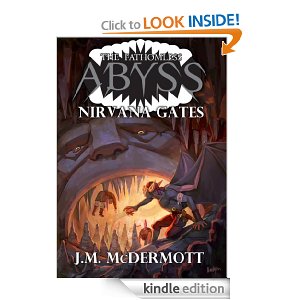
Cover for Tales From The Fathomless Abyss, stories by Mike Resnick & Brad R. Torgersen, Jay Lake, Mel Odom, J.M. McDermott, Cat Rambo, and Philip Athans.
I’m turning in something today that I’ve never tried before: a novella.

Back when I was first approached about the Fathomless Abyss, it involved an initial story and a later novella. Sure, I said, and whacked out a story for the first Fathomless Abyss book, TALES FROM THE FATHOMLESS ABYSS. It was “A Querulous Flute of Bone”, which I based on an O.Henry story, and which I think is one of my best stories to date. If you don’t believe me, spring for the 99 cent download and tell me if I’m wrong.

Then I started on the novella. The first thing I did was look up the length requirements. Wikipedia told me the official SFWA definition was 17500 to 40000 words. So just a long short story, right?


The problem with that was that…I write short. I excel at under 4000 words. So I turned again to a model. I’d been thinking about issues of addiction and so I decided I was going to write about that, and use William S. Burroughs’ JUNKY as my starting point. And I was going to throw in a touch of Lovecraft for spookiness and make the drug of my protagonist’s choice something a bit weird. And I wanted to reference some of the cool stuff the other Fathomless Abyss writers had added to the world.

I was telling a life story, from early days in an Abyssal village, through journeys to all sorts of points, culminating in some sort of…well, you know…climax. There was a chase for one thing, then another chase for what it turned into. I wanted to include something about the philosopher-king Nackle, whose teachings figured in “A Flute of Querulous Bone.” I wanted mushrooms and hallucinogenic wasp stings and pack llamas. I sketched out an outline and started writing. And I kept folding in stuff I wanted to include as I ran across it and then I reread Joe Lansdale’s THE COMPLETE DRIVE-IN and decided to not worry about being too weird and things all fell together…

And I became aware it was too long. Too, too, too long to finish on deadline. But I had the first half written and there was a good place midway to split the narrative, and so I said to Phil, “What if I do a pair of novellas, this first half, and then give you the second half for later release?”

So that’s what we have. I’m turning in A SEED ON THE WIND this time and A CAVERN RIPE WITH DREAMS will follow on its heels.

Wikipedia quotes Warren Cariou when discussing novella structure:

The novella is generally not as formally experimental as the long story and the novel can be, and it usually lacks the subplots, the multiple points of view, and the generic adaptability that are common in the novel. It is most often concerned with personal and emotional development rather than with the larger social sphere. The novella generally retains something of the unity of impression that is a hallmark of the short story, but it also contains more highly developed characterization and more luxuriant description.[7]

I know mine is focused on the development of a protagonist who I fear is somewhat unlovable. I’ve tried for interesting characterization and today I’m finishing up adding a layer of luxuriant description.

If you’ve come looking for advice on writing novellas, I’m not sure I have any. Perhaps you, the readers, can tell me what you think of them and what you’ve done when trying that form. I know Rachel Swirsky is a champ at writing them. What do you think – do you like novellas? What do or don’t you enjoy seeing in them? Can you think of anyone you think does them exceedingly well?

...

Skip to content