

 Edward Hopper’s Nighthawks (1942) is one of my favorite paintings. There’s something uniquely inspirational in the drama and mystery of strangers gathered at a late-night diner. I also like it because it’s stylistically uncluttered, focused, and full of Mad Men era nostalgia. Recently, I had to pick up some friends from the airport at 5:30 am. Because I like to be painfully early, whether to catch a flight, or to pick people up, I left at 3:00 am. Naturally, I had some time to kill, so I dropped into a nearby Waffle House to see what it might have been like to be one of Hopper’s nighthawks. And also for breakfast.
After a few minutes on the interstate, I took an offramp and made a right turn onto an empty road. The darkness was occasionally punctuated by hotel marquees, stop lights, and an unmistakeable bright, yellow-blocked Waffle House sign. I pulled into the empty parking lot and backed my Jetta under the amber glow of the lone street lamp. At least someone might see me if I got mugged.
Through the windows, I saw a man behind the bar, most likely the cook, and a young lady seated at the end of the counter reading a book. Great, I wasn’t the only nighthawk. And someone should definitely see if I get mugged. I grabbed my trusty notebook from my book-bag and headed in.
 People frighten and confuse me.
It’s not their fault. Well, sometimes it is, but that’s a topic for a different day. Today, I’d like to take you on a journey into the awkward glory of social anxiety. If you don’t suffer from this annoying malady, this article may not be for you, though I’d appreciate it if you’d keep reading anyway, because my second book just came out and heaven knows I need the exposure.
Most people don’t peg me for socially anxious, and I don’t blame them for missing it. I’m chatty enough with people I know, and I’m always the first to throw out an inappropriate comment. Indeed, in groups of more than three but fewer than seven, with at least two friends present, I can be absolutely effervescent. You might even say that I’m the life of a very limited range of small parties.
But if you get me in a crowd and tell me to mingle, you had better be ready for a nervous breakdown.
Have someone you need me to introduce myself to? Sorry, they look really busy sitting alone at that table, quietly refolding their napkin. Maybe later, when they’re not so preoccupied.
Got a small favor I should ask of a friend? That feels too much like imposing.
Trying to make me the center of attention? Then the center of attention is going to be a cloud of dust where I was just standing.
Want me to maintain more than a tenth of a second of nervous eye contact with you? Whoa, save something for marriage there, Speedy McTooFast.
 I’m not the world’s best cook by any means. If given the option, to steal more time for writing I will order in or use prepackaged dinners. But there are things I make when I need that extra comfort that take-out or microwave meals won’t provide. It was no surprise that one of my favorite home-made meals made its way into my novel Chaos Wolf.
In that scene, Jordan is due to present herself to the alpha werewolf of the Black Oak Pack for one final test. Alpha Shane has made it clear that if she can’t prove that she is in control her shapeshifting, he will kill her. She has just confronted Montgomery, her vampire mentor, about information he has withheld from her. Her trust in him is shaken when she needs his support the most. She’s exhausted emotionally and physically and needs something she can look forward to beyond mere survival. So she cooks.
Jordan doesn’t toss something into the microwave that warms up in two minutes. She doesn’t reach for the take-out cartons from the dinner the night before. She chooses to make a meal that will take a half hour to prepare and ten hours to cook.
In an act of quiet defiance against all of those who think she’s going to fail, Jordan chooses to hope that she will be there to eat it when it’s done. In her mind, it’s not her last meal, but her next meal to look forward to when she returns home.
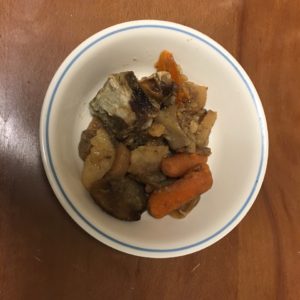
I have made crockpot short ribs many times. It’s a recipe my mother taught me, and now I make it for her. I can throw it in the slow cooker when I leave for work and it’s ready when I get home. Any crockpot with a low, medium, or high heat setting can be used. I make it when I know I’m going to have a rough day and want something comforting when I get home. While it won’t win any plating awards on cooking shows, it is a delicious and satisfying meal.
Crockpot Short Ribs
3.5 Lbs. Bone In Short Ribs
6 Russet Potatoes
1.5 lb. Carrots
2 large Yellow Onions
3 Tablespoons Garlic Salt
7 Quart Crockpot
Does Jordan get to enjoy her meal? You’ll have to read the book to find out.
 About the Author: Sheryl R. Hayes can be found untangling plot threads or the yarn her cats have been playing with. In addition to writing, she is a cosplayer focusing on knit and crochet costumes and works full time at a Bay Area water company. You can follow her at her blog, on Twitter, or on Facebook.
Here’s a sneak peek at Chaos Wolf:
Bitten by a werewolf. Taught by a vampire. At this rate, she’s going to start a war.
Literature major Jordan Abbey ordered a double mocha latte, but it wasn’t supposed to come with a side order bite by a love-sick werewolf. When a vampire comes to her rescue, gut instinct tells her he has questionable motives. But he’s the only one she can trust to help get in touch with her inner animal.
Within a week, her smart mouth lands her in trouble with the hostile alpha of the local pack and the stiff-necked vampire elder. She now has less than a moon cycle to master shape changing… or else. And the besotted werewolf who started this whole mess is stalking Jordan and killing her friends. He won’t take no for an answer.
In the Northern California town of Rancho Robles where the children of the Wolf and the Bat share an uneasy coexistence, one woman makes an epic mess of the status quo.
Chaos Wolf Excerpt
 He gestured toward the couch. “Would you like tea, coffee, or soda?”
“Soda, please.” Although she wasn’t thirsty, accepting what he offered seemed the polite thing to do. She sat down on the leather couch and rested her elbows on her knees. “Don’t you only drink”¦ um”””
“Blood?” Montgomery finished the question for her. “No.” He stepped into the kitchenette. “I can and do drink and eat other things. It’s kind of like eating junk food. There’s no nutritional value. I enjoy the flavors and textures. I don’t like to do it too often, though.”
Jordan tilted her head to one side. “Why not?”
His lip curled into a half smile. “I can’t digest matter like when I was mortal,” he explained. “I have to purge it in a different way.”
She blinked, puzzling it out. Understanding dawned on her face. “Oh”¦ Oh!”
One red-and-silver can in hand, Montgomery stepped out of the kitchenette. “When I last saw you, you were hightailing it out of here, never to return.” He gave her the soda and took a seat in the chair sitting at a right angle to the couch. “What happened?”
Jordan stared down at the soda and rubbed her thumb over the frosty top. “After I left, I went home. I didn’t tell anyone about you.” She gestured in Montgomery’s direction. “I went out to try to forget what happened. When I came back, I found out my roommate’s boyfriend had been mauled to death.”
Montgomery stiffened. “Did you see the werewolf?”
“No,” Jordan said. “I didn’t even think he was real until”¦” She paused and shivered, sloshing the soda in the can. “All I could think about was finding you.”
Montgomery’s lips moved to form a curse. “Did you come directly here?” He stood up and crossed the small space separating the chair and the couch. “Focus. It’s important. Do you think you were followed?”
“No. The police took me and Molly to the station. We’re not allowed to go back to our apartment until sometime tomorrow after the super gets someone in to”¦” Jordan’s voice broke. She swallowed. “Clean up. I spent two hours getting on and off buses to make sure I wasn’t followed.”
Montgomery sat down on the couch. “Good thinking. If the werewolf was following you by scent, that should have thrown him off your trail. If he was tracking you by sight, you would have spotted him. Or he would have broken in here by now. You’ve been lucky.”
“Lucky?” Jordan’s shoulders tightened and her fist clenched, denting the can inward. “I’m being stalked by something out of a horror film and you think I’m lucky?”
“Yes,” Montgomery countered. “If you had been there instead of your friend, the werewolf would have finished what he started.”
“Finished what he started?” Jordan put the soda on the table unopened. “You make it sound like he let me live.”
“He did,” Montgomery stated, as if it were the most obvious thing in the world.
She stared at him with an open mouth. All the movies and books she had seen taught that a werewolf would rip out her throat as soon as look at her. The female victim never survived the attack. “But why?”
“You haven’t figured it out yet?” Montgomery appeared nonplussed by her reaction. “He wasn’t trying to make a meal out of you, Jordan. He was claiming you as his mate.”

Enjoy this writing advice and want more content like it? Check out the classes Cat gives via the Rambo Academy for Wayward Writers, which offers both on-demand and live online writing classes for fantasy and science fiction writers from Cat and other authors, including Ann Leckie, Seanan McGuire, Fran Wilde and other talents! All classes include three free slots.
If you’re an author or other fantasy and science fiction creative, and want to do a guest blog post, please check out the guest blog post guidelines.

When I decided that I wanted to write a book about a medieval woman who leads a raid on Hell, that was the sort of underworld that immediately came to my mind. A mouth, though, implies a throat, and a stomach, and, well, everything else.
So I had a Hellbeast on my hands, a creature that spends centuries underground, but occasionally makes an appearance on the surface. It’s a little like a platypus, but without the bill. And a lot bigger.
Within the Hellbeast, there are revenants. But there are also humans””some have been altered in various ways, and some are extremely long-lived, but they are humans nonetheless. This led me to an unusual world-building question: What do people eat in the underworld?
 Everybody’s tried to make a meal they mess up. A pile of perfectly good ingredients that just won’t come together into something palatable despite our best efforts. And when time and money and supplies are tight, sometimes tossing out the pot and starting over is not an option.
In each act of my new spacepunk steam opera novel, FLOTSAM, the four-person airship crew sits down to a meal. They come together to eat, to debate, and to problem solve. Their thoughts in these scenes are filled with worry over finding work, getting paid, keeping the ship in good repair, and staying out of trouble long enough to spend any money left after that.
Each meal is a backdrop to what’s going on in the story at that moment: an easy, familiar meal to celebrate getting away from a confrontation in one piece; a load of their favorite takeout as distraction from unpleasant news; and, finally, a dinner that goes horribly wrong before coming together in the end.
 5 stories, 5 times
Have you ever wondered how your favorite story would sound if written by another author? What is it exactly, that makes writers different? What does each one bring to the story they’re writing, in terms of style, mood, tone, etc? How would the story sound as written by someone else?
That’s what the Reading 5X5 anthology explores – twenty-five SFF writers writing five variants of five stories. I asked five groups of five authors to start from the same basic story brief, but write in their own way. The result is fascinating – five wildly different approaches to each of the five briefs, but each telling, at its core, the same story.
 Growing up, two of my favorite things were books and video games. If you’d told me twenty years ago that I’d grow up to write both, I probably would have choked on my Mountain Dew.
But over the past few years, I’ve been doing exactly that. I’ve written the Recoletta series, a science fantasy trilogy published by Angry Robot, and I’ve worked as a narrative designer at Obsidian Entertainment for three and a half years now, writing for the Pillars of Eternity games and expansions.
In both media, the principles of good storytelling””establishing a strong story arc; building a vivid, believable world; and populating it with complex, memorable characters””are the same.
But the user experience differs, and understanding that is key to knowing how to satisfy both audiences.
Readers generally pick up novels to immerse themselves in stories that they experience through the eyes of another character. Players generally sit down with games to immerse themselves in stories that they discover and define through their own actions.
A large chunk of storytelling in both media comes down to understanding the role your characters play and how to make them real.
Characters bring a fictional world to life. Their problems and dilemmas create the oft-sought tension and “stakes,” and their choices and conflicts drive the story. Most readers and gamers would be hard-pressed to discuss their favorite stories without also talking about the characters who populate it. We connect emotionally with the people in stories rather than the ideas and philosophies.
But who are those characters?
In a novel, the most important character is typically the protagonist. It’s not just because the action (mostly) follows her. It’s also because we experience the story through her perspective. We see what she sees and know what she feels, even if we don’t always agree with it. First-person and close third-person stories have become immensely popular because of the intimacy of the perspective they offer.
For the protagonist’s story to be engaging, she has to have challenges to overcome. Strengths and vulnerabilities that add variation to her journey. A deeply personal investment in the events of the plot. Writing a protagonist who meets these criteria is often a matter of architecture in the planning stages””figuring out who this person is and what it is about her that generates interest and tension””as well as retrofitting in the revision stages””finding ways to connect her more deeply to other characters and events and building momentum over the successes and setbacks she faces.
When it comes to games, protagonists may be a lot more varied. For the sake of simplicity (ha!), I’m mostly talking about Western-style RPGs, which are often characterized by protagonists who are defined by the player in some significant way and whose stories are often discovered over the course of (fairly) open-ended gameplay.
The degree to which players define their characters differs widely between games. In some games, you have a protagonist with an established identity and established personality whose significant choices are defined by the player. That includes Geralt of Rivia from The Witcher.
In other games, you have a character whose overall identity is set, but whose personality and outlook is determined by the player. For example, Commander Shepard of the Mass Effect series is always a human operative intent on saving the galaxy, but the player can cast her as an idealistic savior or a ruthless maverick.
Finally, there are other games, such as Pillars of Eternity, in which nearly everything about the protagonist, including personality, backstory, and race, is player-determined.
In these types of games, the task of the writer is to build everything around the player character as much as””or more than””defining the player character on his or her own. You develop a story that is just loose enough to fit whatever way the player might choose to define the protagonist according to the options you have given them. You create a world with enough freedom for the player to make choices and enough context to give meaning to those choices. You write side characters who establish the world as a living place and who frame the stakes for the player.
It’s a delicate balance, and it’s one that places a much greater burden on the writing that establishes the world around the protagonist.
That’s because you’re defining this character””or, to some extent, allowing your player to””through negative space rather than positive space. You’re creating a stage that will allow the player to shape a personal story, and one that doesn’t feel at odds with the choices you’ve given them.
 Heroes of their own stories
And yet, protagonists aren’t the only characters on the page (or screen). A common piece of writing advice is to write villains as though they were the heroes of their own stories. It’s good advice, and it holds true for all characters””sidekicks, love interests, mentors, and spear carriers.
In many books, the most memorable and beloved characters are often secondary characters. Written well, they are typically less encumbered by the constraints of following the plot. Writers may feel freer to embody them with the quirks and idiosyncrasies that help them stand out. And the foil they frequently provide for the main character””whether as comic relief or as someone who pushes and challenges the protagonist””can create entertaining humor, conflict, and character development.
Put simply, these characters work because they have goals and interests that do not always line up with those of the protagonist.
Games may contain even more secondary characters””often called NPCs (non-player characters). Of course, if every character is the hero of her own story, you’ve still got to make them good stories. And “bring me five puffleberries” and “get my cat out of this tree” don’t quite cut it. We don’t like busywork in real life, so why does anyone assume we’d do it for fun? Yet “fetch quests”””formulaic tasks in which the player character is sent to handle a routine errand for someone else””are everywhere.
The problem isn’t just that they usually make for dull content. It’s also that they suggest a world in which other characters’ concerns go no deeper than grocery runs. In which they only exist to provide some degree of involvement for the player. And in which the protagonist only relates to them as an errand boy.
Every quest need not be epic. But it should mean something or reveal something, both with respect to the protagonist and the other characters involved.
In both games and novels, we rely on good characters to develop our stories and to hold our audience’s interest in them. Novelists and game writers merely need to understand how their readers and players will relate to them in order to deploy them most effectively.
—————————-
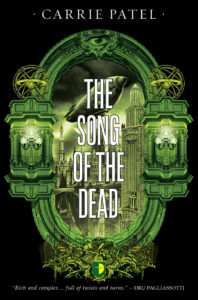
Bio: Carrie Patel is a novelist and a narrative designer at Obsidian Entertainment. She is the author of the Recoletta trilogy, which is published by Angry Robot. The final book in the series, The Song of the Dead, comes out on May 2. She works at Obsidian Entertainment as a narrative designer and writer. She has worked on the award-winning Pillars of Eternity and its expansions, The White March Parts I and II. She is currently working on Pillars of Eternity II: Deadfire. You can find her on Twitter as @Carrie_Patel as well as at http://www.electronicinkblog.com/.
Enjoy this writing advice and want more content like it? Check out the classes Cat gives via the Rambo Academy for Wayward Writers, which offers both on-demand and live online writing classes for fantasy and science fiction writers from Cat and other authors, including Ann Leckie, Seanan McGuire, Fran Wilde and other talents! All classes include three free slots.
If you’re an author or other fantasy and science fiction creative, and want to do a guest blog post, please check out the guest blog post guidelines.
 First, I didn’t set out to be a humorist. And I’ve only got one sci-fi comedy novel so far, Where the Hell is Tesla?, so I’m not sure I qualify as anyone you should listen to. But I’ve always loved funny sci-fi, like Douglas Adams’ The Hitchhiker’s Guide to the Galaxy, or John Scalzi’s Agent to the Stars, or Pratchett and Gaiman’s Good Omens, and I love the process of writing humor. It seems like a fit. I’m sticking with it.
Along the way, I’ve learned a ton from great writers, and great teachers, and from screwing up in every conceivable way. So here are a few of my favorite little nuggets that you might find it useful in your own writing:
1. Exaggerated Contrast.
Imagine you move into your new apartment, and you go next door to ask if they signed for a package you were expecting. You’re invited in, and you find yourself in the middle of four adult males playing Dungeons and Dragons. With costumes on. Hmm. This might make a funny story to tell your friends later. But let’s exaggerate the contrast more by making all four of these guys over-the-top-crazy-smart scientists who revel in everything tech and sci-fi. Now what’s your story? The Big Bang Theory. A huge comedy hit, in its ninth season. A classic fish-out-of-water story pitting poor Penny against the ultimate geek squad.
Or take Dortmunder, the cat burglar hero from the old Donald Westlake novels. He’s literally the only sane person in an insane world filled with incompetent crooks, bungling cops, and inept villains. The result? He had so much comic potential he starred in twenty-five novels and short stories.
Why does fish-out-of-water work? Because the greater you can make the gap between the normal person’s perspective (Penny, Dortmunder) and the crazy world’s perspective (the four scientists, incompetents in general), the richer the vein of comic possibility. And science fiction can be even better, as your worlds are only limited by your imagination. Just look at Hitchhiker’s Guide’s hapless Arthur Dent, thrust into insanity on a galactic scale. And in my novel, the “fish” are two regular joes who find themselves trapped inside an “Interdimensional Transfer Apparatus” ““ where each dimension they visit is strange, and rife with comic opportunity.
Want access to a lively community of writers and readers, free writing classes, co-working sessions, special speakers, weekly writing games, random pictures and MORE for as little as $2? Check out Cat’s Patreon campaign.